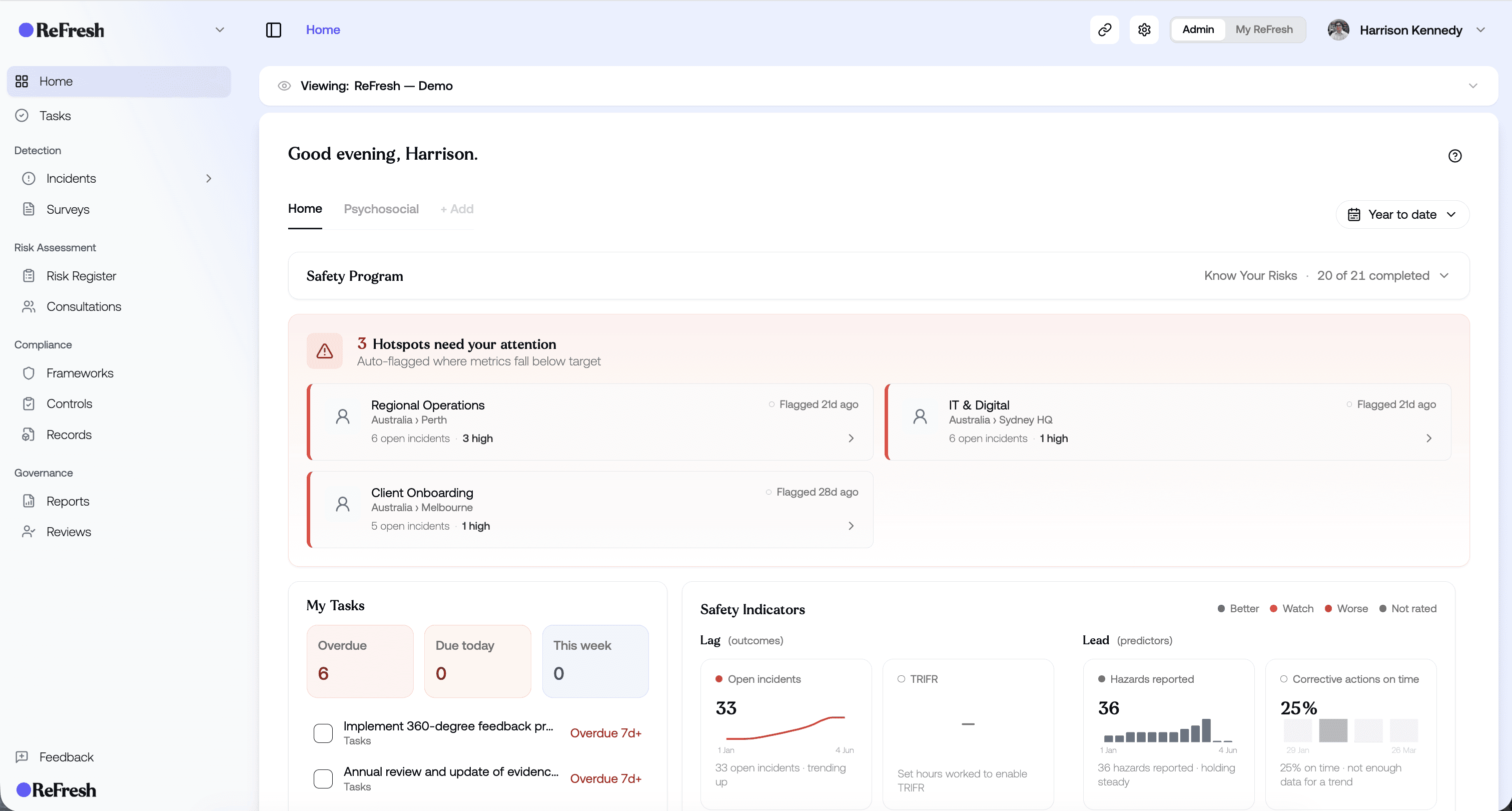
GOVERNANCE AND EVIDENCE

Prove your psychosocial compliance systematically, on demand

Prove your psychosocial compliance systematically, on demand

Prove your psychosocial compliance systematically, on demand

Your board asks for a psychosocial risk report. A regulator requests evidence of systematic action. An officer needs to demonstrate due diligence. The answer to all three should already be structured, time-stamped, and ready.
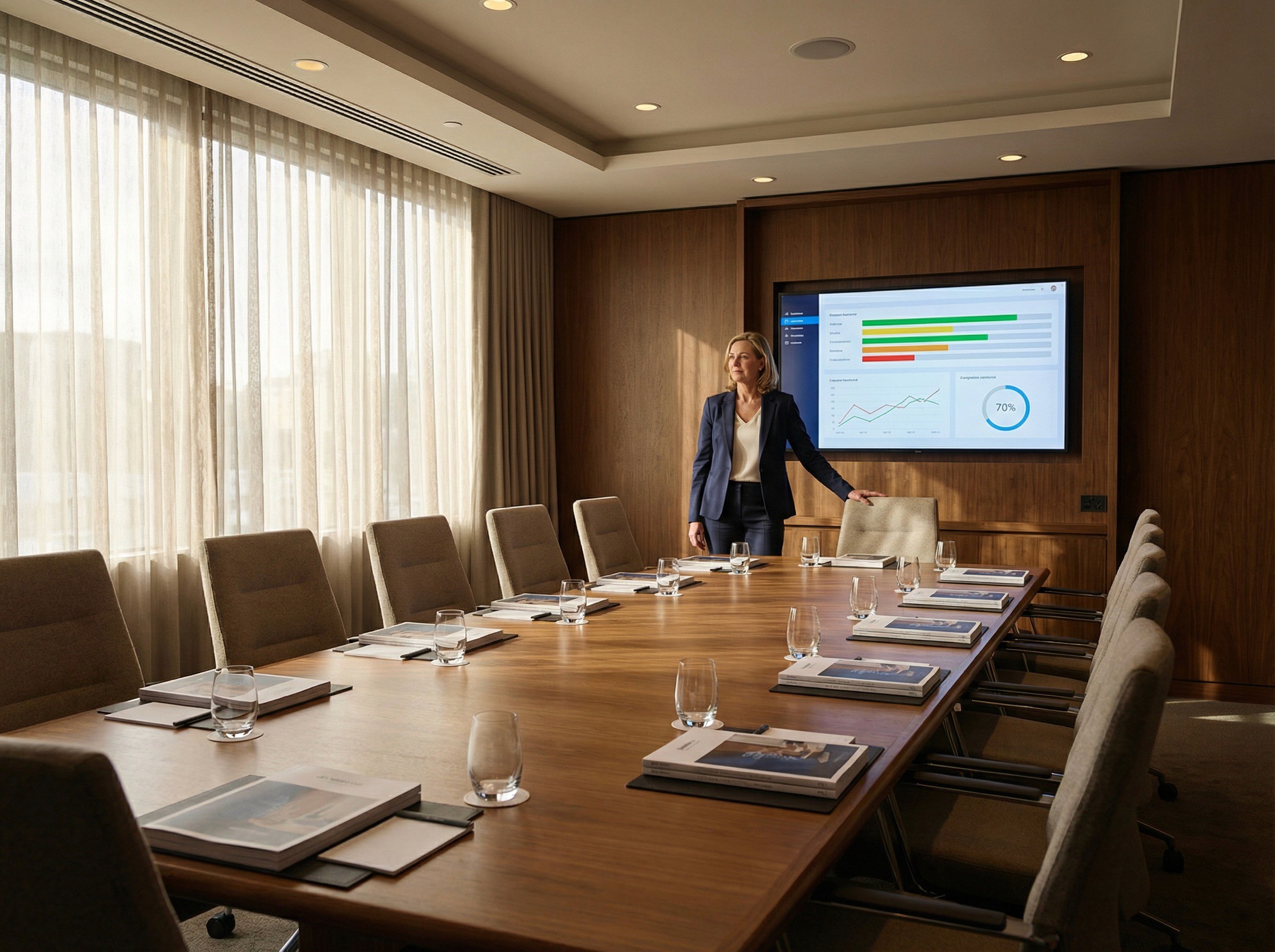

A wide, commanding shot of a large boardroom moments before a governance meeting begins. The room is fully prepared: water glasses at every place, printed board packs at each setting, a wall-mounted screen glowing with a structured summary dashboard — coloured status rows, a trend chart, a completion percentage — visible in shape and colour but not legible. Twelve chairs surround the table, all empty. At the far end of the room, a single figure — a company secretary or governance officer in her early 50s — is standing with one hand resting on the back of the head chair, surveying the room with an expression of composed readiness. Everything is in place. The directors have not arrived yet. She is not anxious. She is ready. The scene captures the meaning of governance on demand — the evidence is structured, the reports are generated, the board packs are printed, the dashboard is live, and the only thing missing is the people who will read it.

How governance and evidence works

How your organisation proves it acted systematically

uNIVERSAL BENEFITS

How your organisation proves it acted systematically

How governance and evidence works

How your organisation proves it acted systematically

Reporting and Reviews

Audits and Evidence

A head of people and culture in her mid-40s standing at a standing desk in a bright, open office, one hand holding a coffee, the other resting on the desk, looking at a monitor that shows a clean, structured report layout — sections, charts, and summary blocks arranged in a polished format, visible in shape and colour but not legible. Her expression is one of quiet disbelief at how quickly this happened — not amazement, just the raised-eyebrow calm of someone who remembers what this used to take.

Generate psychosocial risk reports for your board in minutes

Board-ready psychosocial risk reports, compliance summaries, and trend analysis generated from live data in minutes. Review and approval workflows ensure sign-off before distribution.

Reporting and Reviews

Audits and Evidence

Generate psychosocial risk reports for your board in minutes

Board-ready psychosocial risk reports, compliance summaries, and trend analysis generated from live data in minutes. Review and approval workflows ensure sign-off before distribution.

Built for psychosocial governance

Governance that runs continuously, not when the auditor calls

The evidence trail builds as your organisation identifies hazards, implements controls, and conducts reviews. Governance is a natural output of the system running, not a retrospective exercise.

  • No more retrospective evidence assembly.

  • No more governance gaps between audit cycles.

A quiet, intimate shot of a WHS director in his late 40s on a Sunday afternoon, sitting in a comfortable chair at home with a tablet on his lap, checking something briefly. He is not working — he is in weekend clothing, a dog is lying near his feet, and a book is face-down on the armrest beside him. The tablet shows a governance status overview with green and amber indicators in a simple grid — visible in structure but not legible. His expression is one of casual, confirming glance — the two-second check of someone who knows the system is running and is just verifying, the way you might glance at a weather app before going outside.
A wide, layered shot of a four-storey Australian office building photographed from outside at dusk, looking in through the illuminated windows. Each floor is visible as a distinct horizontal band of warm interior light against the darkening sky. On the ground floor, through large windows, workers in operational clothing are visible at the end of their shift — one putting on a jacket, another talking to a colleague. On the second floor, a small meeting is visible through glass — three people at a table with a laptop. On the third floor, a single person is at a desk reviewing a monitor. On the top floor, a boardroom is lit with a screen glowing at the far wall — empty, prepared, waiting. The building reads as a single organism: activity at the base, coordination in the middle, evidence at the top, governance at the summit. The scene captures end-to-end traceability as a physical, architectural metaphor — a hazard identified on the ground floor by a worker flows upward through the building: recorded on the second floor in a consultation, analysed on the third floor by a coordinator, and visible on the top floor in the boardroom where governance happens. The four floors are the four stages: identification, response, evidence, governance.

The psychosocial operating system

End-to-end traceability from identification to governance

Every hazard identified in risk intelligence flows through controls in safety orchestration and resolves here. The audit trail is continuous and the evidence is already structured when you need it.

What this enables

  • Trace any hazard from identification through control to governance

  • Produce regulator-aligned evidence packs for inspections

  • Generate board-ready reports from live data

  • Demonstrate officer due diligence with time-stamped records

GOT QUESTIONS?

Frequently asked questions

Frequently asked questions

What does "control" actually mean in this context?

A control is any action your organisation takes to eliminate or minimise a psychosocial hazard. Controls follow a hierarchy: * Elimination: remove the hazard entirely (e.g. removing an unsafe process). * Substitution: replace the hazard with something less risky. * Engineering: redesign the work environment or systems. * Administrative: introduce policies, training, or changed procedures (e.g. workload caps, flexible arrangements, conflict resolution training). * Personal support: provide individual-level support such as EAP referrals or coaching. ReFresh helps you document which controls you have implemented for each risk, track whether they are being followed, record the evidence, and schedule reviews to check whether they are working.

How does ReFresh Control work?

ReFresh Control provides a structured control library, hierarchy-based selection, control to risk linkages, rationale documentation, and ownership tracking. This ensures controls are applied consistently and remain reviewable over time.

What does a control look like in practice?

Controls are practical actions, not just policies on paper. Here are examples for common psychosocial hazard categories: * Job demands/workload: implementing workload review processes, redistributing tasks across the team, introducing overtime caps, or redesigning peak period scheduling. * Bullying and harassment: training managers to identify and respond to early warning signs, establishing clear reporting pathways, and conducting regular check-ins with affected teams. * Organisational change: running structured consultation sessions before restructures, providing transition support, and maintaining clear communication timelines. * Remote or isolated work: establishing regular check-in schedules, providing access to peer support, and conducting risk assessments for isolated roles. ReFresh includes a control library with pre-built templates for each hazard category that you can adapt to your organisation's context.

Why is documenting control rationale important?

Regulators and boards expect organisations to demonstrate not only what controls exist, but why they were chosen and how they are maintained. Control rationale documentation ensures decisions are transparent and defensible.

How does ReFresh track control effectiveness?

Controls are linked to specific psychosocial hazards and designated as primary or secondary measures. Over time, organisations can review which control types are most effective for different risk scenarios.

How do we know if our controls are actually working?

ReFresh tracks control effectiveness through multiple signals: * Review schedules: every control has a scheduled review date. When the review comes due, the platform prompts the assigned owner to assess whether the control is still effective. * Survey data trends: if you implement a control for workload and subsequent survey results show improvement in that hazard category, you have evidence the control is working. * Incident data: a reduction in incidents related to a specific hazard after implementing a control supports its effectiveness. * Worker feedback: consultation records capture whether workers feel the controls are making a difference. Regulators want to see that you are not just implementing controls but reviewing whether they work. ReFresh makes that review cycle part of the system rather than something you have to remember to do manually.

GOT QUESTIONS?

Frequently asked questions

What does "control" actually mean in this context?

A control is any action your organisation takes to eliminate or minimise a psychosocial hazard. Controls follow a hierarchy: * Elimination: remove the hazard entirely (e.g. removing an unsafe process). * Substitution: replace the hazard with something less risky. * Engineering: redesign the work environment or systems. * Administrative: introduce policies, training, or changed procedures (e.g. workload caps, flexible arrangements, conflict resolution training). * Personal support: provide individual-level support such as EAP referrals or coaching. ReFresh helps you document which controls you have implemented for each risk, track whether they are being followed, record the evidence, and schedule reviews to check whether they are working.

How does ReFresh Control work?

ReFresh Control provides a structured control library, hierarchy-based selection, control to risk linkages, rationale documentation, and ownership tracking. This ensures controls are applied consistently and remain reviewable over time.

What does a control look like in practice?

Controls are practical actions, not just policies on paper. Here are examples for common psychosocial hazard categories: * Job demands/workload: implementing workload review processes, redistributing tasks across the team, introducing overtime caps, or redesigning peak period scheduling. * Bullying and harassment: training managers to identify and respond to early warning signs, establishing clear reporting pathways, and conducting regular check-ins with affected teams. * Organisational change: running structured consultation sessions before restructures, providing transition support, and maintaining clear communication timelines. * Remote or isolated work: establishing regular check-in schedules, providing access to peer support, and conducting risk assessments for isolated roles. ReFresh includes a control library with pre-built templates for each hazard category that you can adapt to your organisation's context.

Why is documenting control rationale important?

Regulators and boards expect organisations to demonstrate not only what controls exist, but why they were chosen and how they are maintained. Control rationale documentation ensures decisions are transparent and defensible.

How does ReFresh track control effectiveness?

Controls are linked to specific psychosocial hazards and designated as primary or secondary measures. Over time, organisations can review which control types are most effective for different risk scenarios.

How do we know if our controls are actually working?

ReFresh tracks control effectiveness through multiple signals: * Review schedules: every control has a scheduled review date. When the review comes due, the platform prompts the assigned owner to assess whether the control is still effective. * Survey data trends: if you implement a control for workload and subsequent survey results show improvement in that hazard category, you have evidence the control is working. * Incident data: a reduction in incidents related to a specific hazard after implementing a control supports its effectiveness. * Worker feedback: consultation records capture whether workers feel the controls are making a difference. Regulators want to see that you are not just implementing controls but reviewing whether they work. ReFresh makes that review cycle part of the system rather than something you have to remember to do manually.

Don't just measure risk. Prevent it

Bring emotional, psychosocial, and leadership risk into one unified framework.

Don't just measure risk. Prevent it

Bring emotional, psychosocial, and leadership risk into one unified framework.

Don't just measure risk. Prevent it

Bring emotional, psychosocial, and leadership risk into one unified framework.