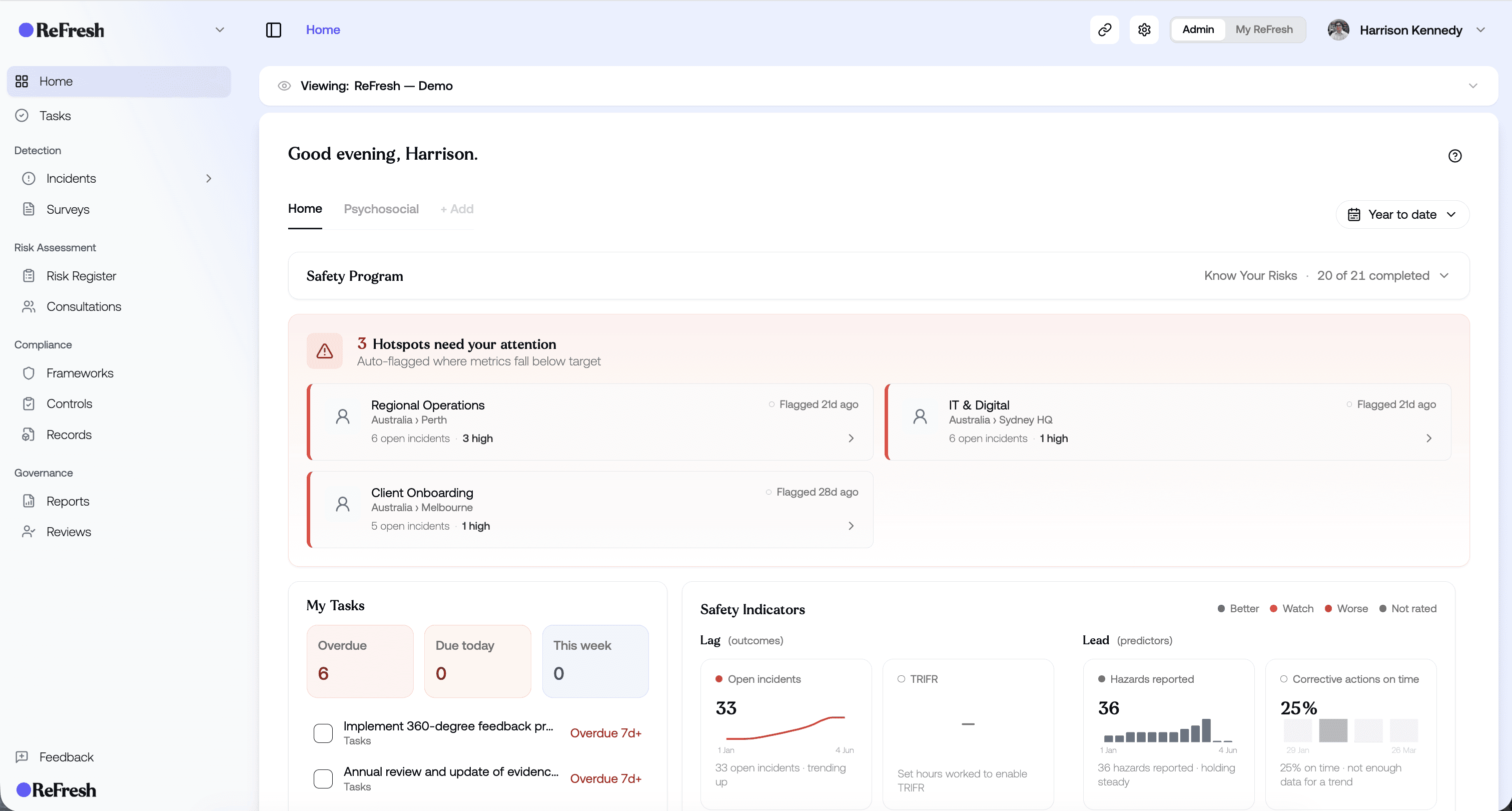
GOVERNANCE AND EVIDENCE

Prove your psychosocial compliance systematically, on demand

Prove your psychosocial compliance systematically, on demand

Prove your psychosocial compliance systematically, on demand

Your board asks for a psychosocial risk report. A regulator requests evidence of systematic action. An officer needs to demonstrate due diligence. The answer to all three should already be structured, time-stamped, and ready.
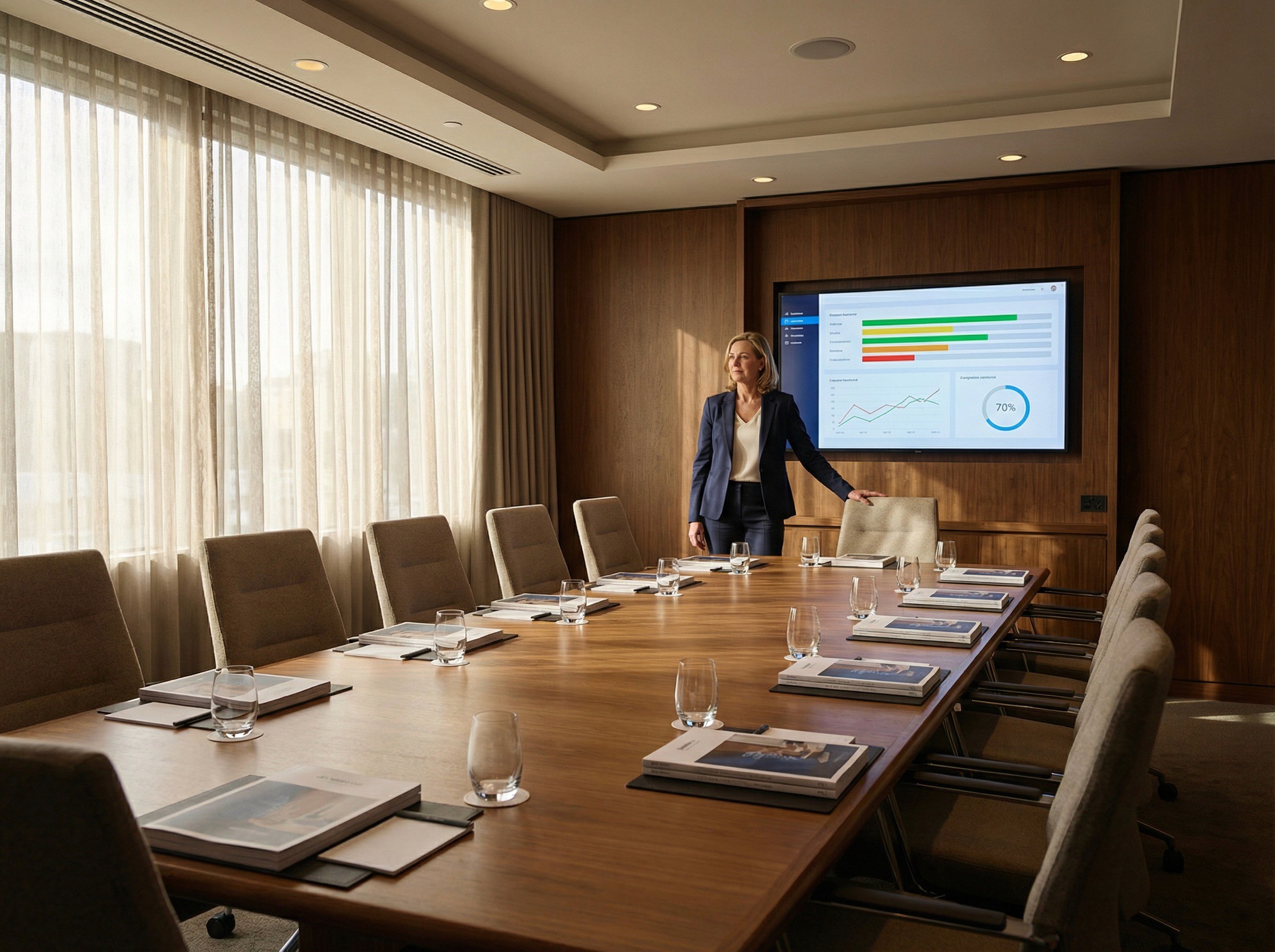

A wide, commanding shot of a large boardroom moments before a governance meeting begins. The room is fully prepared: water glasses at every place, printed board packs at each setting, a wall-mounted screen glowing with a structured summary dashboard — coloured status rows, a trend chart, a completion percentage — visible in shape and colour but not legible. Twelve chairs surround the table, all empty. At the far end of the room, a single figure — a company secretary or governance officer in her early 50s — is standing with one hand resting on the back of the head chair, surveying the room with an expression of composed readiness. Everything is in place. The directors have not arrived yet. She is not anxious. She is ready. The scene captures the meaning of governance on demand — the evidence is structured, the reports are generated, the board packs are printed, the dashboard is live, and the only thing missing is the people who will read it.

How governance and evidence works

How your organisation proves it acted systematically

uNIVERSAL BENEFITS

How your organisation proves it acted systematically

How governance and evidence works

How your organisation proves it acted systematically

Reporting and Reviews

Audits and Evidence

A head of people and culture in her mid-40s standing at a standing desk in a bright, open office, one hand holding a coffee, the other resting on the desk, looking at a monitor that shows a clean, structured report layout — sections, charts, and summary blocks arranged in a polished format, visible in shape and colour but not legible. Her expression is one of quiet disbelief at how quickly this happened — not amazement, just the raised-eyebrow calm of someone who remembers what this used to take.

Generate psychosocial risk reports for your board in minutes

Board-ready psychosocial risk reports, compliance summaries, and trend analysis generated from live data in minutes. Review and approval workflows ensure sign-off before distribution.

Reporting and Reviews

Audits and Evidence

Generate psychosocial risk reports for your board in minutes

Board-ready psychosocial risk reports, compliance summaries, and trend analysis generated from live data in minutes. Review and approval workflows ensure sign-off before distribution.

Built for psychosocial governance

Governance that runs continuously, not when the auditor calls

The evidence trail builds as your organisation identifies hazards, implements controls, and conducts reviews. Governance is a natural output of the system running, not a retrospective exercise.

  • No more retrospective evidence assembly.

  • No more governance gaps between audit cycles.

A quiet, intimate shot of a WHS director in his late 40s on a Sunday afternoon, sitting in a comfortable chair at home with a tablet on his lap, checking something briefly. He is not working — he is in weekend clothing, a dog is lying near his feet, and a book is face-down on the armrest beside him. The tablet shows a governance status overview with green and amber indicators in a simple grid — visible in structure but not legible. His expression is one of casual, confirming glance — the two-second check of someone who knows the system is running and is just verifying, the way you might glance at a weather app before going outside.
A wide, layered shot of a four-storey Australian office building photographed from outside at dusk, looking in through the illuminated windows. Each floor is visible as a distinct horizontal band of warm interior light against the darkening sky. On the ground floor, through large windows, workers in operational clothing are visible at the end of their shift — one putting on a jacket, another talking to a colleague. On the second floor, a small meeting is visible through glass — three people at a table with a laptop. On the third floor, a single person is at a desk reviewing a monitor. On the top floor, a boardroom is lit with a screen glowing at the far wall — empty, prepared, waiting. The building reads as a single organism: activity at the base, coordination in the middle, evidence at the top, governance at the summit. The scene captures end-to-end traceability as a physical, architectural metaphor — a hazard identified on the ground floor by a worker flows upward through the building: recorded on the second floor in a consultation, analysed on the third floor by a coordinator, and visible on the top floor in the boardroom where governance happens. The four floors are the four stages: identification, response, evidence, governance.

The psychosocial operating system

End-to-end traceability from identification to governance

Every hazard identified in risk intelligence flows through controls in safety orchestration and resolves here. The audit trail is continuous and the evidence is already structured when you need it.

What this enables

  • Trace any hazard from identification through control to governance

  • Produce regulator-aligned evidence packs for inspections

  • Generate board-ready reports from live data

  • Demonstrate officer due diligence with time-stamped records

GOT QUESTIONS?

Frequently asked questions

Frequently asked questions

What is psychosocial governance and evidence?

Governance and evidence is how you prove your psychosocial compliance is systematic rather than assumed. It is the continuous, linked record of what your organisation identified, the controls it put in place, the reviews it ran, and the consultations it held, all time-stamped, so you can demonstrate a managed system to a board, a regulator, or an officer at any time.

How does the evidence trail get built?

It builds as you work, not when an audit is due. Each time your organisation identifies a hazard, implements a control, completes a review, or records a consultation, that action is captured and linked. Governance becomes a natural output of the system running, so there are no gaps between audit cycles and no scramble to assemble evidence after the fact.

Can I produce evidence for a regulator or an inspection?

Yes. Because the underlying records are already structured and linked, you can produce a regulator-aligned evidence pack on demand, showing not just that controls exist but that hazards were identified, controls were implemented and reviewed, and workers were consulted. The evidence is dated and attributed, which is what an inspector looks for.

How does this support officer due diligence?

Officers carry a due diligence duty under WHS law (section 27 of the model WHS Act) to take reasonable steps to understand psychosocial risk and ensure it is being managed. Governance and evidence gives officers a current, time-stamped view of the organisation's psychosocial risk posture and the actions taken, so due diligence can be shown with records rather than assertion.

What can I give the board?

Board-ready psychosocial risk reports, generated from live data rather than rebuilt by hand each quarter. Because the reporting draws on the same structured records as the rest of the platform, the board sees the organisation's current risk posture, the controls in place, and how it is trending, on a regular cadence.

How does the evidence connect across the platform?

Every hazard identified in risk intelligence flows through the controls applied in safety orchestration and resolves into governance here, so any item can be traced from identification through control to the evidence that proves it was managed. The trail is continuous rather than a set of disconnected records.

GOT QUESTIONS?

Frequently asked questions

What is psychosocial governance and evidence?

Governance and evidence is how you prove your psychosocial compliance is systematic rather than assumed. It is the continuous, linked record of what your organisation identified, the controls it put in place, the reviews it ran, and the consultations it held, all time-stamped, so you can demonstrate a managed system to a board, a regulator, or an officer at any time.

How does the evidence trail get built?

It builds as you work, not when an audit is due. Each time your organisation identifies a hazard, implements a control, completes a review, or records a consultation, that action is captured and linked. Governance becomes a natural output of the system running, so there are no gaps between audit cycles and no scramble to assemble evidence after the fact.

Can I produce evidence for a regulator or an inspection?

Yes. Because the underlying records are already structured and linked, you can produce a regulator-aligned evidence pack on demand, showing not just that controls exist but that hazards were identified, controls were implemented and reviewed, and workers were consulted. The evidence is dated and attributed, which is what an inspector looks for.

How does this support officer due diligence?

Officers carry a due diligence duty under WHS law (section 27 of the model WHS Act) to take reasonable steps to understand psychosocial risk and ensure it is being managed. Governance and evidence gives officers a current, time-stamped view of the organisation's psychosocial risk posture and the actions taken, so due diligence can be shown with records rather than assertion.

What can I give the board?

Board-ready psychosocial risk reports, generated from live data rather than rebuilt by hand each quarter. Because the reporting draws on the same structured records as the rest of the platform, the board sees the organisation's current risk posture, the controls in place, and how it is trending, on a regular cadence.

How does the evidence connect across the platform?

Every hazard identified in risk intelligence flows through the controls applied in safety orchestration and resolves into governance here, so any item can be traced from identification through control to the evidence that proves it was managed. The trail is continuous rather than a set of disconnected records.

Compliance you can prove

ReFresh is the psychosocial operating system: detect risk, act on it, and prove it, in one place.

Compliance you can prove

ReFresh is the psychosocial operating system: detect risk, act on it, and prove it, in one place.

Compliance you can prove

ReFresh is the psychosocial operating system: detect risk, act on it, and prove it, in one place.