Safety orchestration
Psychosocial risk management that runs as a system
Psychosocial risk management that runs as a system
Psychosocial risk management that runs as a system
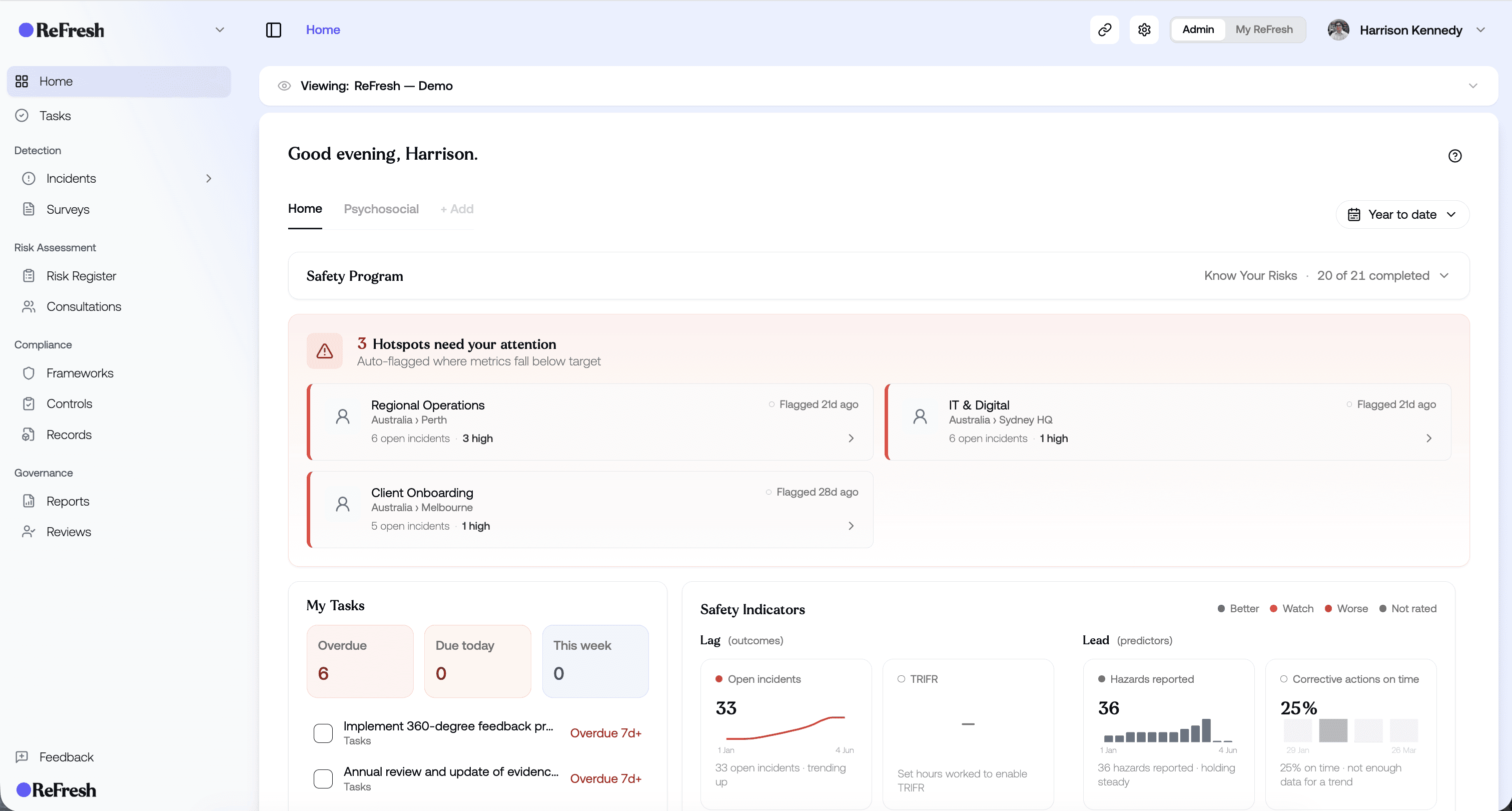
Identifying a hazard is the first step. The regulation requires you to act on it, track your response, and evidence that it worked. ReFresh is the psychosocial risk management software that turns that obligation into a system that runs, so your team is not managing compliance from a spreadsheet.

How safety orchestration works
How your organisation manages and evidences its response
How safety orchestration works
How your organisation manages and evidences its response
uNIVERSAL BENEFITS
How your organisation manages and evidences its response
Compliance frameworks
Controls and evidence
Employee portal
Consultations and tasks

Activate psychosocial compliance frameworks for your jurisdictions
15+ frameworks covering Australian state, national, and international psychosocial safety requirements. Each one maps obligations to the controls and evidence your organisation needs. A guided five-step program takes you from foundation to full compliance maturity.
Compliance frameworks
Controls and evidence
Employee portal
Consultations and tasks
Activate psychosocial compliance frameworks for your jurisdictions
15+ frameworks covering Australian state, national, and international psychosocial safety requirements. Each one maps obligations to the controls and evidence your organisation needs. A guided five-step program takes you from foundation to full compliance maturity.
Built for psychosocial risk management
Structured psychosocial risk management, not scattered spreadsheets
Frameworks, controls, evidence, consultations, and tasks in one system, with a continuous audit trail across every module. No more disconnected documents or scattered evidence. No more unclear control ownership or missing records.

ReFresh has been a game-changer. It gives us a real-time view of how our people are feeling across every platform, making it easier to act fast, build a stronger culture & handle our people compliance needs.
ReFresh has been a game-changer. It gives us a real-time view of how our people are feeling across every platform, making it easier to act fast, build a stronger culture & handle our people compliance needs.

Josh Carder
CEO, Amped HQ

Every action linked, every decision traceable
Every risk identified in risk intelligence flows into controls and evidence here, then resolves into governance reporting. One system, full traceability.
What this enables
Link controls to the risks they address
Track evidence status across teams and locations
Surface gaps and overdue actions
Produce audit-ready evidence for boards and regulators
Organisations using ReFresh reduce psychosocial compliance tracking time by 70% or more.
Organisations using ReFresh reduce psychosocial compliance tracking time by 70% or more.
GOT QUESTIONS?
Frequently asked questions
Frequently asked questions
What is psychosocial risk management?
Psychosocial risk management is the systematic process of controlling identified psychosocial hazards: assigning controls, tracking that they are implemented, checking they are working, and keeping the evidence. It is the action stage of the WHS duty, after hazards have been identified and assessed.
What does psychosocial risk management software do?
It replaces spreadsheets and disconnected documents with one system that links each risk to its controls, records who owns each action and by when, tracks evidence of effectiveness, and produces an audit trail a regulator or board can review.
How does ReFresh turn an identified hazard into a control?
Each risk carries its own controls, owners, and due dates. Once a control is assigned, the platform tracks its status and prompts the responsible person, so action is recorded rather than assumed.
How do you know whether a control is actually working?
Controls are reviewed on a schedule and against incoming signals from surveys, incidents, and consultations. Effectiveness is recorded over time, so you can show a control was monitored, not just put in place.
Can ReFresh show which actions are overdue or which teams have gaps?
Yes. Dashboards surface overdue actions, missing controls, and gaps by team and location, so accountability is visible without chasing people manually.
How does safety orchestration connect to risk intelligence and governance reporting?
Risks identified in risk intelligence flow into controls and evidence here, then resolve into governance reporting. One continuous record runs across the three stages.
Is the evidence audit-ready for a regulator or board?
Every action, owner, date, and review is captured in a versioned audit trail, so you can produce defensible evidence of systematic management on request.
Does it work across multiple sites and jurisdictions?
Yes. Controls, evidence, and reporting can be managed across sites, teams, and states, so multi-jurisdiction organisations run one system rather than one per location.
GOT QUESTIONS?
Frequently asked questions
What is psychosocial risk management?
Psychosocial risk management is the systematic process of controlling identified psychosocial hazards: assigning controls, tracking that they are implemented, checking they are working, and keeping the evidence. It is the action stage of the WHS duty, after hazards have been identified and assessed.
What does psychosocial risk management software do?
It replaces spreadsheets and disconnected documents with one system that links each risk to its controls, records who owns each action and by when, tracks evidence of effectiveness, and produces an audit trail a regulator or board can review.
How does ReFresh turn an identified hazard into a control?
Each risk carries its own controls, owners, and due dates. Once a control is assigned, the platform tracks its status and prompts the responsible person, so action is recorded rather than assumed.
How do you know whether a control is actually working?
Controls are reviewed on a schedule and against incoming signals from surveys, incidents, and consultations. Effectiveness is recorded over time, so you can show a control was monitored, not just put in place.
Can ReFresh show which actions are overdue or which teams have gaps?
Yes. Dashboards surface overdue actions, missing controls, and gaps by team and location, so accountability is visible without chasing people manually.
How does safety orchestration connect to risk intelligence and governance reporting?
Risks identified in risk intelligence flow into controls and evidence here, then resolve into governance reporting. One continuous record runs across the three stages.
Is the evidence audit-ready for a regulator or board?
Every action, owner, date, and review is captured in a versioned audit trail, so you can produce defensible evidence of systematic management on request.
Does it work across multiple sites and jurisdictions?
Yes. Controls, evidence, and reporting can be managed across sites, teams, and states, so multi-jurisdiction organisations run one system rather than one per location.