Safety orchestration
Turn identified psychosocial risk into a systematic response
Turn identified psychosocial risk into a systematic response
Turn identified psychosocial risk into a systematic response
Identifying a hazard is the first step. The regulation requires you to act on it, track your response, and evidence that it worked. ReFresh turns that obligation into a system that runs, so your team is not managing compliance from a spreadsheet.

How safety orchestration works
How your organisation manages and evidences its response
How safety orchestration works
How your organisation manages and evidences its response
uNIVERSAL BENEFITS
How your organisation manages and evidences its response
Compliance frameworks
Controls and evidence
Employee portal
Consultations and tasks

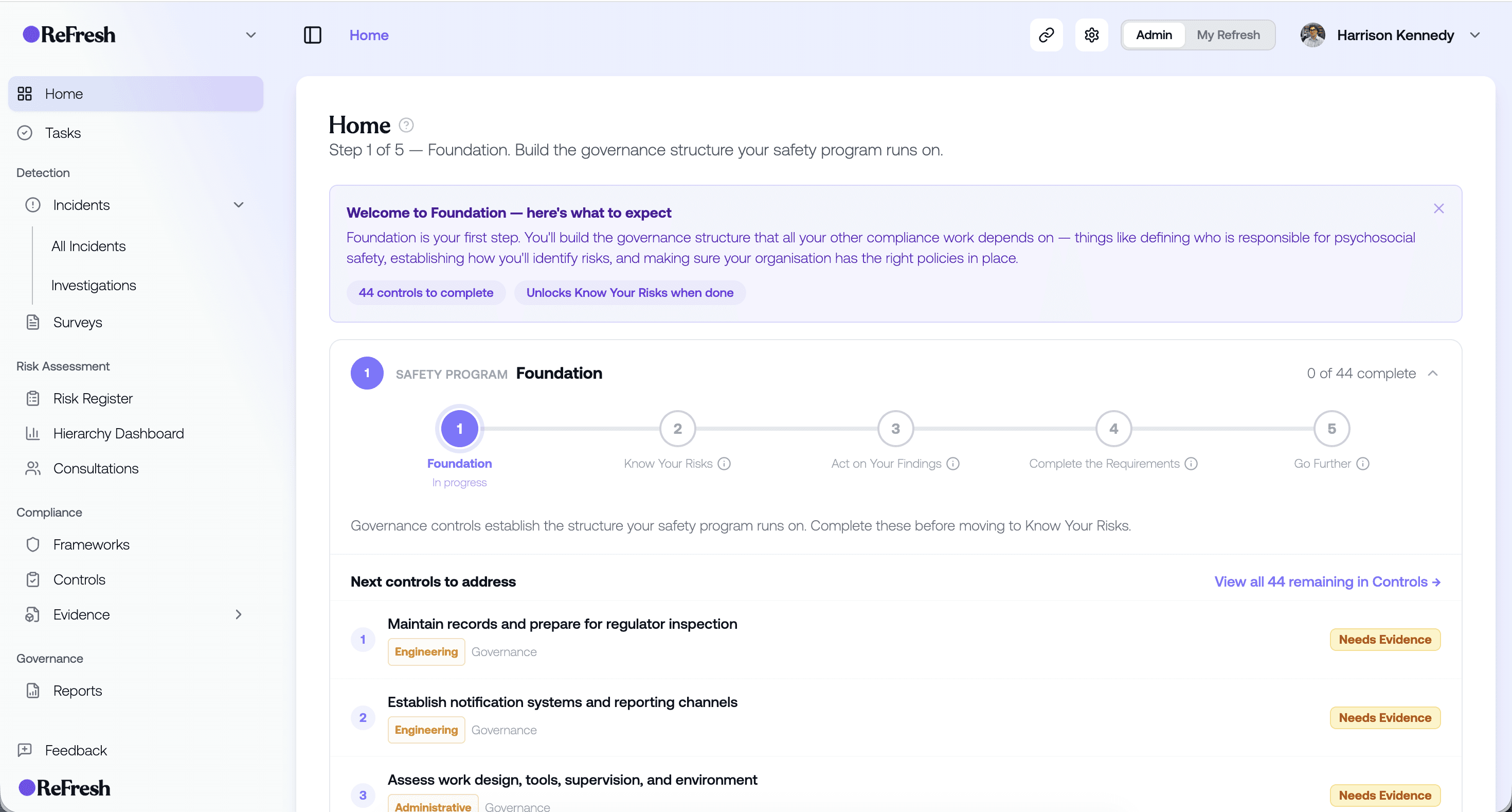
Activate psychosocial compliance frameworks for your jurisdictions
15+ frameworks covering Australian state, national, and international psychosocial safety requirements. Each one maps obligations to the controls and evidence your organisation needs. A guided five-step program takes you from foundation to full compliance maturity.
Compliance frameworks
Controls and evidence
Employee portal
Consultations and tasks
Activate psychosocial compliance frameworks for your jurisdictions
15+ frameworks covering Australian state, national, and international psychosocial safety requirements. Each one maps obligations to the controls and evidence your organisation needs. A guided five-step program takes you from foundation to full compliance maturity.
Built for psychosocial safety orchestration
Structured compliance management, not scattered spreadsheets
Frameworks, controls, evidence, consultations, and tasks in one system. A continuous audit trail across every module.
No more disconnected documents or scattered evidence.
No more unclear control ownership or missing records.

ReFresh has been a game-changer. It gives us a real-time view of how our people are feeling across every platform, making it easier to act fast, build a stronger culture & handle our people compliance needs.
ReFresh has been a game-changer. It gives us a real-time view of how our people are feeling across every platform, making it easier to act fast, build a stronger culture & handle our people compliance needs.

Josh Carder
CEO, Amped HQ
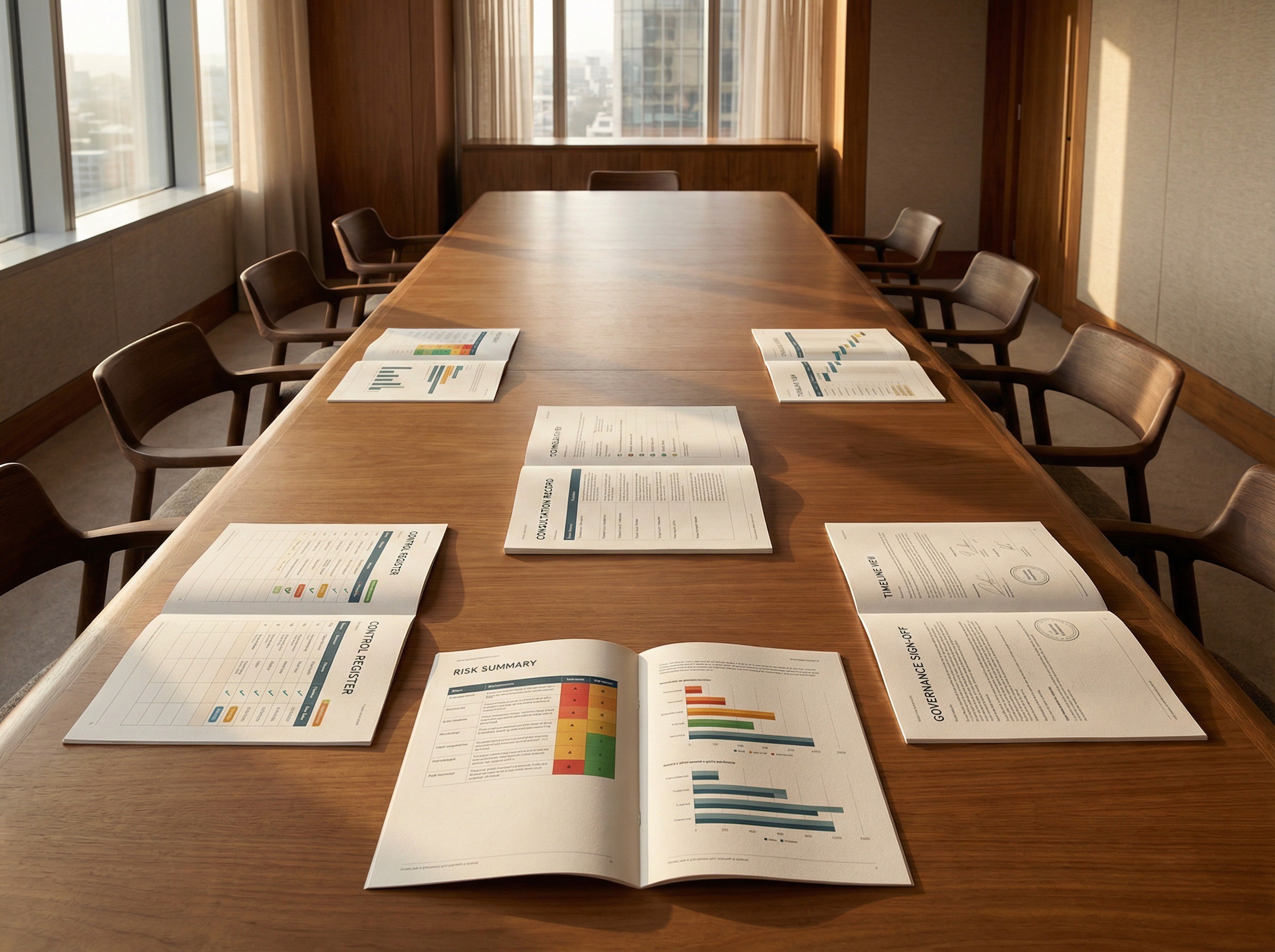
Every action linked, every decision traceable
Every risk identified in risk intelligence flows into controls and evidence here, then resolves into governance reporting. One system, full traceability.
What this enables
Link controls to the risks they address
Track evidence status across teams and locations
Surface gaps and overdue actions
Produce audit-ready evidence for boards and regulators
Organisations using ReFresh reduce psychosocial compliance tracking time by 70% or more.
Organisations using ReFresh reduce psychosocial compliance tracking time by 70% or more.
GOT QUESTIONS?
Frequently asked questions
Frequently asked questions
What does psychosocial risk assessment mean?
Psychosocial risk assessment is the process of analysing identified psychosocial hazards to determine the likelihood and severity of harm, who is exposed, and how risks should be prioritised and managed. It is a core WHS obligation once hazards have been identified.
How does ReFresh Risk Assess work?
ReFresh Risk Assess provides a structured framework to log psychosocial risks, assess exposure and severity, document foreseeable risk scenarios, record worker consultation, and maintain a central psychosocial risk register. All assessments are versioned and auditable.
How is Risk Assess different from Detect?
Detect focuses on identifying psychosocial hazards through incidents, surveys, and confidential intake. Risk Assess formally analyses those hazards by assessing exposure, likelihood, consequence, and foreseeable harm, as required under WHS legislation.
How does ReFresh score or rate risk?
ReFresh uses a structured risk assessment methodology based on two dimensions: * Likelihood: how probable is it that the hazard will cause harm, given the current controls in place? * Consequence: if harm occurs, how severe could it be? These combine to produce a risk rating (typically represented as low, medium, high, or critical) for each hazard across each team or location. The methodology is consistent with ISO 45003 and SafeWork Australia guidance, and can be customised to align with your organisation's existing risk matrix if you already have one.
How do we decide thresholds? At what point is someone working "too much"?
This depends on your industry, the nature of the work, and the specific hazard category. ReFresh helps you work through it: * Risk scenario templates: the platform includes assessment guidance for each of the 17 hazard categories, helping you determine what "reasonable" looks like in your context. * Exposure assessment: for something like excessive working hours, the platform helps you assess the duration, frequency, and severity of the exposure alongside the controls you have in place. * Documentation, not universal numbers: the goal is to document that you assessed the risk, considered the context, and implemented proportionate controls.
How do we prioritise which risks to address first?
ReFresh helps you prioritise based on a combination of: * Risk rating: higher-rated risks (high likelihood, high consequence) should be addressed first. * Regulatory exposure: some hazard categories attract more enforcement attention than others in your jurisdiction. * Data signals: if survey results, incident reports, and workers compensation data all point to the same hazard, that convergence signals urgency. * Control gaps: risks where no controls are currently in place are flagged for immediate attention. The platform surfaces these priorities through dashboards and automated recommendations, so you are not starting from a blank page.
What does the risk register look like?
The ReFresh risk register gives you a structured view of every psychosocial risk across your organisation: * Risk by hazard category: each of the 17 hazard categories is tracked with its current risk rating, based on the likelihood and consequence of harm. * Risk by team and location: you can filter the register by team, site, or business unit to see where risk is concentrated. * Linked controls: every risk is connected to the controls you have implemented to address it, so you can see at a glance what is being done and whether it is working. * Review schedules: risks have scheduled review dates so nothing falls through the cracks. The register is a living document that updates as new survey data, incident reports, and control evidence comes in.
Is ReFresh Risk Assess aligned with WHS and ISO 45003?
Yes. ReFresh Risk Assess aligns with ISO 45003, Safe Work Australia guidance, Comcare expectations, and state-based WHS psychosocial regulations. The framework is designed to meet regulator expectations for documented risk assessment.
Does the platform apply to our specific industry? Our risks are quite unique.
Yes. Psychosocial risks vary significantly by industry and operational context. ReFresh accommodates this through: * Tailored risk scenarios: templates that can be configured for your specific hazard profile, whether that is patron abuse in a stadium, fatigue from 365-day operations, media scrutiny, excessive hours in professional services, or multi-campus complexity in education. * Onboarding customisation: during setup, we work with you to configure the risk scenarios and controls relevant to your operations. * Sector experience: we work with organisations across financial services, education, manufacturing, professional services, sport, and the public sector.
GOT QUESTIONS?
Frequently asked questions
What does psychosocial risk assessment mean?
Psychosocial risk assessment is the process of analysing identified psychosocial hazards to determine the likelihood and severity of harm, who is exposed, and how risks should be prioritised and managed. It is a core WHS obligation once hazards have been identified.
How does ReFresh Risk Assess work?
ReFresh Risk Assess provides a structured framework to log psychosocial risks, assess exposure and severity, document foreseeable risk scenarios, record worker consultation, and maintain a central psychosocial risk register. All assessments are versioned and auditable.
How is Risk Assess different from Detect?
Detect focuses on identifying psychosocial hazards through incidents, surveys, and confidential intake. Risk Assess formally analyses those hazards by assessing exposure, likelihood, consequence, and foreseeable harm, as required under WHS legislation.
How does ReFresh score or rate risk?
ReFresh uses a structured risk assessment methodology based on two dimensions: * Likelihood: how probable is it that the hazard will cause harm, given the current controls in place? * Consequence: if harm occurs, how severe could it be? These combine to produce a risk rating (typically represented as low, medium, high, or critical) for each hazard across each team or location. The methodology is consistent with ISO 45003 and SafeWork Australia guidance, and can be customised to align with your organisation's existing risk matrix if you already have one.
How do we decide thresholds? At what point is someone working "too much"?
This depends on your industry, the nature of the work, and the specific hazard category. ReFresh helps you work through it: * Risk scenario templates: the platform includes assessment guidance for each of the 17 hazard categories, helping you determine what "reasonable" looks like in your context. * Exposure assessment: for something like excessive working hours, the platform helps you assess the duration, frequency, and severity of the exposure alongside the controls you have in place. * Documentation, not universal numbers: the goal is to document that you assessed the risk, considered the context, and implemented proportionate controls.
How do we prioritise which risks to address first?
ReFresh helps you prioritise based on a combination of: * Risk rating: higher-rated risks (high likelihood, high consequence) should be addressed first. * Regulatory exposure: some hazard categories attract more enforcement attention than others in your jurisdiction. * Data signals: if survey results, incident reports, and workers compensation data all point to the same hazard, that convergence signals urgency. * Control gaps: risks where no controls are currently in place are flagged for immediate attention. The platform surfaces these priorities through dashboards and automated recommendations, so you are not starting from a blank page.
What does the risk register look like?
The ReFresh risk register gives you a structured view of every psychosocial risk across your organisation: * Risk by hazard category: each of the 17 hazard categories is tracked with its current risk rating, based on the likelihood and consequence of harm. * Risk by team and location: you can filter the register by team, site, or business unit to see where risk is concentrated. * Linked controls: every risk is connected to the controls you have implemented to address it, so you can see at a glance what is being done and whether it is working. * Review schedules: risks have scheduled review dates so nothing falls through the cracks. The register is a living document that updates as new survey data, incident reports, and control evidence comes in.
Is ReFresh Risk Assess aligned with WHS and ISO 45003?
Yes. ReFresh Risk Assess aligns with ISO 45003, Safe Work Australia guidance, Comcare expectations, and state-based WHS psychosocial regulations. The framework is designed to meet regulator expectations for documented risk assessment.
Does the platform apply to our specific industry? Our risks are quite unique.
Yes. Psychosocial risks vary significantly by industry and operational context. ReFresh accommodates this through: * Tailored risk scenarios: templates that can be configured for your specific hazard profile, whether that is patron abuse in a stadium, fatigue from 365-day operations, media scrutiny, excessive hours in professional services, or multi-campus complexity in education. * Onboarding customisation: during setup, we work with you to configure the risk scenarios and controls relevant to your operations. * Sector experience: we work with organisations across financial services, education, manufacturing, professional services, sport, and the public sector.