Connected Evidence

Link existing records as evidence without duplicate data entry

Link existing records as evidence without duplicate data entry

Link existing records as evidence without duplicate data entry

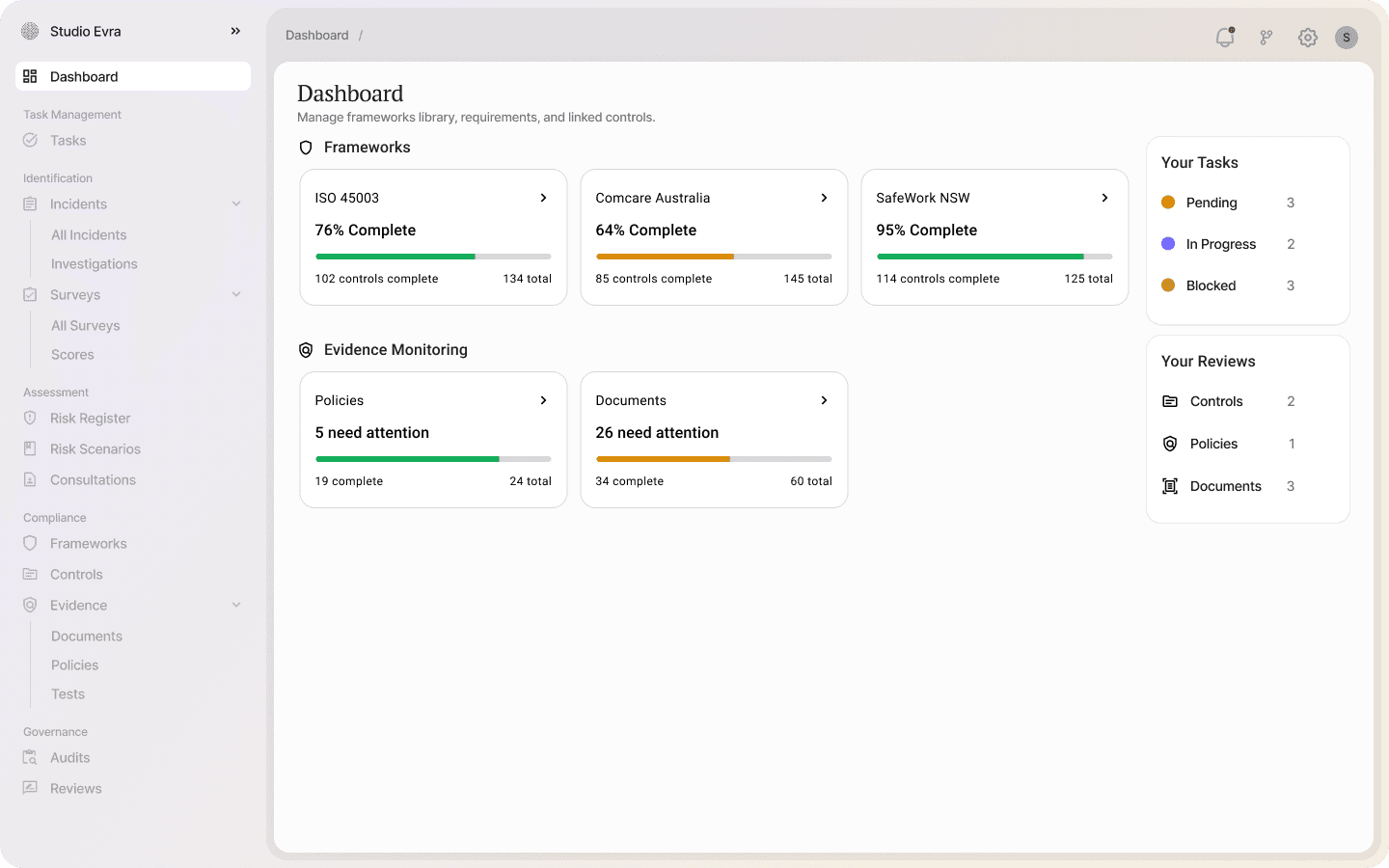
Your risk assessments, consultations, incident investigations, and survey results are already in the system. Link them directly to control evidence requirements instead of uploading the same information twice, creating a connected compliance picture.


Integrated Evidence

Turn completed work into compliance evidence automatically

When a control requires evidence of a risk assessment, consultation, or incident investigation, link the existing record rather than uploading a separate document. Select from your completed risk assessments to fulfill "Risk Assessment Evidence" requirements. Link consultation records to demonstrate worker participation. Connect incident investigations to show corrective action evidence. The linked record stays current: when you update the risk assessment, the evidence updates too.

Risk assessments

Consultations

Incident investigations

Survey results

Risk assessments

Consultations

Incident investigations

Survey results

Risk assessments

Consultations

Incident investigations

Survey results

Data-driven compliance

Survey results inform risk ratings and control effectiveness

Psychosocial surveys do more than collect data. They connect directly to your compliance system. Survey tag scores map to risk scenarios, informing inherent risk ratings with actual employee feedback. High survey scores for bullying concerns can trigger risk assessment reviews. Most importantly, survey results validate control effectiveness: if bullying concerns persist after training, the control may need strengthening regardless of documentation status.

Risk rating input

Effectiveness validation

Control linkage

Trend tracking

Risk rating input

Effectiveness validation

Control linkage

Trend tracking

Risk rating input

Effectiveness validation

Control linkage

Trend tracking

Governance Documents

Manage policies with version control and approval workflows

Policy evidence is distinct from document evidence. Policies are organizational rules (Anti-Bullying Policy, Code of Conduct, WHS Policy) that require formal approval and periodic review. Track policy versions, request approvals from designated reviewers, and maintain review schedules. When policy reviews are due, the system creates review tasks and updates status to "needs review" until approval is complete. Previous versions are preserved in the audit trail.

Version tracking

Approval workflows

Review schedules

Audit history

Version tracking

Approval workflows

Review schedules

Audit history

Version tracking

Approval workflows

Review schedules

Audit history

Worker participation

Document consultation to satisfy legal requirements

WHS legislation requires consultation with workers at each step of risk management. Your consultation records (meeting attendees, topics discussed, outcomes agreed, actions committed) become evidence that you're meeting this legal obligation. Link consultation records to the specific risk assessment, control implementation, or policy change they relate to. Demonstrate the participative process regulators expect to see.


Corrective Action Proof

Connect incidents to controls and risk assessments

When incidents occur, they often relate to specific risks and controls. Link incident reports to the risk scenarios they represent. For example, a bullying complaint links to your bullying risk assessment. Connect incident investigations to the controls being evaluated. This creates traceability: you can show auditors exactly how incidents informed your risk ratings and what corrective actions you implemented.

Build a connected compliance system, not disconnected documents

Evidence shouldn't live in isolation. Connect your surveys, risk assessments, consultations, and incident investigations directly to control requirements. Create a compliance system where completed work automatically satisfies evidence requirements and real-world data validates control effectiveness.

GOT QUESTIONS?

Frequently asked questions

Frequently asked questions

What does psychosocial risk detection mean?

Psychosocial risk detection is the process of identifying psychosocial hazards, concerns, and early warning signs that may affect workers’ mental health and wellbeing. This includes capturing incidents, confidential concerns, and survey-based risk indicators so organisations can meet WHS obligations and act before harm occurs.

What does psychosocial risk detection mean?

Psychosocial risk detection is the process of identifying psychosocial hazards, concerns, and early warning signs that may affect workers’ mental health and wellbeing. This includes capturing incidents, confidential concerns, and survey-based risk indicators so organisations can meet WHS obligations and act before harm occurs.

How does ReFresh detect work?

ReFresh Detect provides structured detection pathways including psychosocial incident reporting, confidential risk intake, and compliance-aligned surveys. These inputs are centrally recorded and linked, giving organisations a clear, auditable view of psychosocial risk across teams, roles, and locations.

How does ReFresh detect work?

ReFresh Detect provides structured detection pathways including psychosocial incident reporting, confidential risk intake, and compliance-aligned surveys. These inputs are centrally recorded and linked, giving organisations a clear, auditable view of psychosocial risk across teams, roles, and locations.

What is the objective of the Detect module?

The objective of Detect is to help organisations identify psychosocial risk early, maintain visibility over foreseeable hazards, and create documented evidence aligned with WHS duties. Detect ensures risks are identified consistently and are ready to be assessed, controlled, and managed.

What is the objective of the Detect module?

The objective of Detect is to help organisations identify psychosocial risk early, maintain visibility over foreseeable hazards, and create documented evidence aligned with WHS duties. Detect ensures risks are identified consistently and are ready to be assessed, controlled, and managed.

What problem does psychosocial risk detection solve?

Many organisations rely on fragmented surveys, inbox reports, or informal disclosures that create blind spots and compliance risk. ReFresh Detect replaces these with a structured system that captures, documents, and links psychosocial risk data in one place.

What problem does psychosocial risk detection solve?

Many organisations rely on fragmented surveys, inbox reports, or informal disclosures that create blind spots and compliance risk. ReFresh Detect replaces these with a structured system that captures, documents, and links psychosocial risk data in one place.

Is ReFresh Detect compliant with WHS requirements?

Yes. ReFresh Detect is designed to align with ISO 45003, Safe Work Australia guidance, Comcare expectations, and state-based WHS psychosocial regulations. Detection activity is documented to support audits, regulator enquiries, and board oversight.

Is ReFresh Detect compliant with WHS requirements?

Yes. ReFresh Detect is designed to align with ISO 45003, Safe Work Australia guidance, Comcare expectations, and state-based WHS psychosocial regulations. Detection activity is documented to support audits, regulator enquiries, and board oversight.

Is reporting confidential for workers?

Yes. Psychosocial incident reporting and confidential risk intake are designed to protect worker privacy and psychological safety. Access controls and structured workflows ensure sensitive information is handled appropriately while still providing duty holders with necessary visibility.

Is reporting confidential for workers?

Yes. Psychosocial incident reporting and confidential risk intake are designed to protect worker privacy and psychological safety. Access controls and structured workflows ensure sensitive information is handled appropriately while still providing duty holders with necessary visibility.

Can we use only the Detect module?

Yes. ReFresh Detect can be used as a standalone module or as part of the broader Detect, Assess, Control, Manage workflow. Many organisations start with Detect and expand as their psychosocial risk management maturity grows.

Can we use only the Detect module?

Yes. ReFresh Detect can be used as a standalone module or as part of the broader Detect, Assess, Control, Manage workflow. Many organisations start with Detect and expand as their psychosocial risk management maturity grows.

Does ReFresh use automated or AI-based detection?

No. ReFresh Detect does not automatically monitor or infer psychosocial risk. Detection is based on structured surveys, incident reporting, and confidential intake processes to ensure accuracy, transparency, and regulatory defensibility.

Does ReFresh use automated or AI-based detection?

No. ReFresh Detect does not automatically monitor or infer psychosocial risk. Detection is based on structured surveys, incident reporting, and confidential intake processes to ensure accuracy, transparency, and regulatory defensibility.

How does Detect support audits and regulator requests?

All detection activity is time-stamped, structured, and centrally recorded. This creates a clear audit trail that demonstrates how psychosocial risks were identified, reviewed, and escalated in line with WHS obligations.

How does Detect support audits and regulator requests?

All detection activity is time-stamped, structured, and centrally recorded. This creates a clear audit trail that demonstrates how psychosocial risks were identified, reviewed, and escalated in line with WHS obligations.

GOT QUESTIONS?

Frequently asked questions

What does psychosocial risk detection mean?

Psychosocial risk detection is the process of identifying psychosocial hazards, concerns, and early warning signs that may affect workers’ mental health and wellbeing. This includes capturing incidents, confidential concerns, and survey-based risk indicators so organisations can meet WHS obligations and act before harm occurs.

How does ReFresh detect work?

ReFresh Detect provides structured detection pathways including psychosocial incident reporting, confidential risk intake, and compliance-aligned surveys. These inputs are centrally recorded and linked, giving organisations a clear, auditable view of psychosocial risk across teams, roles, and locations.

What is the objective of the Detect module?

The objective of Detect is to help organisations identify psychosocial risk early, maintain visibility over foreseeable hazards, and create documented evidence aligned with WHS duties. Detect ensures risks are identified consistently and are ready to be assessed, controlled, and managed.

What problem does psychosocial risk detection solve?

Many organisations rely on fragmented surveys, inbox reports, or informal disclosures that create blind spots and compliance risk. ReFresh Detect replaces these with a structured system that captures, documents, and links psychosocial risk data in one place.

Is ReFresh Detect compliant with WHS requirements?

Yes. ReFresh Detect is designed to align with ISO 45003, Safe Work Australia guidance, Comcare expectations, and state-based WHS psychosocial regulations. Detection activity is documented to support audits, regulator enquiries, and board oversight.

Is reporting confidential for workers?

Yes. Psychosocial incident reporting and confidential risk intake are designed to protect worker privacy and psychological safety. Access controls and structured workflows ensure sensitive information is handled appropriately while still providing duty holders with necessary visibility.

Can we use only the Detect module?

Yes. ReFresh Detect can be used as a standalone module or as part of the broader Detect, Assess, Control, Manage workflow. Many organisations start with Detect and expand as their psychosocial risk management maturity grows.

Does ReFresh use automated or AI-based detection?

No. ReFresh Detect does not automatically monitor or infer psychosocial risk. Detection is based on structured surveys, incident reporting, and confidential intake processes to ensure accuracy, transparency, and regulatory defensibility.

How does Detect support audits and regulator requests?

All detection activity is time-stamped, structured, and centrally recorded. This creates a clear audit trail that demonstrates how psychosocial risks were identified, reviewed, and escalated in line with WHS obligations.

Don't just measure risk. Prevent it

Bring emotional, psychosocial, and leadership risk into one unified framework.

Don't just measure risk. Prevent it

Bring emotional, psychosocial, and leadership risk into one unified framework.

Don't just measure risk. Prevent it

Bring emotional, psychosocial, and leadership risk into one unified framework.