Control

Take control of psychosocial risk

Take control of psychosocial risk

Take control of psychosocial risk

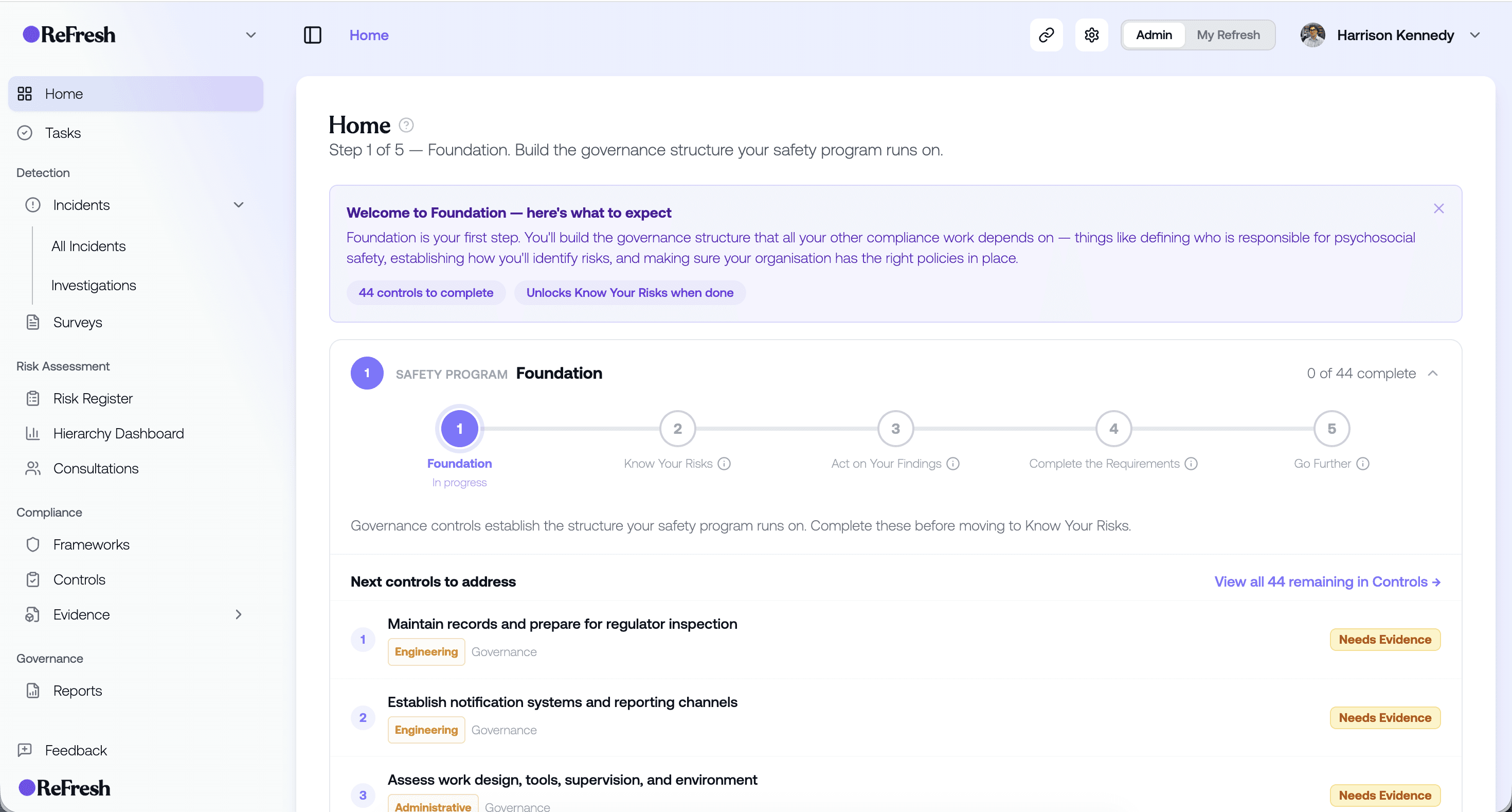
Implement and track controls that address psychosocial hazards in your workplace. ReFresh provides a structured control library, evidence collection workflows, and effectiveness tracking to demonstrate compliance and protect your people.

UNIVERSAL BENEFITS

Designed for every team

UNIVERSAL BENEFITS

Designed for every team

uNIVERSAL BENEFITS

Designed for every team

Evidence Collection

Control Library

Evidence Requirements

Testing & Verification

Effectiveness Reviews

Collect and manage control evidence in one place

Keep all your control evidence organised and accessible. Upload documents, track policy approvals, and record test results against each control requirement. Clear status indicators show what's complete, what's due soon, and what needs attention.

Evidence Collection

Control Library

Evidence Requirements

Testing & Verification

Effectiveness Reviews

Collect and manage control evidence in one place

Keep all your control evidence organised and accessible. Upload documents, track policy approvals, and record test results against each control requirement. Clear status indicators show what's complete, what's due soon, and what needs attention.

Built-in Control

Control psychosocial risk with structured, compliant processes

ReFresh brings psychosocial risk controls into one structured system. Deploy controls from our compliance library, collect evidence against requirements, and track effectiveness without complex spreadsheets or manual tracking.

Everything you need to implement controls, maintain evidence, and meet WHS obligations consistently.

  • No more disconnected documents or scattered evidence.

  • No more unclear control ownership or missing records.

END-TO-END PSYCHOSOCIAL PLATFORM

Connect every signal of psychosocial risk

Move away from disconnected documents, manual registers, and spreadsheet tracking. ReFresh brings control implementation, evidence collection, effectiveness reviews, and compliance tracking into one integrated system, giving organisations a single, defensible view of control status.

What this enables

  • Link controls to the risks they address in one system

  • Maintain a comprehensive record of control evidence and status

  • Identify gaps and overdue evidence across teams and locations

  • Track effectiveness through reviews and survey results

  • Produce clear, audit-ready evidence for boards and regulators

Link existing records as evidence without duplicate data entry

Connect your existing incident reports, consultation records, and survey results as evidence for controls. When a control requires evidence of consultation, link directly to consultation records already in ReFresh. No duplication, complete traceability.

GOT QUESTIONS?

Frequently asked questions

Frequently asked questions

What does "control" actually mean in this context?

A control is any action your organisation takes to eliminate or minimise a psychosocial hazard. Controls follow a hierarchy: * Elimination: remove the hazard entirely (e.g. removing an unsafe process). * Substitution: replace the hazard with something less risky. * Engineering: redesign the work environment or systems. * Administrative: introduce policies, training, or changed procedures (e.g. workload caps, flexible arrangements, conflict resolution training). * Personal support: provide individual-level support such as EAP referrals or coaching. ReFresh helps you document which controls you have implemented for each risk, track whether they are being followed, record the evidence, and schedule reviews to check whether they are working.

How does ReFresh Control work?

ReFresh Control provides a structured control library, hierarchy-based selection, control to risk linkages, rationale documentation, and ownership tracking. This ensures controls are applied consistently and remain reviewable over time.

What does a control look like in practice?

Controls are practical actions, not just policies on paper. Here are examples for common psychosocial hazard categories: * Job demands/workload: implementing workload review processes, redistributing tasks across the team, introducing overtime caps, or redesigning peak period scheduling. * Bullying and harassment: training managers to identify and respond to early warning signs, establishing clear reporting pathways, and conducting regular check-ins with affected teams. * Organisational change: running structured consultation sessions before restructures, providing transition support, and maintaining clear communication timelines. * Remote or isolated work: establishing regular check-in schedules, providing access to peer support, and conducting risk assessments for isolated roles. ReFresh includes a control library with pre-built templates for each hazard category that you can adapt to your organisation's context.

Why is documenting control rationale important?

Regulators and boards expect organisations to demonstrate not only what controls exist, but why they were chosen and how they are maintained. Control rationale documentation ensures decisions are transparent and defensible.

How does ReFresh track control effectiveness?

Controls are linked to specific psychosocial hazards and designated as primary or secondary measures. Over time, organisations can review which control types are most effective for different risk scenarios.

How do we know if our controls are actually working?

ReFresh tracks control effectiveness through multiple signals: * Review schedules: every control has a scheduled review date. When the review comes due, the platform prompts the assigned owner to assess whether the control is still effective. * Survey data trends: if you implement a control for workload and subsequent survey results show improvement in that hazard category, you have evidence the control is working. * Incident data: a reduction in incidents related to a specific hazard after implementing a control supports its effectiveness. * Worker feedback: consultation records capture whether workers feel the controls are making a difference. Regulators want to see that you are not just implementing controls but reviewing whether they work. ReFresh makes that review cycle part of the system rather than something you have to remember to do manually.

GOT QUESTIONS?

Frequently asked questions

What does "control" actually mean in this context?

A control is any action your organisation takes to eliminate or minimise a psychosocial hazard. Controls follow a hierarchy: * Elimination: remove the hazard entirely (e.g. removing an unsafe process). * Substitution: replace the hazard with something less risky. * Engineering: redesign the work environment or systems. * Administrative: introduce policies, training, or changed procedures (e.g. workload caps, flexible arrangements, conflict resolution training). * Personal support: provide individual-level support such as EAP referrals or coaching. ReFresh helps you document which controls you have implemented for each risk, track whether they are being followed, record the evidence, and schedule reviews to check whether they are working.

How does ReFresh Control work?

ReFresh Control provides a structured control library, hierarchy-based selection, control to risk linkages, rationale documentation, and ownership tracking. This ensures controls are applied consistently and remain reviewable over time.

What does a control look like in practice?

Controls are practical actions, not just policies on paper. Here are examples for common psychosocial hazard categories: * Job demands/workload: implementing workload review processes, redistributing tasks across the team, introducing overtime caps, or redesigning peak period scheduling. * Bullying and harassment: training managers to identify and respond to early warning signs, establishing clear reporting pathways, and conducting regular check-ins with affected teams. * Organisational change: running structured consultation sessions before restructures, providing transition support, and maintaining clear communication timelines. * Remote or isolated work: establishing regular check-in schedules, providing access to peer support, and conducting risk assessments for isolated roles. ReFresh includes a control library with pre-built templates for each hazard category that you can adapt to your organisation's context.

Why is documenting control rationale important?

Regulators and boards expect organisations to demonstrate not only what controls exist, but why they were chosen and how they are maintained. Control rationale documentation ensures decisions are transparent and defensible.

How does ReFresh track control effectiveness?

Controls are linked to specific psychosocial hazards and designated as primary or secondary measures. Over time, organisations can review which control types are most effective for different risk scenarios.

How do we know if our controls are actually working?

ReFresh tracks control effectiveness through multiple signals: * Review schedules: every control has a scheduled review date. When the review comes due, the platform prompts the assigned owner to assess whether the control is still effective. * Survey data trends: if you implement a control for workload and subsequent survey results show improvement in that hazard category, you have evidence the control is working. * Incident data: a reduction in incidents related to a specific hazard after implementing a control supports its effectiveness. * Worker feedback: consultation records capture whether workers feel the controls are making a difference. Regulators want to see that you are not just implementing controls but reviewing whether they work. ReFresh makes that review cycle part of the system rather than something you have to remember to do manually.

Don't just measure risk. Prevent it

Bring emotional, psychosocial, and leadership risk into one unified framework.

Don't just measure risk. Prevent it

Bring emotional, psychosocial, and leadership risk into one unified framework.

Don't just measure risk. Prevent it

Bring emotional, psychosocial, and leadership risk into one unified framework.