DETECT
Detect psychosocial risk across your workplace
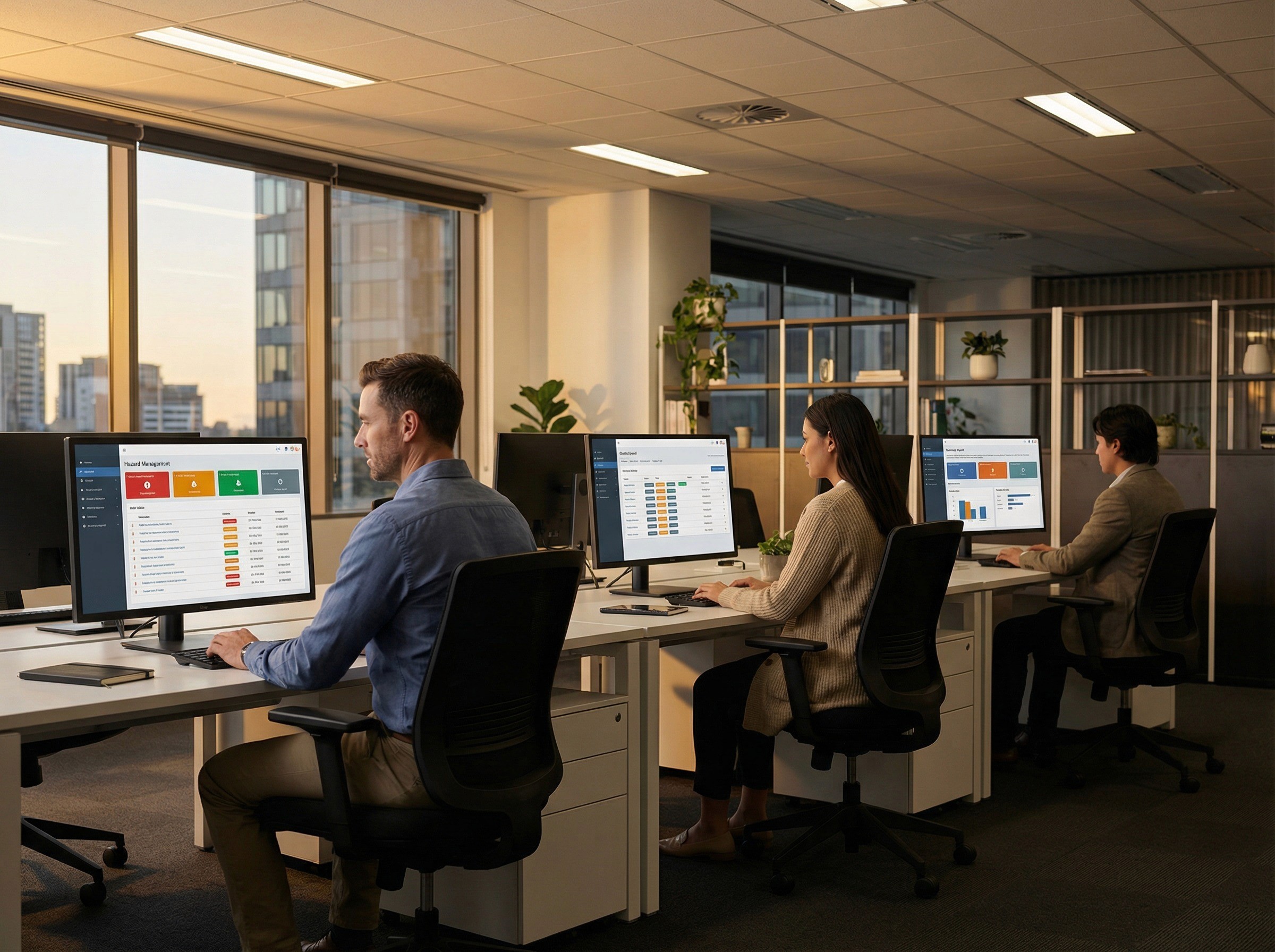
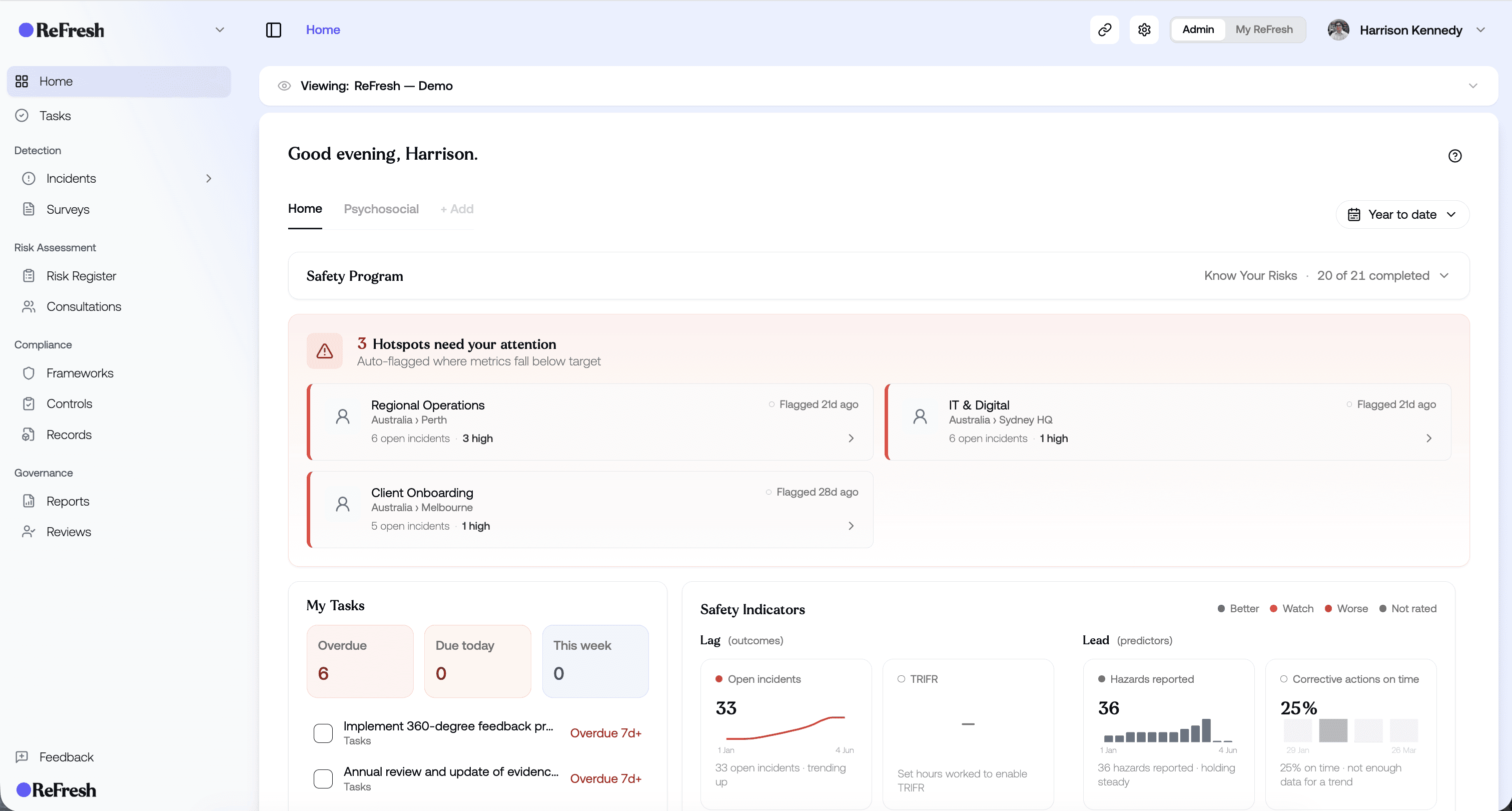
Identify hazards early. ReFresh gives you compliant survey and incident reporting detection tools to surface concerns, capture incidents and monitor risk across the workplace in one place.

UNIVERSAL BENEFITS
Designed for every team
UNIVERSAL BENEFITS
Designed for every team
uNIVERSAL BENEFITS
Designed for every team
Incident Reporting
Confidential Risk Intake
Risk Scanning
Severity & Exposure Assessment
Worker Consultation Records

Identify and document psychosocial incidents with clarity and care
Enable workers to report psychosocial hazards, concerns, or incidents through a secure, confidential reporting process designed for sensitive matters. Capture clear, time-stamped records with assignable workflows to support WHS duties, early intervention, and demonstrate compliance.
Incident Reporting
Confidential Risk Intake
Risk Scanning
Severity & Exposure Assessment
Worker Consultation Records

Identify and document psychosocial incidents with clarity and care
Enable workers to report psychosocial hazards, concerns, or incidents through a secure, confidential reporting process designed for sensitive matters. Capture clear, time-stamped records with assignable workflows to support WHS duties, early intervention, and demonstrate compliance.
BUILT-IN DETECTION
Detect psychosocial risk with structured, compliant processes
ReFresh brings psychosocial risk detection into one structured system. Deploy flexible risk surveys, manage incident reporting, and capture concerns without complex technical configuration. Everything you need to identify risk, maintain oversight, and meet WHS obligations consistently.
No more disconnected surveys or spreadsheets.
No more unclear reporting pathways or missing records.


End-to-End Psychosocial Platform
Connect every signal of psychosocial risk
Move away from disconnected surveys, inbox reports, and manual registers. ReFresh brings psychosocial risk identification, surveys, incident reporting, severity rating, and more into one integrated detection system, giving organisations a single, defensible view of psychosocial risk.
What this enables
Link incident reports, survey results, and early concerns in one system
Maintain a comprehensive record of detected psychosocial hazards
Identify patterns and emerging risks across teams and locations
Surface concerns through appropriate channels while protecting worker confidentiality
Produce clear, audit-ready evidence for boards and regulators
82% of leaders using ReFresh detect risk three months earlier than through engagement surveys.
GOT QUESTIONS?
Frequently asked questions
What does psychosocial risk detection mean?
Psychosocial risk detection is the process of identifying psychosocial hazards, concerns, and early warning signs that may affect workers’ mental health and wellbeing. This includes capturing incidents, confidential concerns, and survey-based risk indicators so organisations can meet WHS obligations and act before harm occurs.
What are the 17 psychosocial hazard categories?
The SafeWork Australia Code of Practice for Managing Psychosocial Hazards at Work identifies the following hazard categories: * Job demands * Low job control * Poor support * Lack of role clarity * Poor organisational change management * Low recognition and reward * Poor organisational justice * Traumatic events or material * Remote or isolated work * Poor physical environment * Violence and aggression * Workplace bullying * Harassment including sexual harassment * Conflict or poor workplace relationships and interactions * Poor environmental conditions * Hazardous manual tasks (psychosocial component) * Fatigue ReFresh incident reporting, surveys, risk assessments, and controls are aligned to all 17 categories, so your compliance coverage is comprehensive from day one.
How does ReFresh detect work?
ReFresh Detect provides structured detection pathways including psychosocial incident reporting, confidential risk intake, and compliance-aligned surveys. These inputs are centrally recorded and linked, giving organisations a clear, auditable view of psychosocial risk across teams, roles, and locations.
How do the psychosocial surveys work? What do they measure?
ReFresh surveys are aligned to all 17 psychosocial hazard categories defined under the SafeWork Australia Code of Practice. They cover areas including: * Job demands and workload * Role clarity and organisational change * Workplace relationships, bullying, and harassment * Remote or isolated work * Support from supervisors and colleagues The questions are designed to both measure psychosocial wellbeing and assess specific hazard exposure, so the data serves a dual purpose: giving you a picture of how your people are doing and generating the structured evidence regulators expect. Surveys can be run at any cadence, and results are broken down by team, location, and risk category.
Does ReFresh use automated or AI-based detection?
No. ReFresh Detect does not automatically monitor or infer psychosocial risk. Detection is based on structured surveys, incident reporting, and confidential intake processes to ensure accuracy, transparency, and regulatory defensibility.
How does incident reporting work? Can employees report anonymously?
Yes. Employees can report psychosocial incidents directly through the platform: * Anonymous or non-anonymous: the reporter chooses at the time of submission. * Optional de-anonymisation: if someone reports anonymously, they are given the option to identify themselves later in the process if they choose to, so the organisation can take more specific action. * Structured data capture: the reporting form captures enough information for the organisation to begin an investigation, even in anonymous cases. * Full workflow: once reported, the incident flows into the investigation and case management workflow with tracking from start to finish.
Is reporting confidential for workers?
Yes. Psychosocial incident reporting and confidential risk intake are designed to protect worker privacy and psychological safety. Access controls and structured workflows ensure sensitive information is handled appropriately while still providing duty holders with necessary visibility.
How does Detect support audits and regulator requests?
All detection activity is time-stamped, structured, and centrally recorded. This creates a clear audit trail that demonstrates how psychosocial risks were identified, reviewed, and escalated in line with WHS obligations.
Can we benchmark our results against other organisations?
ReFresh provides benchmarking data so you can see how your organisation's psychosocial risk profile compares to: * Industry averages across your sector. * Size-matched organisations with a similar employee count. * Your own historical data over time, which is often the most useful benchmark for demonstrating progress to your board and regulators. Benchmarking is useful context, but regulators care most about whether you identified, assessed, and controlled the risks specific to your organisation, regardless of how you compare to others.
GOT QUESTIONS?
Frequently asked questions
What does psychosocial risk detection mean?
Psychosocial risk detection is the process of identifying psychosocial hazards, concerns, and early warning signs that may affect workers’ mental health and wellbeing. This includes capturing incidents, confidential concerns, and survey-based risk indicators so organisations can meet WHS obligations and act before harm occurs.
What are the 17 psychosocial hazard categories?
The SafeWork Australia Code of Practice for Managing Psychosocial Hazards at Work identifies the following hazard categories: * Job demands * Low job control * Poor support * Lack of role clarity * Poor organisational change management * Low recognition and reward * Poor organisational justice * Traumatic events or material * Remote or isolated work * Poor physical environment * Violence and aggression * Workplace bullying * Harassment including sexual harassment * Conflict or poor workplace relationships and interactions * Poor environmental conditions * Hazardous manual tasks (psychosocial component) * Fatigue ReFresh incident reporting, surveys, risk assessments, and controls are aligned to all 17 categories, so your compliance coverage is comprehensive from day one.
How does ReFresh detect work?
ReFresh Detect provides structured detection pathways including psychosocial incident reporting, confidential risk intake, and compliance-aligned surveys. These inputs are centrally recorded and linked, giving organisations a clear, auditable view of psychosocial risk across teams, roles, and locations.
How do the psychosocial surveys work? What do they measure?
ReFresh surveys are aligned to all 17 psychosocial hazard categories defined under the SafeWork Australia Code of Practice. They cover areas including: * Job demands and workload * Role clarity and organisational change * Workplace relationships, bullying, and harassment * Remote or isolated work * Support from supervisors and colleagues The questions are designed to both measure psychosocial wellbeing and assess specific hazard exposure, so the data serves a dual purpose: giving you a picture of how your people are doing and generating the structured evidence regulators expect. Surveys can be run at any cadence, and results are broken down by team, location, and risk category.
Does ReFresh use automated or AI-based detection?
No. ReFresh Detect does not automatically monitor or infer psychosocial risk. Detection is based on structured surveys, incident reporting, and confidential intake processes to ensure accuracy, transparency, and regulatory defensibility.
How does incident reporting work? Can employees report anonymously?
Yes. Employees can report psychosocial incidents directly through the platform: * Anonymous or non-anonymous: the reporter chooses at the time of submission. * Optional de-anonymisation: if someone reports anonymously, they are given the option to identify themselves later in the process if they choose to, so the organisation can take more specific action. * Structured data capture: the reporting form captures enough information for the organisation to begin an investigation, even in anonymous cases. * Full workflow: once reported, the incident flows into the investigation and case management workflow with tracking from start to finish.
Is reporting confidential for workers?
Yes. Psychosocial incident reporting and confidential risk intake are designed to protect worker privacy and psychological safety. Access controls and structured workflows ensure sensitive information is handled appropriately while still providing duty holders with necessary visibility.
How does Detect support audits and regulator requests?
All detection activity is time-stamped, structured, and centrally recorded. This creates a clear audit trail that demonstrates how psychosocial risks were identified, reviewed, and escalated in line with WHS obligations.
Can we benchmark our results against other organisations?
ReFresh provides benchmarking data so you can see how your organisation's psychosocial risk profile compares to: * Industry averages across your sector. * Size-matched organisations with a similar employee count. * Your own historical data over time, which is often the most useful benchmark for demonstrating progress to your board and regulators. Benchmarking is useful context, but regulators care most about whether you identified, assessed, and controlled the risks specific to your organisation, regardless of how you compare to others.
Explore our full platform
Helping businesses build safer workplaces
Manage psychosocial risk end to end, from detection and assessment through to controls, oversight, and governance.


Helping businesses build safer workplaces
Manage psychosocial risk end to end, from detection and assessment through to controls, oversight, and governance.


Helping businesses build safer workplaces
Manage psychosocial risk end to end, from detection and assessment through to controls, oversight, and governance.