Risk Intelligence

Stay informed about emerging and escalating psychosocial risks

Stay informed about emerging and escalating psychosocial risks

Stay informed about emerging and escalating psychosocial risks

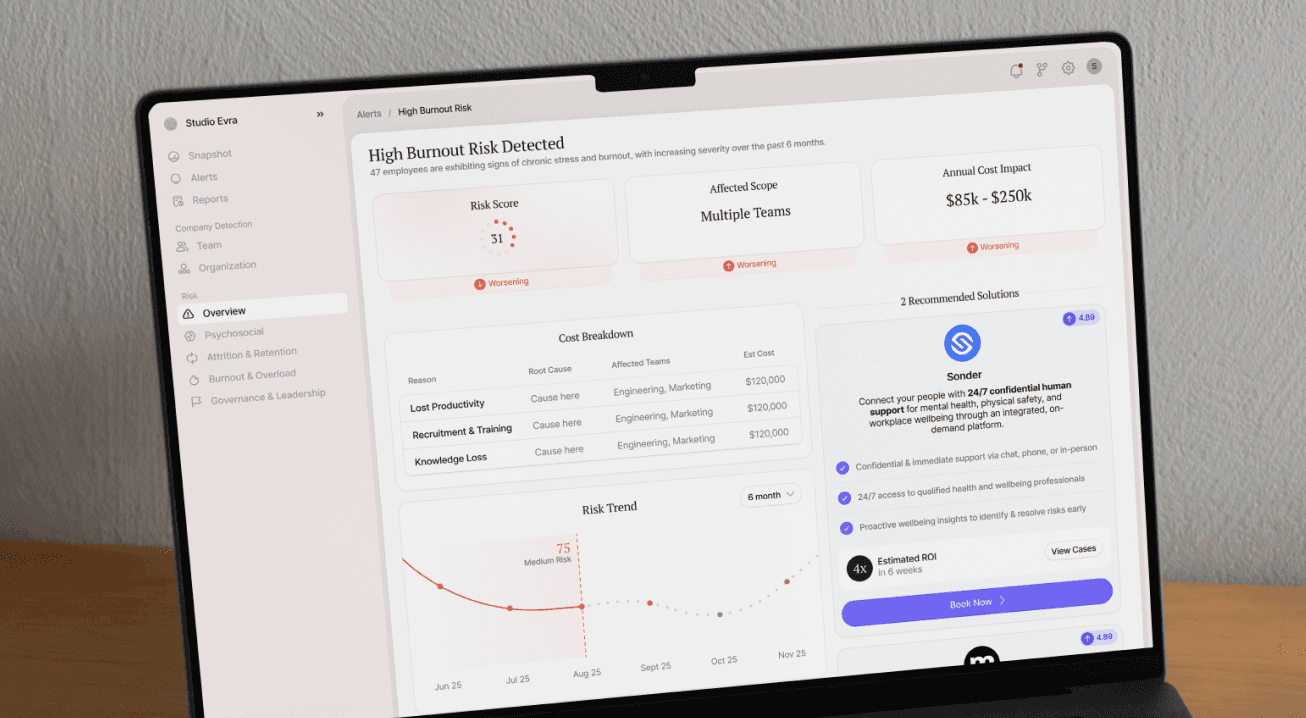
ReFresh's risk intelligence capabilities help you spot patterns, identify trends, and respond proactively to psychosocial hazards before they escalate. With risk score monitoring, emerging risk flagging, and configurable alerts, leadership stays informed about critical risks while maintaining appropriate confidentiality.


Visibility

Track psychosocial risk levels across your organisation

ReFresh aggregates data from incident reports, risk submissions, and surveys to provide ongoing visibility into psychosocial risk levels. Risk scores are calculated across each of the 17 hazard categories and can be viewed at organisation, department, team, or location levels.

Monitor how risk scores change over time to identify trends. See which areas of your organisation have elevated risks requiring attention. Compare risk profiles across different teams to understand where to focus resources and interventions.

Early warning

Identify new psychosocial risks before they escalate

ReFresh helps you identify emerging psychosocial risks by tracking reporting patterns across hazard categories. When you see multiple reports about similar issues, new types of incidents appearing, or gradual increases in certain hazard categories, you can flag these as emerging risks for closer monitoring.

This visibility allows you to investigate and address risks proactively rather than waiting for a serious incident. Review frequency and recency of reports to distinguish between isolated incidents and developing patterns.

Pattern detection

Frequency analysis

Proactive flagging

Category-based alerts

Pattern detection

Frequency analysis

Proactive flagging

Category-based alerts

Pattern detection

Frequency analysis

Proactive flagging

Category-based alerts

Notifications

Ensure the right people know about critical risks

Configure ReFresh to notify designated personnel about high-severity incidents and risk concerns. Set up notification preferences based on hazard category, location, or severity level to ensure the right people are informed when risks need attention.

All alerts respect the confidentiality settings of the underlying reports. Identity-protected submissions never expose reporter identity while still triggering appropriate notifications. Alert recipients receive enough information to understand the risk and take action without knowing who submitted the report.

Insights

Understand how psychosocial risks change over time

ReFresh's trend analysis tools show how psychosocial risks evolve across weeks, months, and years. Identify seasonal patterns, understand the impact of organisational changes, and measure how interventions affect risk levels. Trend data can be filtered by hazard category, location, department, or other attributes.

Trend analysis helps you demonstrate continuous improvement to regulators and stakeholders. Show how risk scores have decreased following targeted interventions. Identify which hazard categories persistently need attention. Build evidence-based arguments for resource allocation to psychosocial risk programs.


Evidence Ready

Generate reports that demonstrate active risk management

ReFresh provides comprehensive reporting capabilities that show regulators, leadership, and other stakeholders how your organisation is managing psychosocial risks. Export risk intelligence data for WHS reports, board presentations, or compliance audits.

Reports can be configured to show aggregate risk scores, trend data, incident volumes, survey results, and response actions - all the evidence needed to demonstrate that you're meeting your WHS obligations for psychosocial risk management.

Confidentiality

Gain insights while protecting reporter identity

ReFresh's risk intelligence capabilities are designed to provide actionable insights without compromising the confidentiality that makes employees willing to report. Aggregate data, minimum threshold reporting, and careful de-identification ensure leadership gets the information they need without exposing individual reporters to your organisation.

This balance is critical for maintaining trust in your psychosocial risk management system. Employees need to know their reports contribute to organisational awareness without their employer being able to identify who submitted them.

Aggregate reporting

Minimum thresholds enforced

De-identified patterns

Confidentiality-first design

Aggregate reporting

Minimum thresholds enforced

De-identified patterns

Confidentiality-first design

Aggregate reporting

Minimum thresholds enforced

De-identified patterns

Confidentiality-first design

Turn psychosocial risk data into proactive action

ReFresh's risk intelligence capabilities transform scattered incident reports, survey responses, and risk submissions into clear insights about your organisation's psychosocial health. With monitoring, flagging, alerts, and trend analysis, you'll identify and address risks before they escalate while maintaining the confidentiality that encourages honest reporting.

Early warning system

Trend analysis

Privacy-preserving

Proactive insights

Early warning system

Trend analysis

Privacy-preserving

Proactive insights

Early warning system

Trend analysis

Privacy-preserving

Proactive insights

GOT QUESTIONS?

Frequently asked questions

Frequently asked questions

What does psychosocial risk detection mean?

Psychosocial risk detection is the process of identifying psychosocial hazards, concerns, and early warning signs that may affect workers’ mental health and wellbeing. This includes capturing incidents, confidential concerns, and survey-based risk indicators so organisations can meet WHS obligations and act before harm occurs.

What does psychosocial risk detection mean?

Psychosocial risk detection is the process of identifying psychosocial hazards, concerns, and early warning signs that may affect workers’ mental health and wellbeing. This includes capturing incidents, confidential concerns, and survey-based risk indicators so organisations can meet WHS obligations and act before harm occurs.

How does ReFresh detect work?

ReFresh Detect provides structured detection pathways including psychosocial incident reporting, confidential risk intake, and compliance-aligned surveys. These inputs are centrally recorded and linked, giving organisations a clear, auditable view of psychosocial risk across teams, roles, and locations.

How does ReFresh detect work?

ReFresh Detect provides structured detection pathways including psychosocial incident reporting, confidential risk intake, and compliance-aligned surveys. These inputs are centrally recorded and linked, giving organisations a clear, auditable view of psychosocial risk across teams, roles, and locations.

What is the objective of the Detect module?

The objective of Detect is to help organisations identify psychosocial risk early, maintain visibility over foreseeable hazards, and create documented evidence aligned with WHS duties. Detect ensures risks are identified consistently and are ready to be assessed, controlled, and managed.

What is the objective of the Detect module?

The objective of Detect is to help organisations identify psychosocial risk early, maintain visibility over foreseeable hazards, and create documented evidence aligned with WHS duties. Detect ensures risks are identified consistently and are ready to be assessed, controlled, and managed.

What problem does psychosocial risk detection solve?

Many organisations rely on fragmented surveys, inbox reports, or informal disclosures that create blind spots and compliance risk. ReFresh Detect replaces these with a structured system that captures, documents, and links psychosocial risk data in one place.

What problem does psychosocial risk detection solve?

Many organisations rely on fragmented surveys, inbox reports, or informal disclosures that create blind spots and compliance risk. ReFresh Detect replaces these with a structured system that captures, documents, and links psychosocial risk data in one place.

Is ReFresh Detect compliant with WHS requirements?

Yes. ReFresh Detect is designed to align with ISO 45003, Safe Work Australia guidance, Comcare expectations, and state-based WHS psychosocial regulations. Detection activity is documented to support audits, regulator enquiries, and board oversight.

Is ReFresh Detect compliant with WHS requirements?

Yes. ReFresh Detect is designed to align with ISO 45003, Safe Work Australia guidance, Comcare expectations, and state-based WHS psychosocial regulations. Detection activity is documented to support audits, regulator enquiries, and board oversight.

Is reporting confidential for workers?

Yes. Psychosocial incident reporting and confidential risk intake are designed to protect worker privacy and psychological safety. Access controls and structured workflows ensure sensitive information is handled appropriately while still providing duty holders with necessary visibility.

Is reporting confidential for workers?

Yes. Psychosocial incident reporting and confidential risk intake are designed to protect worker privacy and psychological safety. Access controls and structured workflows ensure sensitive information is handled appropriately while still providing duty holders with necessary visibility.

Can we use only the Detect module?

Yes. ReFresh Detect can be used as a standalone module or as part of the broader Detect, Assess, Control, Manage workflow. Many organisations start with Detect and expand as their psychosocial risk management maturity grows.

Can we use only the Detect module?

Yes. ReFresh Detect can be used as a standalone module or as part of the broader Detect, Assess, Control, Manage workflow. Many organisations start with Detect and expand as their psychosocial risk management maturity grows.

Does ReFresh use automated or AI-based detection?

No. ReFresh Detect does not automatically monitor or infer psychosocial risk. Detection is based on structured surveys, incident reporting, and confidential intake processes to ensure accuracy, transparency, and regulatory defensibility.

Does ReFresh use automated or AI-based detection?

No. ReFresh Detect does not automatically monitor or infer psychosocial risk. Detection is based on structured surveys, incident reporting, and confidential intake processes to ensure accuracy, transparency, and regulatory defensibility.

How does Detect support audits and regulator requests?

All detection activity is time-stamped, structured, and centrally recorded. This creates a clear audit trail that demonstrates how psychosocial risks were identified, reviewed, and escalated in line with WHS obligations.

How does Detect support audits and regulator requests?

All detection activity is time-stamped, structured, and centrally recorded. This creates a clear audit trail that demonstrates how psychosocial risks were identified, reviewed, and escalated in line with WHS obligations.

GOT QUESTIONS?

Frequently asked questions

What does psychosocial risk detection mean?

Psychosocial risk detection is the process of identifying psychosocial hazards, concerns, and early warning signs that may affect workers’ mental health and wellbeing. This includes capturing incidents, confidential concerns, and survey-based risk indicators so organisations can meet WHS obligations and act before harm occurs.

How does ReFresh detect work?

ReFresh Detect provides structured detection pathways including psychosocial incident reporting, confidential risk intake, and compliance-aligned surveys. These inputs are centrally recorded and linked, giving organisations a clear, auditable view of psychosocial risk across teams, roles, and locations.

What is the objective of the Detect module?

The objective of Detect is to help organisations identify psychosocial risk early, maintain visibility over foreseeable hazards, and create documented evidence aligned with WHS duties. Detect ensures risks are identified consistently and are ready to be assessed, controlled, and managed.

What problem does psychosocial risk detection solve?

Many organisations rely on fragmented surveys, inbox reports, or informal disclosures that create blind spots and compliance risk. ReFresh Detect replaces these with a structured system that captures, documents, and links psychosocial risk data in one place.

Is ReFresh Detect compliant with WHS requirements?

Yes. ReFresh Detect is designed to align with ISO 45003, Safe Work Australia guidance, Comcare expectations, and state-based WHS psychosocial regulations. Detection activity is documented to support audits, regulator enquiries, and board oversight.

Is reporting confidential for workers?

Yes. Psychosocial incident reporting and confidential risk intake are designed to protect worker privacy and psychological safety. Access controls and structured workflows ensure sensitive information is handled appropriately while still providing duty holders with necessary visibility.

Can we use only the Detect module?

Yes. ReFresh Detect can be used as a standalone module or as part of the broader Detect, Assess, Control, Manage workflow. Many organisations start with Detect and expand as their psychosocial risk management maturity grows.

Does ReFresh use automated or AI-based detection?

No. ReFresh Detect does not automatically monitor or infer psychosocial risk. Detection is based on structured surveys, incident reporting, and confidential intake processes to ensure accuracy, transparency, and regulatory defensibility.

How does Detect support audits and regulator requests?

All detection activity is time-stamped, structured, and centrally recorded. This creates a clear audit trail that demonstrates how psychosocial risks were identified, reviewed, and escalated in line with WHS obligations.

Don't just measure risk. Prevent it

Bring emotional, psychosocial, and leadership risk into one unified framework.

Don't just measure risk. Prevent it

Bring emotional, psychosocial, and leadership risk into one unified framework.

Don't just measure risk. Prevent it

Bring emotional, psychosocial, and leadership risk into one unified framework.