Compliance Framework

Align your program with multiple compliance frameworks

Align your program with multiple compliance frameworks

Align your program with multiple compliance frameworks

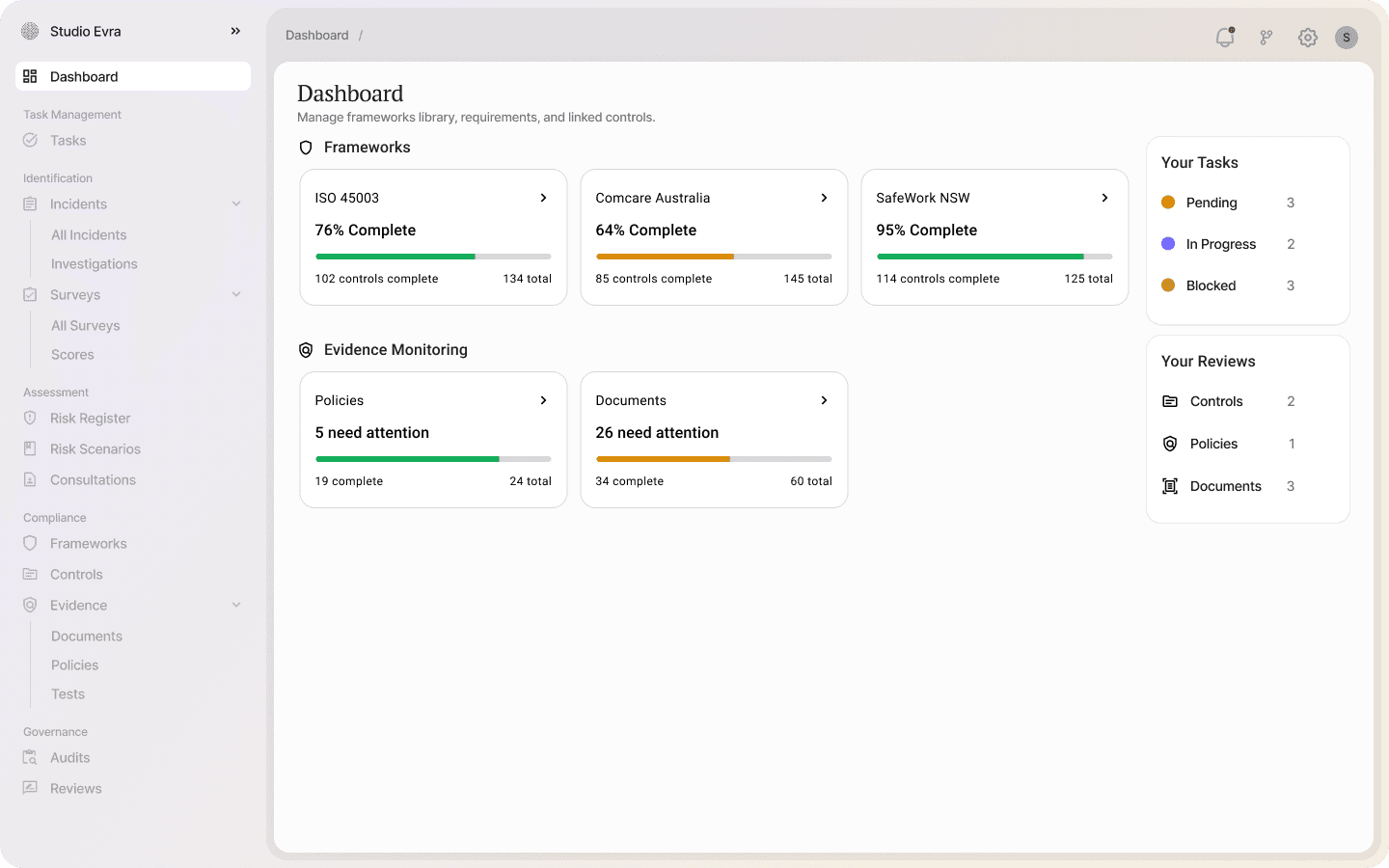
Navigate the complexity of psychosocial safety compliance with Refresh's framework mapping. We help you demonstrate alignment with ISO 45003, SafeWork Australia Code of Practice, and state-based WHS regulations through structured documentation and gap analysis.


Standards Alignment

Map your activities to compliance requirements

Refresh structures your psychosocial risk management activities around established frameworks. Each risk assessment, control implementation, and review cycle links to specific requirements in ISO 45003, SafeWork Australia guidance, and WHS regulations. This mapping shows you exactly where you meet expectations and where gaps remain.

ISO 45003 mapping

SafeWork alignment

WHS regulation tracking

Multi-framework visibility

ISO 45003 mapping

SafeWork alignment

WHS regulation tracking

Multi-framework visibility

ISO 45003 mapping

SafeWork alignment

WHS regulation tracking

Multi-framework visibility

International Standard

Structure your program around ISO 45003 guidelines

ISO 45003 provides internationally recognized guidance for managing psychosocial risks and promoting well-being at work. Refresh organizes your program around key ISO 45003 elements including hazard identification, risk assessment, control implementation, monitoring and evaluation, and incident investigation. Your activities automatically map to relevant clauses.

Risk planning

Worker consultation

Control implementation

Incident investigation

Risk planning

Worker consultation

Control implementation

Incident investigation

Risk planning

Worker consultation

Control implementation

Incident investigation

Australian guidance

Follow SafeWork Australia Code of Practice

The SafeWork Australia Code of Practice for managing psychosocial hazards provides practical guidance for Australian workplaces. Refresh supports each step of the Code's recommended approach: identifying psychosocial hazards, assessing risks, implementing controls, reviewing effectiveness, and consulting with workers throughout the process.

Regulatory requirements

Meet WHS obligations across Australian jurisdictions

Australian WHS regulations require employers to identify psychosocial hazards and manage associated risks so far as is reasonably practicable. Refresh helps you meet these obligations through systematic hazard identification, documented risk assessments, hierarchy-based control selection, and regular review processes. Our platform accommodates state and territory variations in WHS legislation.


Compliance Tracking

Identify and address compliance gaps

Refresh shows you which framework requirements are fully met, partially addressed, or still require action. For each gap, you can create tasks, assign owners, and track progress toward compliance. This ongoing gap analysis helps you prioritize effort and demonstrate continuous improvement to auditors and regulators.

Australian Coverage

Navigate state and territory variations

WHS legislation varies across Australian states and territories. Refresh accommodates these jurisdictional differences while maintaining a consistent approach to psychosocial risk management. Configure your program to reflect local requirements in NSW, Victoria, Queensland, Western Australia, South Australia, Tasmania, ACT, or Northern Territory.


Demonstrate compliance with confidence

Managing psychosocial risks means meeting multiple compliance obligations simultaneously. Refresh helps you navigate this complexity through framework mapping, gap analysis, and structured documentation that shows you meet your obligations under Australian law and international standards.


GOT QUESTIONS?

Frequently asked questions

Frequently asked questions

What does psychosocial risk detection mean?

Psychosocial risk detection is the process of identifying psychosocial hazards, concerns, and early warning signs that may affect workers’ mental health and wellbeing. This includes capturing incidents, confidential concerns, and survey-based risk indicators so organisations can meet WHS obligations and act before harm occurs.

What does psychosocial risk detection mean?

Psychosocial risk detection is the process of identifying psychosocial hazards, concerns, and early warning signs that may affect workers’ mental health and wellbeing. This includes capturing incidents, confidential concerns, and survey-based risk indicators so organisations can meet WHS obligations and act before harm occurs.

How does ReFresh detect work?

ReFresh Detect provides structured detection pathways including psychosocial incident reporting, confidential risk intake, and compliance-aligned surveys. These inputs are centrally recorded and linked, giving organisations a clear, auditable view of psychosocial risk across teams, roles, and locations.

How does ReFresh detect work?

ReFresh Detect provides structured detection pathways including psychosocial incident reporting, confidential risk intake, and compliance-aligned surveys. These inputs are centrally recorded and linked, giving organisations a clear, auditable view of psychosocial risk across teams, roles, and locations.

What is the objective of the Detect module?

The objective of Detect is to help organisations identify psychosocial risk early, maintain visibility over foreseeable hazards, and create documented evidence aligned with WHS duties. Detect ensures risks are identified consistently and are ready to be assessed, controlled, and managed.

What is the objective of the Detect module?

The objective of Detect is to help organisations identify psychosocial risk early, maintain visibility over foreseeable hazards, and create documented evidence aligned with WHS duties. Detect ensures risks are identified consistently and are ready to be assessed, controlled, and managed.

What problem does psychosocial risk detection solve?

Many organisations rely on fragmented surveys, inbox reports, or informal disclosures that create blind spots and compliance risk. ReFresh Detect replaces these with a structured system that captures, documents, and links psychosocial risk data in one place.

What problem does psychosocial risk detection solve?

Many organisations rely on fragmented surveys, inbox reports, or informal disclosures that create blind spots and compliance risk. ReFresh Detect replaces these with a structured system that captures, documents, and links psychosocial risk data in one place.

Is ReFresh Detect compliant with WHS requirements?

Yes. ReFresh Detect is designed to align with ISO 45003, Safe Work Australia guidance, Comcare expectations, and state-based WHS psychosocial regulations. Detection activity is documented to support audits, regulator enquiries, and board oversight.

Is ReFresh Detect compliant with WHS requirements?

Yes. ReFresh Detect is designed to align with ISO 45003, Safe Work Australia guidance, Comcare expectations, and state-based WHS psychosocial regulations. Detection activity is documented to support audits, regulator enquiries, and board oversight.

Is reporting confidential for workers?

Yes. Psychosocial incident reporting and confidential risk intake are designed to protect worker privacy and psychological safety. Access controls and structured workflows ensure sensitive information is handled appropriately while still providing duty holders with necessary visibility.

Is reporting confidential for workers?

Yes. Psychosocial incident reporting and confidential risk intake are designed to protect worker privacy and psychological safety. Access controls and structured workflows ensure sensitive information is handled appropriately while still providing duty holders with necessary visibility.

Can we use only the Detect module?

Yes. ReFresh Detect can be used as a standalone module or as part of the broader Detect, Assess, Control, Manage workflow. Many organisations start with Detect and expand as their psychosocial risk management maturity grows.

Can we use only the Detect module?

Yes. ReFresh Detect can be used as a standalone module or as part of the broader Detect, Assess, Control, Manage workflow. Many organisations start with Detect and expand as their psychosocial risk management maturity grows.

Does ReFresh use automated or AI-based detection?

No. ReFresh Detect does not automatically monitor or infer psychosocial risk. Detection is based on structured surveys, incident reporting, and confidential intake processes to ensure accuracy, transparency, and regulatory defensibility.

Does ReFresh use automated or AI-based detection?

No. ReFresh Detect does not automatically monitor or infer psychosocial risk. Detection is based on structured surveys, incident reporting, and confidential intake processes to ensure accuracy, transparency, and regulatory defensibility.

How does Detect support audits and regulator requests?

All detection activity is time-stamped, structured, and centrally recorded. This creates a clear audit trail that demonstrates how psychosocial risks were identified, reviewed, and escalated in line with WHS obligations.

How does Detect support audits and regulator requests?

All detection activity is time-stamped, structured, and centrally recorded. This creates a clear audit trail that demonstrates how psychosocial risks were identified, reviewed, and escalated in line with WHS obligations.

GOT QUESTIONS?

Frequently asked questions

What does psychosocial risk detection mean?

Psychosocial risk detection is the process of identifying psychosocial hazards, concerns, and early warning signs that may affect workers’ mental health and wellbeing. This includes capturing incidents, confidential concerns, and survey-based risk indicators so organisations can meet WHS obligations and act before harm occurs.

How does ReFresh detect work?

ReFresh Detect provides structured detection pathways including psychosocial incident reporting, confidential risk intake, and compliance-aligned surveys. These inputs are centrally recorded and linked, giving organisations a clear, auditable view of psychosocial risk across teams, roles, and locations.

What is the objective of the Detect module?

The objective of Detect is to help organisations identify psychosocial risk early, maintain visibility over foreseeable hazards, and create documented evidence aligned with WHS duties. Detect ensures risks are identified consistently and are ready to be assessed, controlled, and managed.

What problem does psychosocial risk detection solve?

Many organisations rely on fragmented surveys, inbox reports, or informal disclosures that create blind spots and compliance risk. ReFresh Detect replaces these with a structured system that captures, documents, and links psychosocial risk data in one place.

Is ReFresh Detect compliant with WHS requirements?

Yes. ReFresh Detect is designed to align with ISO 45003, Safe Work Australia guidance, Comcare expectations, and state-based WHS psychosocial regulations. Detection activity is documented to support audits, regulator enquiries, and board oversight.

Is reporting confidential for workers?

Yes. Psychosocial incident reporting and confidential risk intake are designed to protect worker privacy and psychological safety. Access controls and structured workflows ensure sensitive information is handled appropriately while still providing duty holders with necessary visibility.

Can we use only the Detect module?

Yes. ReFresh Detect can be used as a standalone module or as part of the broader Detect, Assess, Control, Manage workflow. Many organisations start with Detect and expand as their psychosocial risk management maturity grows.

Does ReFresh use automated or AI-based detection?

No. ReFresh Detect does not automatically monitor or infer psychosocial risk. Detection is based on structured surveys, incident reporting, and confidential intake processes to ensure accuracy, transparency, and regulatory defensibility.

How does Detect support audits and regulator requests?

All detection activity is time-stamped, structured, and centrally recorded. This creates a clear audit trail that demonstrates how psychosocial risks were identified, reviewed, and escalated in line with WHS obligations.

Don't just measure risk. Prevent it

Bring emotional, psychosocial, and leadership risk into one unified framework.

Don't just measure risk. Prevent it

Bring emotional, psychosocial, and leadership risk into one unified framework.

Don't just measure risk. Prevent it

Bring emotional, psychosocial, and leadership risk into one unified framework.