controls

Turn every risk into an owned, evidenced control

A risk you have named but not controlled is still an open exposure. Controls connect each risk to the documents, policies and actions that manage it, with an owner, a status and a place in the hierarchy of control.

woman working comfortably on a laptop in a warm office setting

controls

Turn every risk into an owned, evidenced control

A risk you have named but not controlled is still an open exposure. Controls connect each risk to the documents, policies and actions that manage it, with an owner, a status and a place in the hierarchy of control.

woman working comfortably on a laptop in a warm office setting

controls

Turn every risk into an owned, evidenced control

A risk you have named but not controlled is still an open exposure. Controls connect each risk to the documents, policies and actions that manage it, with an owner, a status and a place in the hierarchy of control.

woman working comfortably on a laptop in a warm office setting
A team of three — a WHS coordinator, a HR business partner, and an operations manager — sitting around a round table in a bright, informal meeting space within a manufacturing company's office area. A laptop at the centre of the table faces mostly toward the WHS coordinator, who is scrolling through a register-style interface with rows, coloured status tags, and date columns — visible as structured elements but not legible.

RISK-TO-CONTROL MAPPING

Connect every risk to the control that manages it

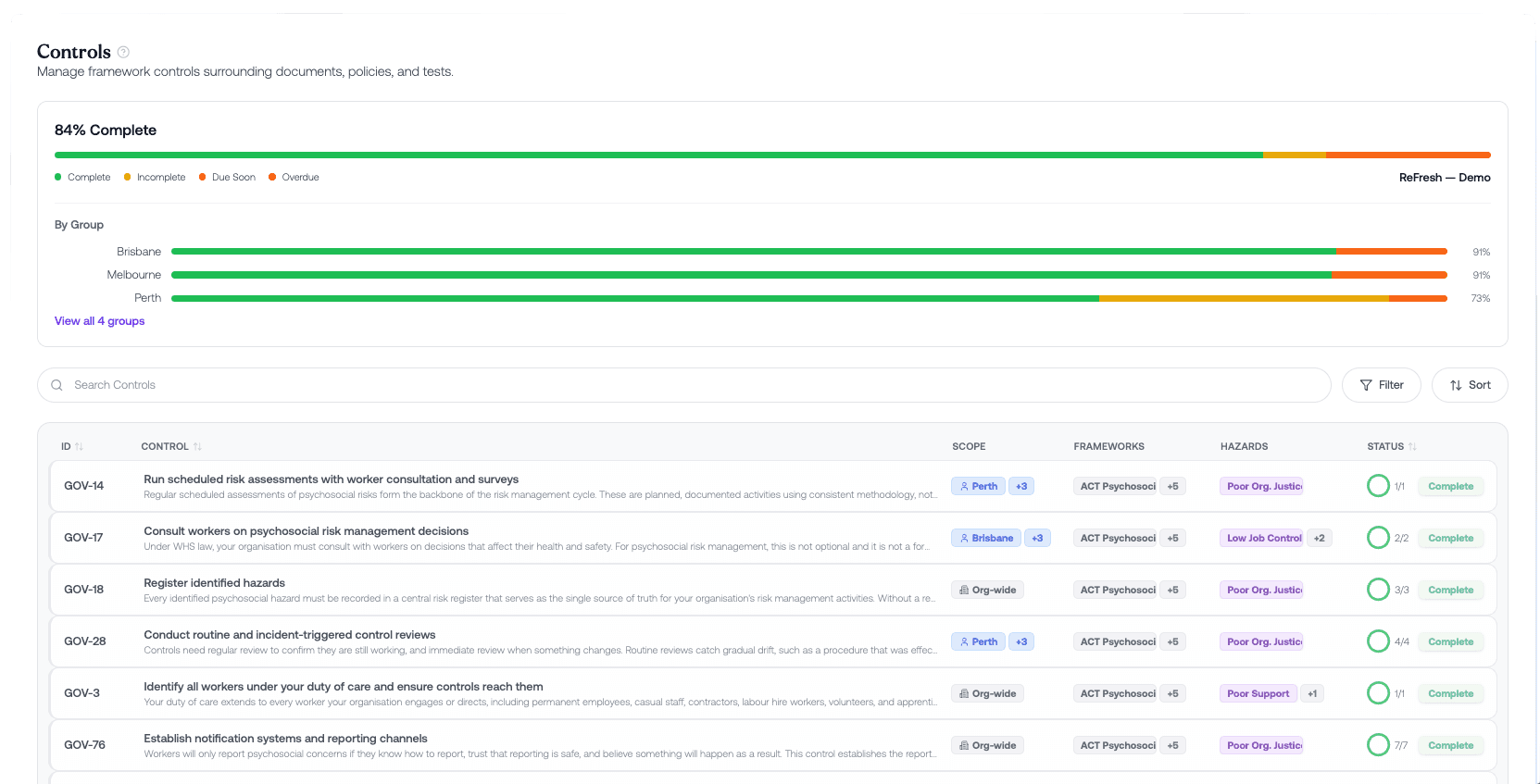
Each control maps to the hazards it addresses, with an owner and a status, so a named risk always has a named response rather than sitting open on the register.

HIERARCHY OF CONTROL

Move beyond training as your only control

Controls are ordered by the hierarchy of control, elimination and substitution before administrative measures before personal support, so reliance on weaker measures is visible and stronger, more proactive controls get the priority.

A safety officer in her early 30s standing in a well-lit corridor of a large aged care facility, using her phone to photograph a printed sign on a notice board — a workplace safety notice, a consultation schedule, or a policy update. She is holding the phone at a natural angle, one hand steadying the notice flat, her expression casual and task-oriented — this is a ten-second job, not a documentation project. Her lanyard and ID badge are visible. Behind her, an aged care worker in scrubs is walking past carrying linens, and the corridor has warm lighting and handrails.
A HR operations coordinator in her late 20s sitting at a tidy desk in a shared office within a mid-sized professional services firm, working on a monitor that shows a clean, table-style register with rows of document entries, each with a coloured expiry status indicator — greens, a couple of ambers, no reds — visible in structure but not legible. She is mid-task but unhurried, one hand on the mouse, scrolling casually through the register the way someone checks a system that is largely in order. With her other hand she is reaching for a glass of water.

LINKED ACROSS THE PLATFORM

Link a control to frameworks, risks, incidents and records

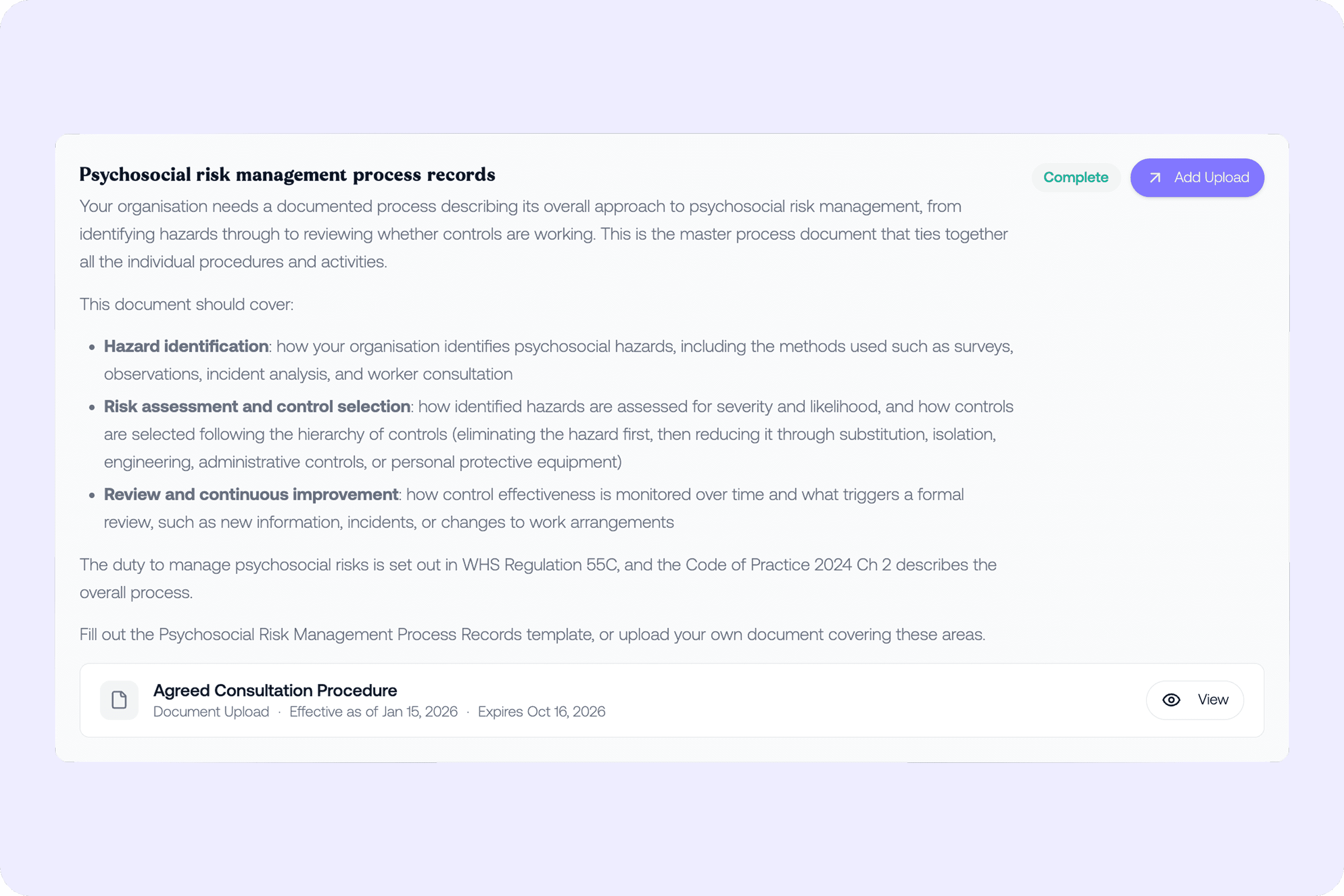
A single control connects to the frameworks it satisfies, the risks it treats, the incidents that triggered it and the records that evidence it, so it sits at the centre of everything it touches rather than in isolation.

GOT QUESTIONS?

Frequently asked questions

Frequently asked questions

What is a control in ReFresh?

A control is the measure you put in place to manage a psychosocial hazard, such as a right to disconnect policy for always-on expectations or a fatigue management policy for high job demands. ReFresh recommends controls based on the legislation and lets you link them to the specific risks and hazards they address.

How do controls connect to risks and incidents?

Controls are linked across the platform. A control sits against:

  1. The hazard it manages

  2. The risk register entries it relates to

  3. Any tasks created to implement it

This means you can trace any control back to the risk it exists for and forward to the actions taken.

How do controls map to the hierarchy of controls?

ReFresh positions your controls against the hierarchy of controls and shows which hazard categories are on target and which sit below target. This matters for psychosocial risk, where lower-order measures such as training are far less effective than changing how work is designed.

Can I assign responsibility for a control?

Responsibility for a control is assigned through groups and reviews. You can assign the group accountable for completing a control and assign a user as its reviewer. ReFresh does not currently set a single named owner on an individual control, so accountability sits with the responsible group rather than one person.

How do I know a control is still working?

Control effectiveness is rated and reviewed over time through the Reviews module, so a control is not assumed to work indefinitely once it is in place.

GOT QUESTIONS?

Frequently asked questions

What is a control in ReFresh?

A control is the measure you put in place to manage a psychosocial hazard, such as a right to disconnect policy for always-on expectations or a fatigue management policy for high job demands. ReFresh recommends controls based on the legislation and lets you link them to the specific risks and hazards they address.

How do controls connect to risks and incidents?

Controls are linked across the platform. A control sits against:

  1. The hazard it manages

  2. The risk register entries it relates to

  3. Any tasks created to implement it

This means you can trace any control back to the risk it exists for and forward to the actions taken.

How do controls map to the hierarchy of controls?

ReFresh positions your controls against the hierarchy of controls and shows which hazard categories are on target and which sit below target. This matters for psychosocial risk, where lower-order measures such as training are far less effective than changing how work is designed.

Can I assign responsibility for a control?

Responsibility for a control is assigned through groups and reviews. You can assign the group accountable for completing a control and assign a user as its reviewer. ReFresh does not currently set a single named owner on an individual control, so accountability sits with the responsible group rather than one person.

How do I know a control is still working?

Control effectiveness is rated and reviewed over time through the Reviews module, so a control is not assumed to work indefinitely once it is in place.

Don't just measure risk. Prevent it

Bring emotional, psychosocial, and leadership risk into one unified framework.

Don't just measure risk. Prevent it

Bring emotional, psychosocial, and leadership risk into one unified framework.

Don't just measure risk. Prevent it

Bring emotional, psychosocial, and leadership risk into one unified framework.