EXECUTIVE LEADERSHIP
Your officers' duty is personal. The evidence should be systematic.
Under Australian WHS law, officers carry personal, non-delegable duties to exercise due diligence in relation to psychosocial hazards. That duty requires more than good intentions or retrospective reports from the team. It requires evidence that the organisation is identifying, assessing, and controlling psychosocial hazards continuously, and that you, as an officer, can demonstrate you have taken reasonable steps to ensure that is happening. ReFresh is the psychosocial operating system that produces that evidence.
EXECUTIVE LEADERSHIP
Your officers' duty is personal. The evidence should be systematic.
Under Australian WHS law, officers carry personal, non-delegable duties to exercise due diligence in relation to psychosocial hazards. That duty requires more than good intentions or retrospective reports from the team. It requires evidence that the organisation is identifying, assessing, and controlling psychosocial hazards continuously, and that you, as an officer, can demonstrate you have taken reasonable steps to ensure that is happening. ReFresh is the psychosocial operating system that produces that evidence.
trusted by leading ASX & Global enterprises













trusted by leading ASX & Global enterprises
FEATURES
Know your psychosocial risk exposure across the organisation, continuously
Most executives receive psychosocial risk information episodically: an annual survey, a quarterly update, or an escalation after something has already gone wrong. The regulation requires continuous management, not periodic snapshots.
ReFresh provides structured, real-time visibility into psychosocial risk across teams, locations, and hazard categories, so executive leadership can see the organisation's risk exposure and the status of controls without waiting for a report to be assembled.
Organisation-wide risk view
Continuous monitoring
Team and location breakdown
Status of controls
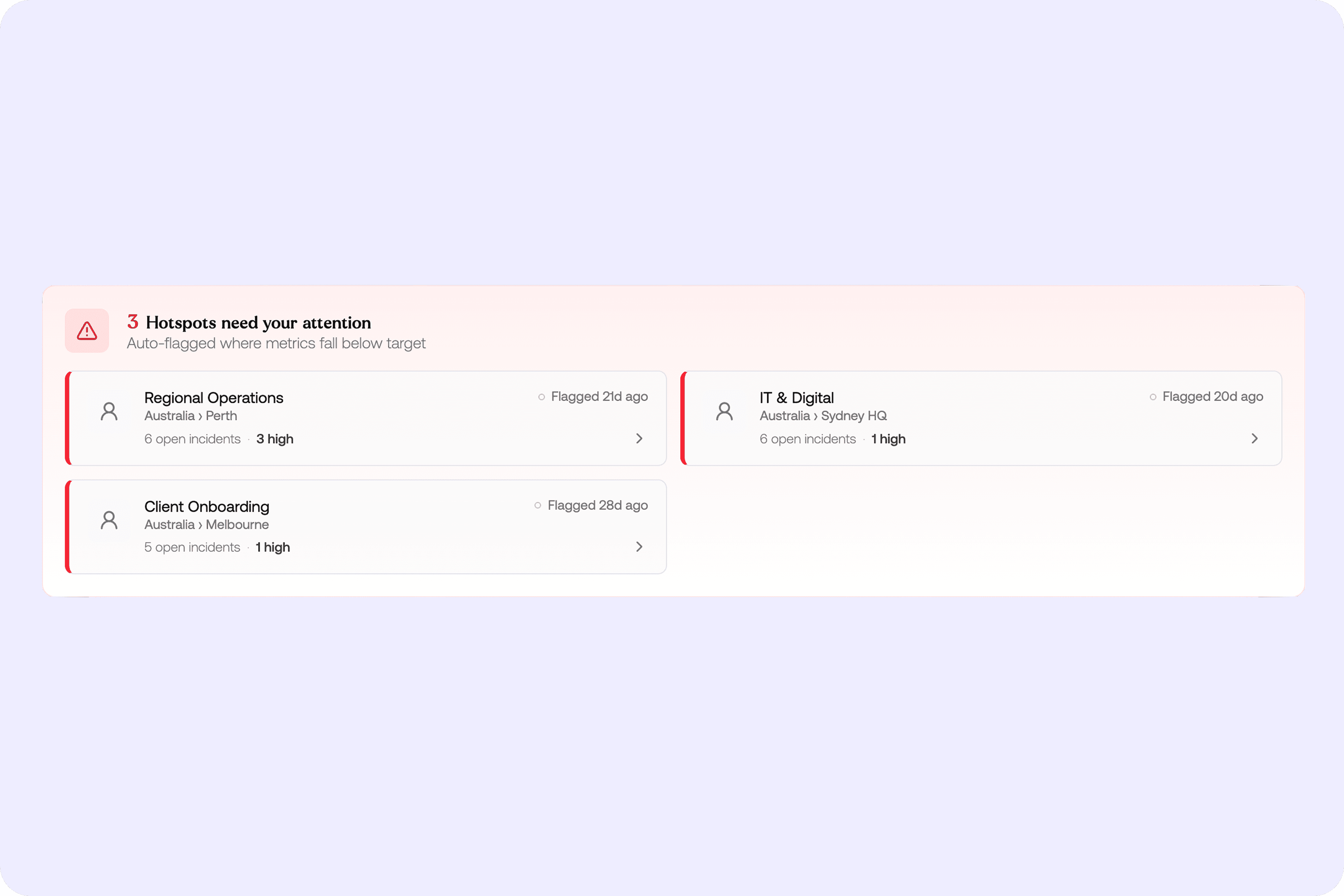
Know your psychosocial risk exposure across the organisation, continuously
Most executives receive psychosocial risk information episodically: an annual survey, a quarterly update, or an escalation after something has already gone wrong. The regulation requires continuous management, not periodic snapshots.
ReFresh provides structured, real-time visibility into psychosocial risk across teams, locations, and hazard categories, so executive leadership can see the organisation's risk exposure and the status of controls without waiting for a report to be assembled.
Organisation-wide risk view
Continuous monitoring
Team and location breakdown
Status of controls
Demonstrate officer due diligence with a documented evidence trail
The WHS Act imposes personal due diligence obligations on officers, including CEOs, directors, and C-suite executives. An officer must take reasonable steps to ensure the organisation is complying with its WHS duties.
ReFresh creates a time-stamped, auditable record of how psychosocial hazards are identified, assessed, controlled, and reviewed, producing the evidence that supports a due diligence defence if the question is ever asked.
Time-stamped audit trail
Officer liability evidence
Due diligence documentation
Structured governance records

Demonstrate officer due diligence with a documented evidence trail
The WHS Act imposes personal due diligence obligations on officers, including CEOs, directors, and C-suite executives. An officer must take reasonable steps to ensure the organisation is complying with its WHS duties.
ReFresh creates a time-stamped, auditable record of how psychosocial hazards are identified, assessed, controlled, and reviewed, producing the evidence that supports a due diligence defence if the question is ever asked.
Time-stamped audit trail
Officer liability evidence
Due diligence documentation
Structured governance records
Understand your financial exposure before it becomes a claim
A single psychological injury claim costs an average of $288,542 and takes approximately five times longer to resolve than a physical injury claim. Mental health-related workers' compensation premiums have increased by 161% over the past decade.
The cost of a purpose-built operating system is a fraction of the cost of a single claim, and the operating system runs continuously, reducing the likelihood that claims arise in the first place.
~$288,542 average claim cost
4x cost vs physical claims
Premium trajectory
Faster response to emerging issues
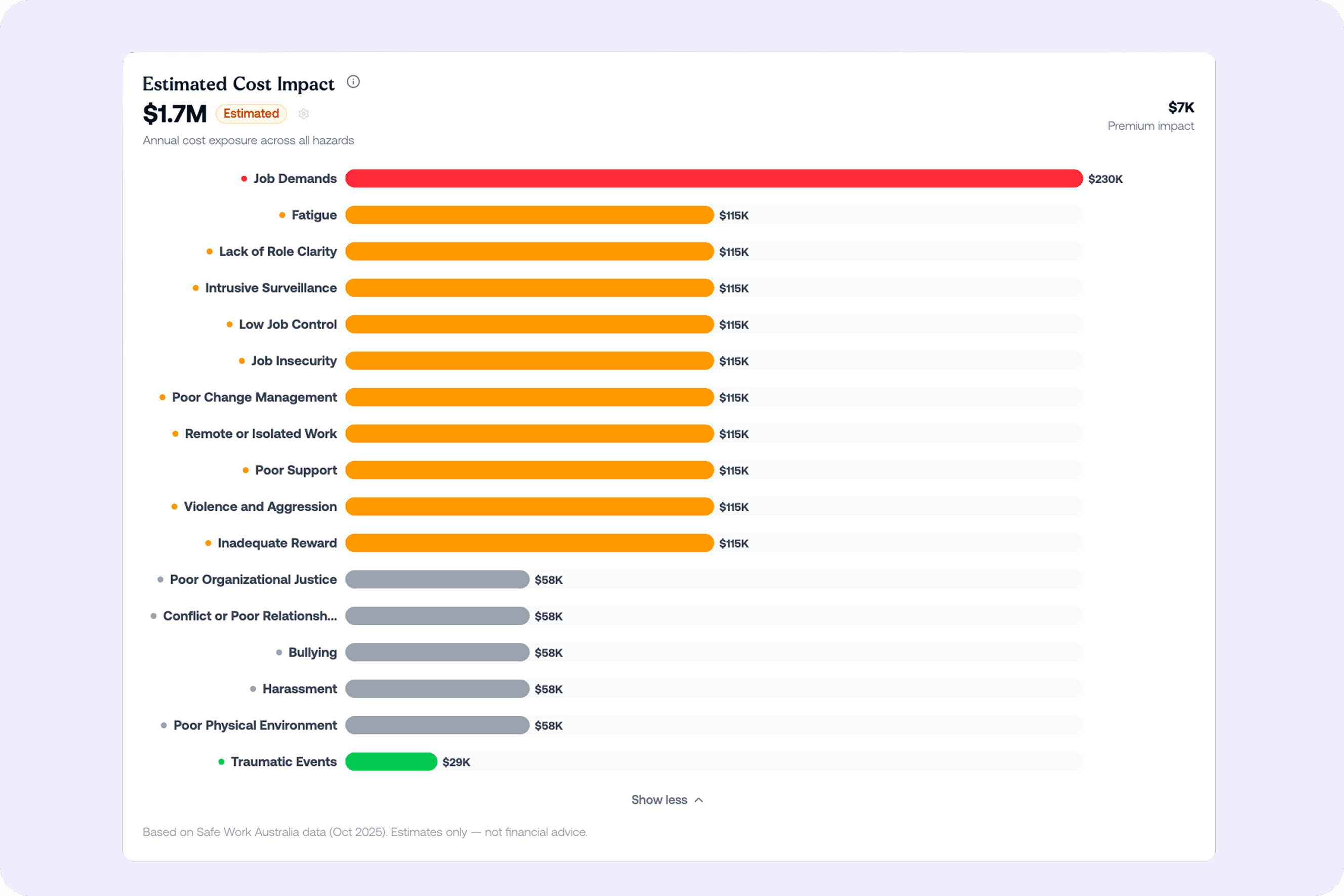
Understand your financial exposure before it becomes a claim
A single psychological injury claim costs an average of $288,542 and takes approximately five times longer to resolve than a physical injury claim. Mental health-related workers' compensation premiums have increased by 161% over the past decade.
The cost of a purpose-built operating system is a fraction of the cost of a single claim, and the operating system runs continuously, reducing the likelihood that claims arise in the first place.
~$288,542 average claim cost
4x cost vs physical claims
Premium trajectory
Faster response to emerging issues
Receive governance-ready reporting without operational burden
Executives need to see the strategic picture: which hazards are most prevalent, which controls are working, which areas require attention, and whether the organisation's overall compliance posture is defensible.
ReFresh generates board-ready and executive-ready reports from the same operational data the safety and HR teams work with, without requiring a separate reporting exercise or manual data assembly.
Board-ready reports
Executive dashboards
Compliance posture summary
No manual assembly
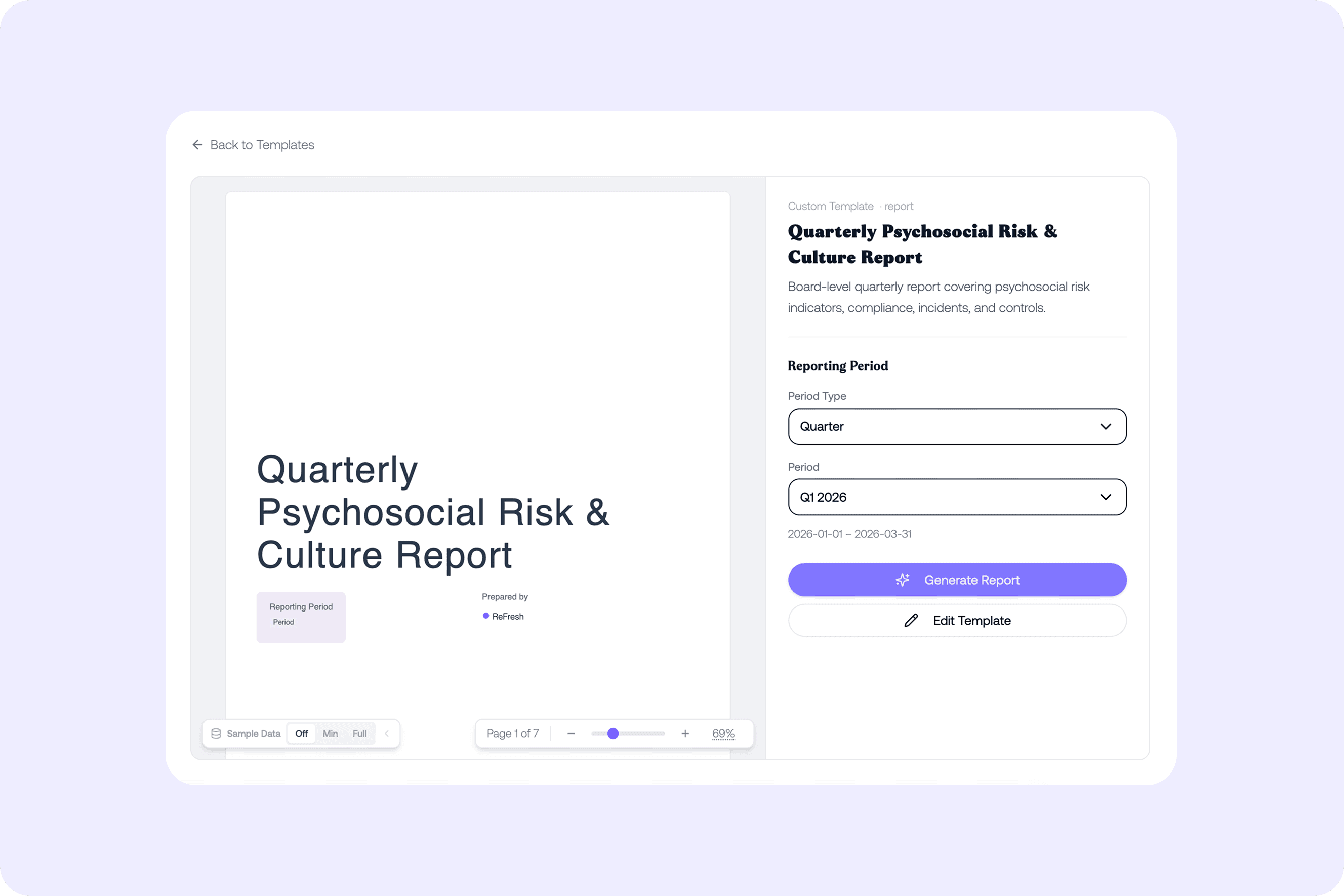
Receive governance-ready reporting without operational burden
Executives need to see the strategic picture: which hazards are most prevalent, which controls are working, which areas require attention, and whether the organisation's overall compliance posture is defensible.
ReFresh generates board-ready and executive-ready reports from the same operational data the safety and HR teams work with, without requiring a separate reporting exercise or manual data assembly.
Board-ready reports
Executive dashboards
Compliance posture summary
No manual assembly
SECURITY & COMPLIANCE
Your data.
Always protected.
Your data.
Always protected.
Your data.
Always protected.
Refresh is GDPR, SOC2, & USDP compliant
Refresh is GDPR, SOC2, & USDP compliant



Security standards
We are GDPR, SOC2, and USDP compliant. AWS hosts our app, and we undergo annual third-party audits to ensure platform and infrastructure security.
Security standards
We are GDPR, SOC2, and USDP compliant. AWS hosts our app, and we undergo annual third-party audits to ensure platform and infrastructure security.
Anonymous by design
Sensitive psychosocial information is handled by design. Data is structured and access-controlled so information is only visible where necessary.
Anonymous by design
Sensitive psychosocial information is handled by design. Data is structured and access-controlled so information is only visible where necessary.
Custom permissions
Set clear boundaries with flexible permissions. Admins and teams manage access, keeping data visible only where it belongs.
Custom permissions
Set clear boundaries with flexible permissions. Admins and teams manage access, keeping data visible only where it belongs.
Custom permissions
Set clear boundaries with flexible permissions. Admins and teams manage access, keeping data visible only where it belongs.
GOT QUESTIONS?
Frequently asked questions
Frequently asked questions
Why should an executive team care about psychosocial risk?
Because the duty is legal, the exposure is financial, and officers carry a personal due diligence obligation. Unmanaged psychosocial risk shows up in insurance premiums, workers compensation claims, absenteeism, and potential regulatory penalties.
What visibility does ReFresh give leadership?
It shows where psychosocial risk concentrates across the workforce, how your controls are tracking against the hierarchy of controls, the priority gaps, and the estimated cost impact. Combined with Groups, you can see which sites and teams carry the most exposure.
What is our exposure if we do nothing?
The regulation places enforceable duties on the organisation and on officers personally, with penalties for non-compliance. ReFresh frames that exposure in financial terms alongside the wellbeing case so it can be weighed like any other business risk.
What are my personal obligations as an officer under WHS law?
How does ReFresh help me demonstrate due diligence?
What is the financial exposure from unmanaged psychosocial risk?
How quickly can the organisation be operational?