Professional services
Your people team should be with people, not producing compliance documentation
ReFresh is the psychosocial operating system that runs alongside your people programmes, producing the evidence the regulation requires as a byproduct so your people team keeps doing what they do best: looking after people.
Professional services
Your people team should be with people, not producing compliance documentation
ReFresh is the psychosocial operating system that runs alongside your people programmes, producing the evidence the regulation requires as a byproduct so your people team keeps doing what they do best: looking after people.
trusted by leading ASX & Global enterprises













trusted by leading ASX & Global enterprises
FEATURES
ReFresh produces the compliance evidence your people programmes cannot
ReFresh is the psychosocial operating system that sits alongside engagement surveys, EAP, and wellbeing programmes as the structured compliance layer professional services firms are missing. The regulation under Australian WHS law requires something your current programmes were not designed for: identifying what specific hazards exist across 17 categories, assessing their severity, implementing documented controls, and producing evidence that this cycle runs continuously. A regulator will not accept an engagement survey as evidence of psychosocial hazard identification. Different tool, different job.
This is not a criticism of what your firm already does. The care is real. What the OS adds is the infrastructure that turns that care into defensible documentation. The operating system handles risk intelligence (making hazards visible), safety orchestration (turning identified hazards into tracked, owned responses), and governance evidence (proving the cycle is running), so your people team's time goes back to the people rather than to producing compliance reports.
Structured compliance layer alongside existing wellbeing programmes
Hazard identification across all 17 Code of Practice categories
Evidence the regulation requires, generated as a byproduct
Clear separation between wellbeing and compliance documentation

ReFresh produces the compliance evidence your people programmes cannot
ReFresh is the psychosocial operating system that sits alongside engagement surveys, EAP, and wellbeing programmes as the structured compliance layer professional services firms are missing. The regulation under Australian WHS law requires something your current programmes were not designed for: identifying what specific hazards exist across 17 categories, assessing their severity, implementing documented controls, and producing evidence that this cycle runs continuously. A regulator will not accept an engagement survey as evidence of psychosocial hazard identification. Different tool, different job.
This is not a criticism of what your firm already does. The care is real. What the OS adds is the infrastructure that turns that care into defensible documentation. The operating system handles risk intelligence (making hazards visible), safety orchestration (turning identified hazards into tracked, owned responses), and governance evidence (proving the cycle is running), so your people team's time goes back to the people rather than to producing compliance reports.
Structured compliance layer alongside existing wellbeing programmes
Hazard identification across all 17 Code of Practice categories
Evidence the regulation requires, generated as a byproduct
Clear separation between wellbeing and compliance documentation
The OS identifies the hazards professional services workers face, without heavy WHS process
ReFresh provides risk intelligence across the psychosocial hazards most prevalent in professional services: high job demands with variable support, poor organisational justice, lack of role clarity, bullying, harassment, intrusive surveillance from remote monitoring tools, and remote or isolated work. The shift to remote and hybrid work has intensified several of these hazards, and many firms have not connected those operational changes to the compliance obligation because the obligation itself is not well understood in this sector.
The OS identifies these hazards by prevalence and severity across roles, teams, and offices through structured assessment, not heavy WHS process. The system is designed for organisations where the people and culture team leads this work, not a dedicated safety function. Confidential reporting pathways with role-based access controls ensure sensitive concerns are handled consistently and documented defensibly, so worker trust is built through the design of the system rather than through a policy that nobody is sure is being followed.
Job demands, role clarity, remote work, and surveillance hazards assessed
Prevalence and severity scoring across roles and offices
Confidential reporting pathways with role-based access
Designed for people-led teams, not dedicated safety functions

The OS identifies the hazards professional services workers face, without heavy WHS process
ReFresh provides risk intelligence across the psychosocial hazards most prevalent in professional services: high job demands with variable support, poor organisational justice, lack of role clarity, bullying, harassment, intrusive surveillance from remote monitoring tools, and remote or isolated work. The shift to remote and hybrid work has intensified several of these hazards, and many firms have not connected those operational changes to the compliance obligation because the obligation itself is not well understood in this sector.
The OS identifies these hazards by prevalence and severity across roles, teams, and offices through structured assessment, not heavy WHS process. The system is designed for organisations where the people and culture team leads this work, not a dedicated safety function. Confidential reporting pathways with role-based access controls ensure sensitive concerns are handled consistently and documented defensibly, so worker trust is built through the design of the system rather than through a policy that nobody is sure is being followed.
Job demands, role clarity, remote work, and surveillance hazards assessed
Prevalence and severity scoring across roles and offices
Confidential reporting pathways with role-based access
Designed for people-led teams, not dedicated safety functions
The operating system runs so your people team does not have to build a compliance function
ReFresh handles the full psychosocial safety lifecycle as a continuous operating system, producing inspection-ready evidence as a byproduct of the management process rather than requiring the people team to build a separate compliance reporting function. Most professional services firms do not have a WHS team. The people and culture leader already carries a broad remit: recruitment, retention, culture, engagement, and performance. Adding a structured compliance obligation on top of that risks overwhelming the team or, more commonly, the obligation simply does not get addressed.
The OS is designed for this reality. Standard onboarding takes approximately four weeks. From the first survey cycle forward, the operating system produces a time-stamped audit trail from hazard identification through risk assessment, control assignment, effectiveness review, and governance reporting, all without manual compilation. The cost of not having this infrastructure is disproportionate: the average serious psychological injury claim costs $288,542, takes five times longer to resolve than a physical injury, and workers who experience psychological injury return to work at approximately half the rate of those with physical injuries.
Four-week onboarding from configuration to first survey
Time-stamped audit trail generated automatically
No separate compliance reporting exercise required
Governance reporting without manual data assembly

The operating system runs so your people team does not have to build a compliance function
ReFresh handles the full psychosocial safety lifecycle as a continuous operating system, producing inspection-ready evidence as a byproduct of the management process rather than requiring the people team to build a separate compliance reporting function. Most professional services firms do not have a WHS team. The people and culture leader already carries a broad remit: recruitment, retention, culture, engagement, and performance. Adding a structured compliance obligation on top of that risks overwhelming the team or, more commonly, the obligation simply does not get addressed.
The OS is designed for this reality. Standard onboarding takes approximately four weeks. From the first survey cycle forward, the operating system produces a time-stamped audit trail from hazard identification through risk assessment, control assignment, effectiveness review, and governance reporting, all without manual compilation. The cost of not having this infrastructure is disproportionate: the average serious psychological injury claim costs $288,542, takes five times longer to resolve than a physical injury, and workers who experience psychological injury return to work at approximately half the rate of those with physical injuries.
Four-week onboarding from configuration to first survey
Time-stamped audit trail generated automatically
No separate compliance reporting exercise required
Governance reporting without manual data assembly
Evidence that your values are real, not just intended
ReFresh generates governance evidence that demonstrates your firm's people-first values are backed by systematic psychosocial safety management, not just good intentions. For firms with governance obligations to a managing partner, board, or parent company, the OS produces governance-level reporting that aggregates risk data across teams and offices without exposing individual detail, structured for the audience that needs to see it.
The emotional transformation for people leaders is clear: instead of hoping their wellbeing programmes are enough, they can show that those programmes sit alongside a structured system that identifies hazards, tracks controls, and produces the evidence the regulation requires. Your culture is real. The OS makes that provable. That is the bridge from values to defensible compliance, and it runs without adding admin burden to the team that should be spending their time with people.
Governance-level reporting for partners, boards, or parent companies
Risk data aggregated across teams without individual exposure
Values-to-compliance bridge documented and defensible
People team capacity preserved for people work
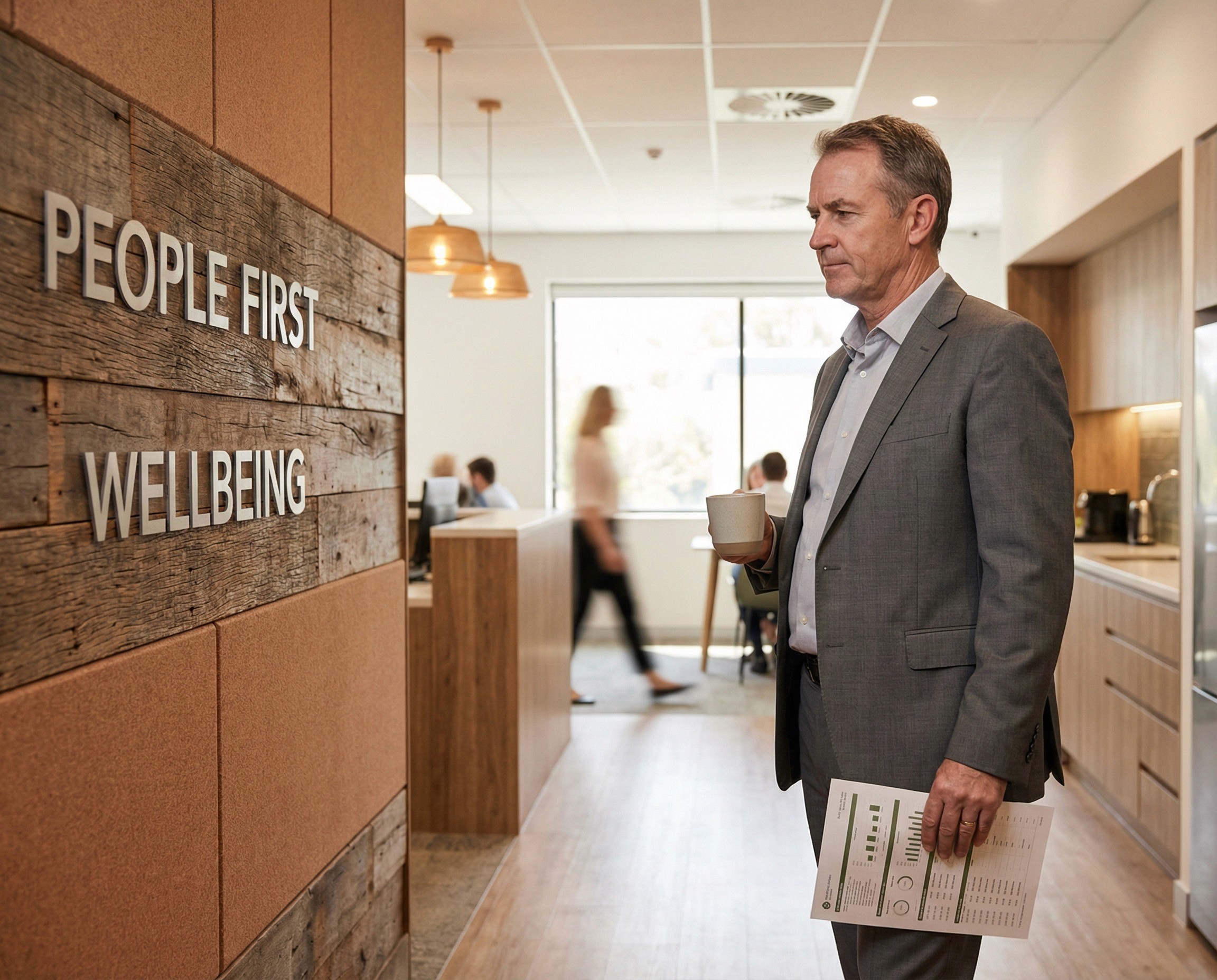
Evidence that your values are real, not just intended
ReFresh generates governance evidence that demonstrates your firm's people-first values are backed by systematic psychosocial safety management, not just good intentions. For firms with governance obligations to a managing partner, board, or parent company, the OS produces governance-level reporting that aggregates risk data across teams and offices without exposing individual detail, structured for the audience that needs to see it.
The emotional transformation for people leaders is clear: instead of hoping their wellbeing programmes are enough, they can show that those programmes sit alongside a structured system that identifies hazards, tracks controls, and produces the evidence the regulation requires. Your culture is real. The OS makes that provable. That is the bridge from values to defensible compliance, and it runs without adding admin burden to the team that should be spending their time with people.
Governance-level reporting for partners, boards, or parent companies
Risk data aggregated across teams without individual exposure
Values-to-compliance bridge documented and defensible
People team capacity preserved for people work
SECURITY & COMPLIANCE
Your data.
Always protected.
Your data.
Always protected.
Your data.
Always protected.
Refresh is GDPR, SOC2, & USDP compliant
Refresh is GDPR, SOC2, & USDP compliant


Security standards
We are GDPR, SOC2, and USDP compliant. AWS hosts our app, and we undergo annual third-party audits to ensure platform and infrastructure security.
Security standards
We are GDPR, SOC2, and USDP compliant. AWS hosts our app, and we undergo annual third-party audits to ensure platform and infrastructure security.
Anonymous by design
Sensitive psychosocial information is handled by design. Data is structured and access-controlled so information is only visible where necessary.
Anonymous by design
Sensitive psychosocial information is handled by design. Data is structured and access-controlled so information is only visible where necessary.
Custom permissions
Set clear boundaries with flexible permissions. Admins and teams manage access, keeping data visible only where it belongs.
Custom permissions
Set clear boundaries with flexible permissions. Admins and teams manage access, keeping data visible only where it belongs.
Custom permissions
Set clear boundaries with flexible permissions. Admins and teams manage access, keeping data visible only where it belongs.
GOT QUESTIONS?
Frequently asked questions
Frequently asked questions
What psychosocial risks are most common in professional services?
Long hours, high and often unpredictable workloads, billable and client-driven pressure, and limited recovery time. Over a sustained period these are the hazards that drive burnout and turnover.
How does ReFresh help a professional services firm?
It surfaces where job demands and workload concentrate, holds the controls put in place to manage them, and keeps the consultation and evidence record. It gives a firm a structured response to a risk that is often acknowledged but rarely managed systematically.
Our firm has a strong culture. Do we need a system?