education
Your safety and people teams are buried in admin. ReFresh handles it across every campus.
ReFresh is the psychosocial operating system that gives safety and people leaders their time back by turning psychosocial safety into infrastructure that runs: risk intelligence, safety orchestration, and governance evidence across every campus and jurisdiction, so your team spends less time producing documentation and more time with the people they are responsible for.
education
Your safety and people teams are buried in admin. ReFresh handles it across every campus.
ReFresh is the psychosocial operating system that gives safety and people leaders their time back by turning psychosocial safety into infrastructure that runs: risk intelligence, safety orchestration, and governance evidence across every campus and jurisdiction.
trusted by leading ASX & Global enterprises













trusted by leading ASX & Global enterprises
FEATURES
One operating system across every campus instead of a patchwork that nobody trusts
ReFresh is the psychosocial operating system that replaces disconnected, campus-by-campus approaches with a single system producing consistent risk intelligence across every location. A university with five campuses across two states currently manages psychosocial safety through a patchwork of spreadsheets, local processes, and ad hoc reviews that cannot maintain consistency, cannot produce a consolidated organisational view, and cannot generate the evidence a regulator expects under the Code of Practice. The OS handles location-scoped hazard identification across all 17 categories, jurisdiction-aware compliance mapping between NSW and Victoria, and consolidated reporting that rolls up into one organisational view.
The time this gives back is significant. Instead of each campus assembling its own documentation, tracking its own controls, and producing its own reports, the operating system runs those processes continuously and produces the evidence as a byproduct. Your safety and people teams stop managing spreadsheets and start managing safety. That is the shift from spreadsheet compliance to a system that runs.
Consistent hazard identification across every campus
Jurisdiction-aware compliance mapping across states
Consolidated organisational risk view from one system
Location-scoped reporting with site-level detail
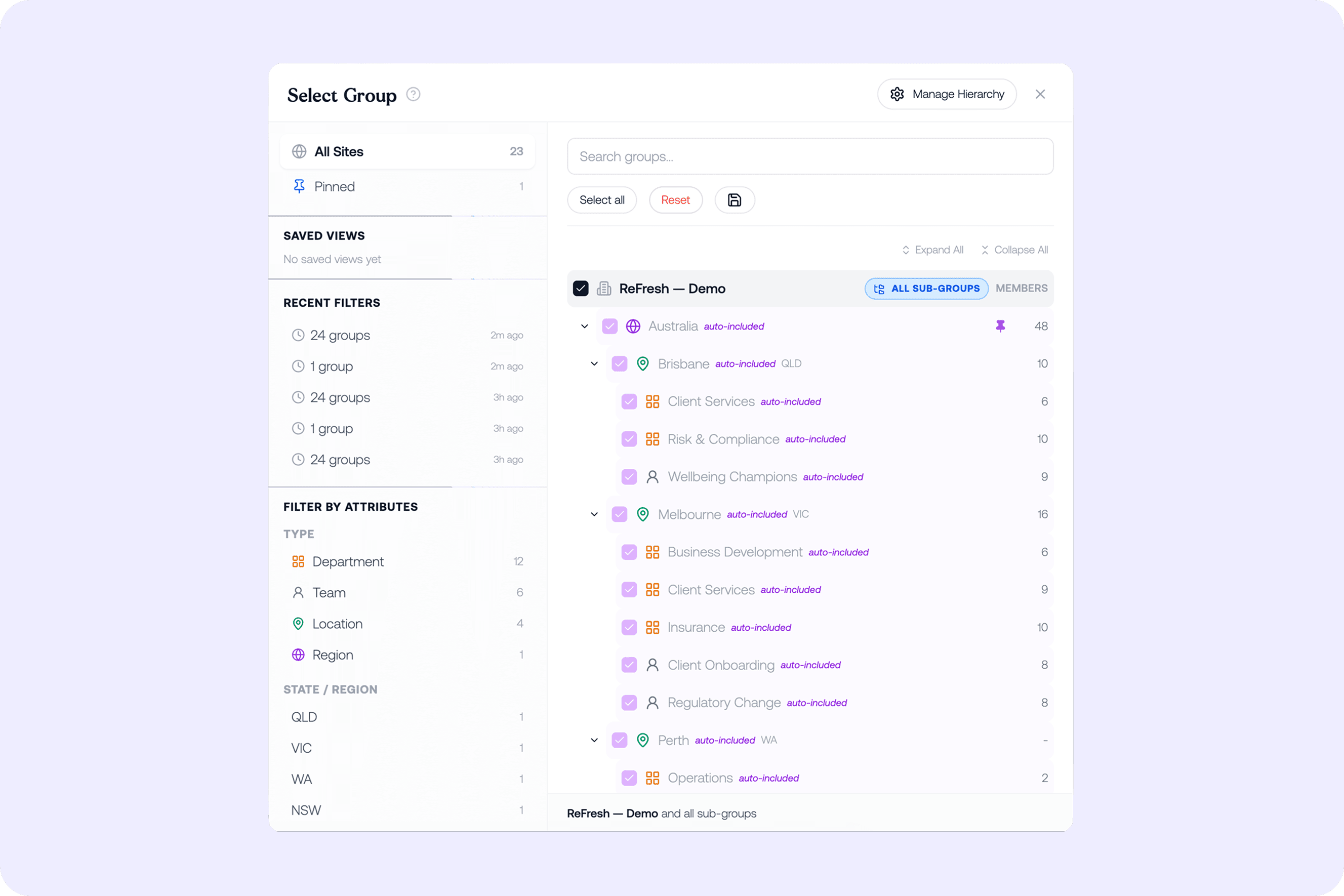
One operating system across every campus instead of a patchwork that nobody trusts
ReFresh is the psychosocial operating system that replaces disconnected, campus-by-campus approaches with a single system producing consistent risk intelligence across every location. A university with five campuses across two states currently manages psychosocial safety through a patchwork of spreadsheets, local processes, and ad hoc reviews that cannot maintain consistency, cannot produce a consolidated organisational view, and cannot generate the evidence a regulator expects under the Code of Practice. The OS handles location-scoped hazard identification across all 17 categories, jurisdiction-aware compliance mapping between NSW and Victoria, and consolidated reporting that rolls up into one organisational view.
The time this gives back is significant. Instead of each campus assembling its own documentation, tracking its own controls, and producing its own reports, the operating system runs those processes continuously and produces the evidence as a byproduct. Your safety and people teams stop managing spreadsheets and start managing safety. That is the shift from spreadsheet compliance to a system that runs.
Consistent hazard identification across every campus
Jurisdiction-aware compliance mapping across states
Consolidated organisational risk view from one system
Location-scoped reporting with site-level detail
The OS identifies the hazards education workers actually face, systematically
ReFresh provides risk intelligence across all 17 psychosocial hazard categories with assessment calibrated to the hazards most prevalent in education: job demands and workload pressure, student aggression and violence, poor organisational change management, lack of role clarity, job insecurity, bullying, and conflict. These hazards interact and compound, particularly during restructuring events where course changes, funding shifts, and campus consolidation trigger multiple categories simultaneously. The OS identifies them by prevalence and severity across roles, locations, and teams, producing structured data rather than anecdotal incident reports.
This structured identification is what moves an education provider from reactive to operational. Instead of responding to individual incidents after they surface, the operating system makes hazards visible before they become claims, measurable so the organisation knows where they concentrate, and manageable through orchestrated controls with named ownership and deadlines. Compliance evidence is the byproduct of that management cycle, not a separate exercise.
All 17 hazard categories assessed by prevalence and severity
Role, location, and team-level scoping
Change cascade detection across restructuring events
Structured data replacing anecdotal incident reports

The OS identifies the hazards education workers actually face, systematically
ReFresh provides risk intelligence across all 17 psychosocial hazard categories with assessment calibrated to the hazards most prevalent in education: job demands and workload pressure, student aggression and violence, poor organisational change management, lack of role clarity, job insecurity, bullying, and conflict. These hazards interact and compound, particularly during restructuring events where course changes, funding shifts, and campus consolidation trigger multiple categories simultaneously. The OS identifies them by prevalence and severity across roles, locations, and teams, producing structured data rather than anecdotal incident reports.
This structured identification is what moves an education provider from reactive to operational. Instead of responding to individual incidents after they surface, the operating system makes hazards visible before they become claims, measurable so the organisation knows where they concentrate, and manageable through orchestrated controls with named ownership and deadlines. Compliance evidence is the byproduct of that management cycle, not a separate exercise.
All 17 hazard categories assessed by prevalence and severity
Role, location, and team-level scoping
Change cascade detection across restructuring events
Structured data replacing anecdotal incident reports
Safety orchestration that tracks whether controls are working, not just that they exist
ReFresh turns identified hazards into systematic, trackable responses through safety orchestration: every control is connected to the hazard it addresses, assigned to a named owner with a deadline, and monitored for effectiveness over time. Most education providers can point to controls they have put in place, such as workload management policies, anti-bullying procedures, and change management guidelines, but what they cannot produce is evidence that those controls have owners, that they are being reviewed on a documented schedule, and that their effectiveness is measured. That gap between having a policy and having a system that demonstrates the policy is working is where regulators focus.
The OS closes that gap by producing a time-stamped audit trail from identification through to the most recent review. SafeWork NSW has committed $127.7 million in new enforcement funding with 51 new inspectors, including 20 dedicated to psychosocial hazards. When a regulator arrives at a campus, the evidence pack is already there, generated continuously by the operating system rather than assembled manually from shared drives by a team that should be spending that time with people.
Named control ownership with defined deadlines
Effectiveness monitoring over time
Time-stamped audit trail from identification to review
Continuous evidence generation without manual compilation
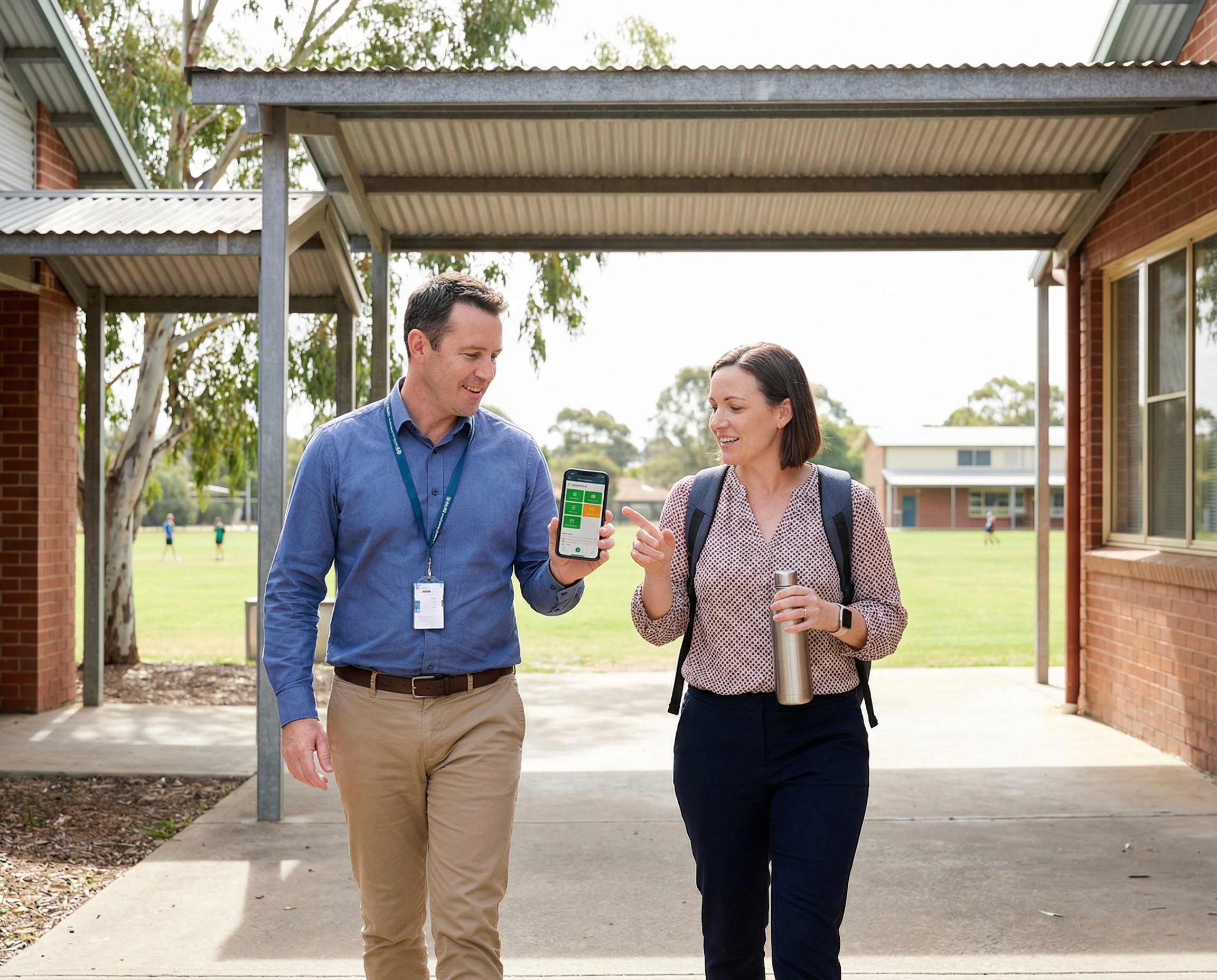
Safety orchestration that tracks whether controls are working, not just that they exist
ReFresh turns identified hazards into systematic, trackable responses through safety orchestration: every control is connected to the hazard it addresses, assigned to a named owner with a deadline, and monitored for effectiveness over time. Most education providers can point to controls they have put in place, such as workload management policies, anti-bullying procedures, and change management guidelines, but what they cannot produce is evidence that those controls have owners, that they are being reviewed on a documented schedule, and that their effectiveness is measured. That gap between having a policy and having a system that demonstrates the policy is working is where regulators focus.
The OS closes that gap by producing a time-stamped audit trail from identification through to the most recent review. SafeWork NSW has committed $127.7 million in new enforcement funding with 51 new inspectors, including 20 dedicated to psychosocial hazards. When a regulator arrives at a campus, the evidence pack is already there, generated continuously by the operating system rather than assembled manually from shared drives by a team that should be spending that time with people.
Named control ownership with defined deadlines
Effectiveness monitoring over time
Time-stamped audit trail from identification to review
Continuous evidence generation without manual compilation
Governance evidence that gives university councils and boards what they need
ReFresh generates governance-ready reporting from the same operational data the safety and people teams work with, so boards and university councils receive structured visibility into psychosocial risk without requiring a separate reporting exercise. The operating system aggregates risk data across campuses, hazard categories, and time periods, presenting the organisation's compliance posture, the status of controls, and trend data without exposing individual worker detail.
For education providers, the cost of unmanaged psychosocial risk is substantial: the average serious psychological injury claim costs $288,542, mental health claims have increased by 161% over the past decade, and education is among the sectors where enforcement is intensifying fastest. Directors and officers carry personal due diligence obligations under the WHS Act. The OS produces the evidence trail that supports those obligations as a continuous output, not a once-a-year board paper.
Board-ready reporting from live operational data
Compliance posture and control status at a glance
Trend data across campuses and hazard categories
Officer due diligence evidence produced continuously

Governance evidence that gives university councils and boards what they need
ReFresh generates governance-ready reporting from the same operational data the safety and people teams work with, so boards and university councils receive structured visibility into psychosocial risk without requiring a separate reporting exercise. The operating system aggregates risk data across campuses, hazard categories, and time periods, presenting the organisation's compliance posture, the status of controls, and trend data without exposing individual worker detail.
For education providers, the cost of unmanaged psychosocial risk is substantial: the average serious psychological injury claim costs $288,542, mental health claims have increased by 161% over the past decade, and education is among the sectors where enforcement is intensifying fastest. Directors and officers carry personal due diligence obligations under the WHS Act. The OS produces the evidence trail that supports those obligations as a continuous output, not a once-a-year board paper.
Board-ready reporting from live operational data
Compliance posture and control status at a glance
Trend data across campuses and hazard categories
Officer due diligence evidence produced continuously
SECURITY & COMPLIANCE
Your data.
Always protected.
Your data.
Always protected.
Your data.
Always protected.
Refresh is GDPR, SOC2, & USDP compliant
Refresh is GDPR, SOC2, & USDP compliant



Security standards
We are GDPR, SOC2, and USDP compliant. AWS hosts our app, and we undergo annual third-party audits to ensure platform and infrastructure security.
Security standards
We are GDPR, SOC2, and USDP compliant. AWS hosts our app, and we undergo annual third-party audits to ensure platform and infrastructure security.
Anonymous by design
Sensitive psychosocial information is handled by design. Data is structured and access-controlled so information is only visible where necessary.
Anonymous by design
Sensitive psychosocial information is handled by design. Data is structured and access-controlled so information is only visible where necessary.
Custom permissions
Set clear boundaries with flexible permissions. Admins and teams manage access, keeping data visible only where it belongs.
Custom permissions
Set clear boundaries with flexible permissions. Admins and teams manage access, keeping data visible only where it belongs.
Custom permissions
Set clear boundaries with flexible permissions. Admins and teams manage access, keeping data visible only where it belongs.
GOT QUESTIONS?
Frequently asked questions
Frequently asked questions
What psychosocial risks are most common in education?
Heavy and uneven academic and teaching workloads, emotionally demanding student-facing work, exposure to disclosures including gender-based violence, and the insecurity that comes with casual and fixed-term roles.
How does multi-campus compliance work?
We handle psychosocial issues as they arise. Is that sufficient?
What psychosocial hazards are most prevalent in education?
Does ReFresh work alongside existing WHS platforms used in education?
How long does implementation take?