Incident & Risk Reporting

Report, investigate and resolve incidents with audit-ready records

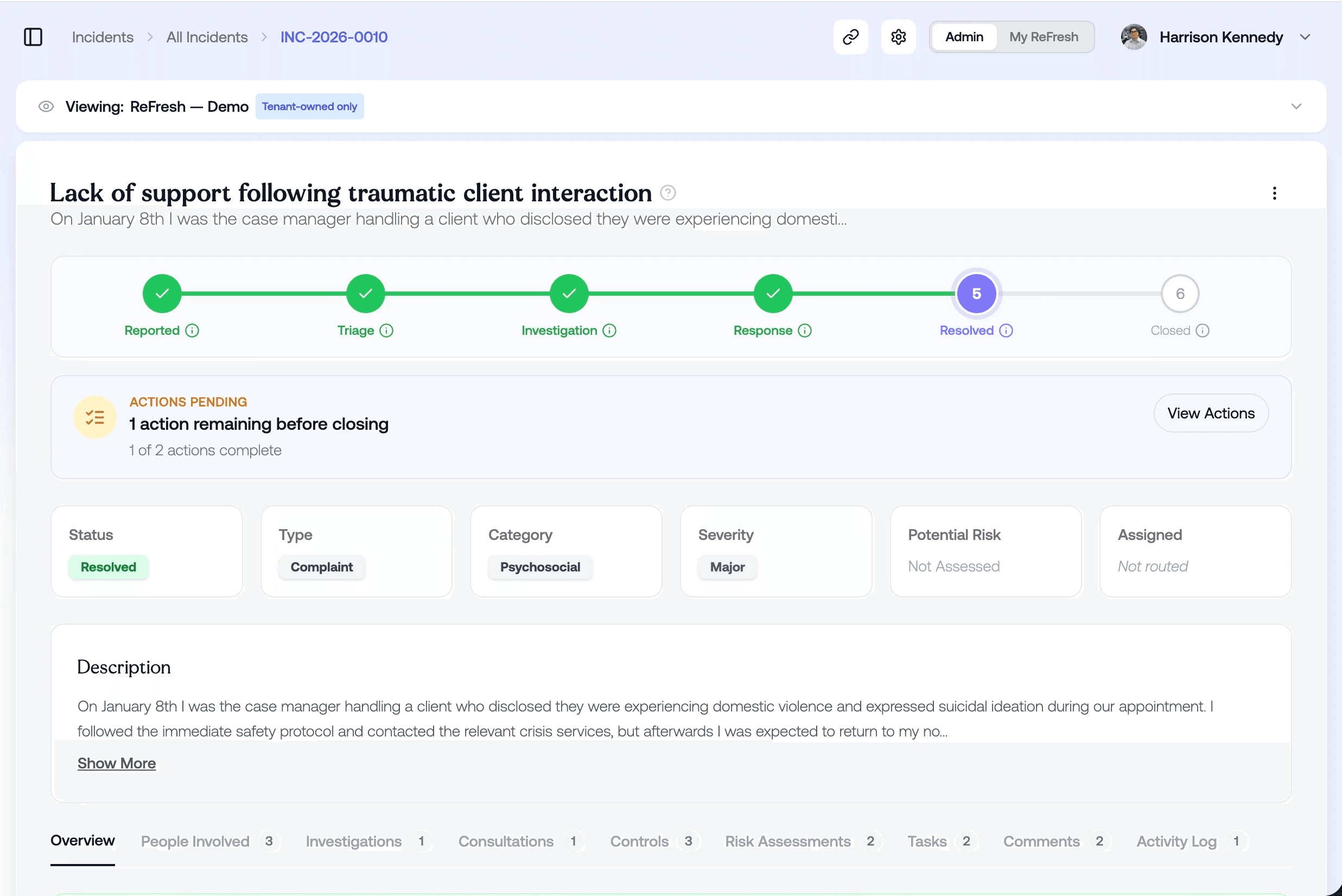
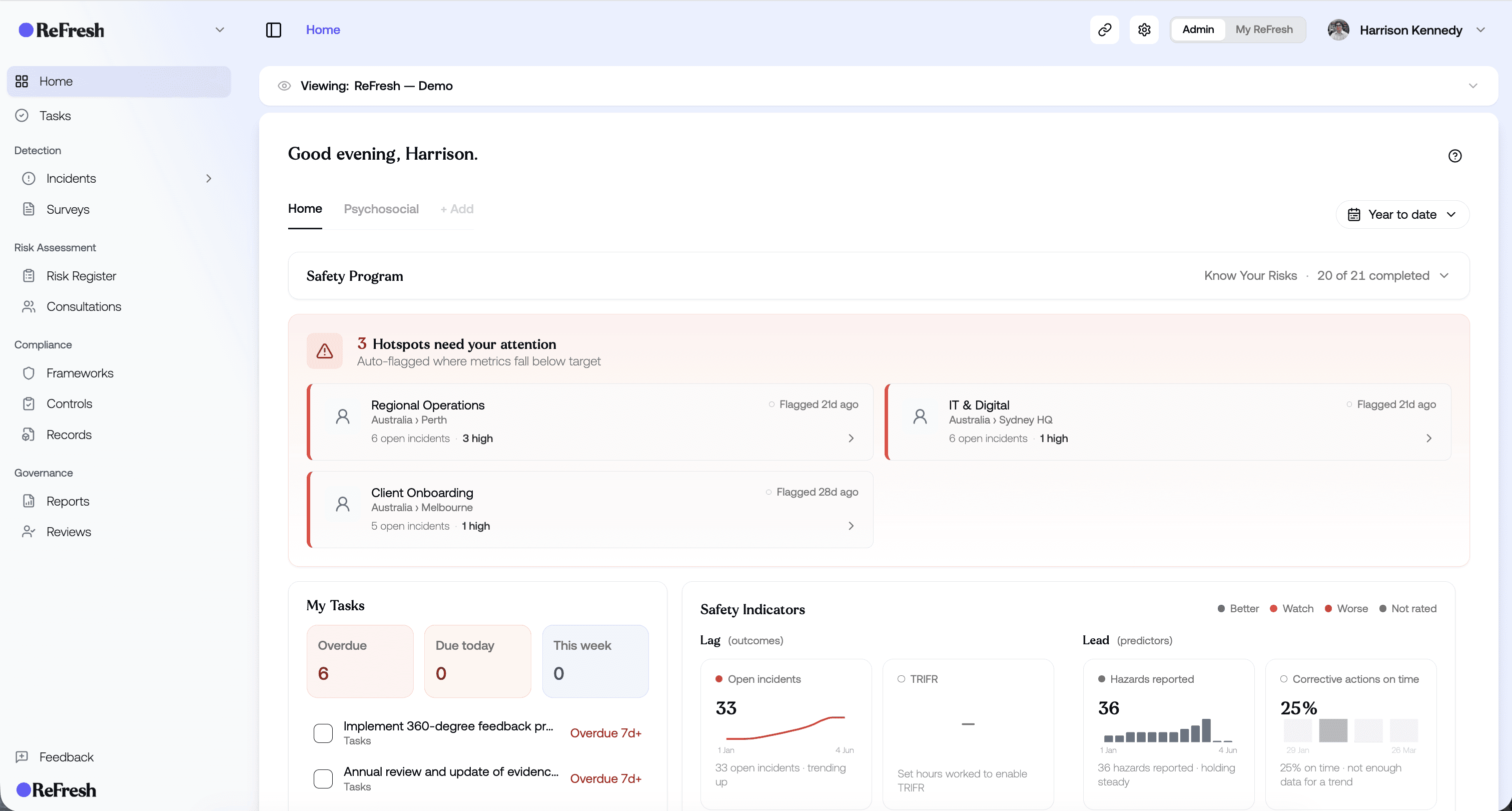
Every psychosocial incident flows through one structured path, from the first report to a closed investigation, with every decision, owner and date recorded as evidence a regulator can follow.

woman working comfortably on a laptop in a warm office setting

Incident & Risk Reporting

Report, investigate and resolve incidents with audit-ready records

Every psychosocial incident flows through one structured path, from the first report to a closed investigation, with every decision, owner and date recorded as evidence a regulator can follow.

woman working comfortably on a laptop in a warm office setting

Incident & Risk Reporting

Report, investigate and resolve incidents with audit-ready records

Every psychosocial incident flows through one structured path, from the first report to a closed investigation, with every decision, owner and date recorded as evidence a regulator can follow.

woman working comfortably on a laptop in a warm office setting
A young man in a high vis vest and safety glasses sits in a workplace kitchen on his mobile phone

INCIDENT REPORTING

Reach your entire workforce with a shareable psychosocial reporting link

Distribute a shareable incident reporting link via email, intranet, QR code, or team noticeboard so that every worker in your organisation, including contractors, casual staff, and frontline teams without regular system access, has a direct pathway to report psychosocial hazards without needing a platform account, login credentials, or any familiarity with the system.

ANONYMOUS REPORTING

Let workers report anonymously, and ask for identification only when needed

Workers can submit a report without attaching their name, which is often what gets a sensitive psychosocial issue raised at all, and the compliance team can send an optional request for identification later if an investigation genuinely needs it, so anonymity and accountability are balanced rather than traded off.

A hospital hallway with staff standing by a noticeboard, a qr code prominently displayed for their ease of access
A woman sits in an offie in front of her computer, with a dashboard pictured on screen. She appears comfortable

INCIDENT TRIAGE

Classify and route every report the moment it arrives

Triage classifies each incident by event type, domain and primary hazard, assigns it to the owning group, and flags any time-critical actions, so a report is understood and routed to the right people instead of waiting in a queue for someone to notice it.

CASE MANAGEMENT

Manage each incident as a case from triage to close

Every incident becomes a case on one record that holds its status, owner, the people involved, the hazards and risks it links to, and the consultations, controls and tasks raised in response, so a matter is managed end to end through its lifecycle rather than tracked across separate tools and inboxes.

A pair of office workers collaborate on a laptop in an office setting
A female healthcare workers in navy scrubs sits quietly in the corner of a staff lounge, finishing a cup of tea, with her phone face-down on the table besider her.

INVESTIGATIONS

Run formal investigations, internal or external, side by side

Escalate any incident into a structured investigation with an assigned investigator, an opened date and a live status, run several at once, and keep external investigators clearly flagged, so accountability holds from the first report through to a documented outcome.

ACTIVITY LOG

Close the loop with a record that stands up to an inspector

Every change, comment and decision is captured in an activity log with the person and the time, so when the case is closed the full lifecycle can be reconstructed on demand for an inspector or a tribunal rather than pieced together from emails.

A pair of office workers collaborate on a laptop in an office setting

GOT QUESTIONS?

Frequently asked questions

Frequently asked questions

How are incidents reported into ReFresh?

Incidents can be reported four ways:

  1. Through a shareable reporting link

  2. QR code that workers scan on site

  3. Logged manually by an administrator

  4. Through a worker's own My ReFresh portal

Each report captures the domain category (psychosocial, physical safety, conduct, or other), the primary hazard, a description, when it occurred, the group it sits under, whether it is an immediate risk, and any supporting documents.

Can incidents be reported anonymously?

Yes. A worker can raise a report without attaching their name. Anonymous reporting is one of the main ways to lift reporting rates where people hold back for fear of being identified, which is a common gap in psychosocial reporting.

What is the triage queue and why does it exist?

Every new report lands in a triage queue before anything else happens. Triage answers two questions:

  1. Is this a legitimate incident or hazard, rather than a general complaint?

  2. Who owns it from here?

During triage you can reclassify how the worker reported it, confirm whether it is notifiable or an immediate risk, flag a potential workers compensation claim, and assign the matter to the right person by location, state, or team.

Can we restrict who sees sensitive incidents?

Yes. Access is controlled through Groups, and sensitive matters can be restricted further so only named people can view them, including within the administrator team. This matters for conduct and grievance reports that should not be broadly visible.

How does ReFresh help with notifiable incidents?

When an incident is classified as notifiable, ReFresh records when it occurred and shows the time remaining against the regulator notification deadline, so the responsible person can act within the required window rather than tracking it manually.

Can more than one investigation run on a single incident?

Yes. You can open multiple investigations under one incident, which is common where a matter has both a safety lens and an HR lens. Each investigation captures:

  1. A finding summary

  2. Root causes

  3. Contributing factors

  4. Policy findings

It also records the people involved and their statements, noting whether each statement was taken in person, by video, by phone, or in writing.

How does this stand up to a regulator audit?

Every change to an incident or investigation is captured in a full activity log, so there is a documented record of who did what and when. This is how SafeWork and WorkSafe assess an organisation: not on intent, but on whether the process was followed and evidenced. The record is built as you work, not reconstructed afterwards.

Can investigation records be exported or linked to our HR system?

Records can be exported from the platform at any time. Where your HR system supports it, investigation data can also be synced back out through an API connection, configured during onboarding.

GOT QUESTIONS?

Frequently asked questions

How are incidents reported into ReFresh?

Incidents can be reported four ways:

  1. Through a shareable reporting link

  2. QR code that workers scan on site

  3. Logged manually by an administrator

  4. Through a worker's own My ReFresh portal

Each report captures the domain category (psychosocial, physical safety, conduct, or other), the primary hazard, a description, when it occurred, the group it sits under, whether it is an immediate risk, and any supporting documents.

Can incidents be reported anonymously?

Yes. A worker can raise a report without attaching their name. Anonymous reporting is one of the main ways to lift reporting rates where people hold back for fear of being identified, which is a common gap in psychosocial reporting.

What is the triage queue and why does it exist?

Every new report lands in a triage queue before anything else happens. Triage answers two questions:

  1. Is this a legitimate incident or hazard, rather than a general complaint?

  2. Who owns it from here?

During triage you can reclassify how the worker reported it, confirm whether it is notifiable or an immediate risk, flag a potential workers compensation claim, and assign the matter to the right person by location, state, or team.

Can we restrict who sees sensitive incidents?

Yes. Access is controlled through Groups, and sensitive matters can be restricted further so only named people can view them, including within the administrator team. This matters for conduct and grievance reports that should not be broadly visible.

How does ReFresh help with notifiable incidents?

When an incident is classified as notifiable, ReFresh records when it occurred and shows the time remaining against the regulator notification deadline, so the responsible person can act within the required window rather than tracking it manually.

Can more than one investigation run on a single incident?

Yes. You can open multiple investigations under one incident, which is common where a matter has both a safety lens and an HR lens. Each investigation captures:

  1. A finding summary

  2. Root causes

  3. Contributing factors

  4. Policy findings

It also records the people involved and their statements, noting whether each statement was taken in person, by video, by phone, or in writing.

How does this stand up to a regulator audit?

Every change to an incident or investigation is captured in a full activity log, so there is a documented record of who did what and when. This is how SafeWork and WorkSafe assess an organisation: not on intent, but on whether the process was followed and evidenced. The record is built as you work, not reconstructed afterwards.

Can investigation records be exported or linked to our HR system?

Records can be exported from the platform at any time. Where your HR system supports it, investigation data can also be synced back out through an API connection, configured during onboarding.

Don't just measure risk. Prevent it

Bring emotional, psychosocial, and leadership risk into one unified framework.

Don't just measure risk. Prevent it

Bring emotional, psychosocial, and leadership risk into one unified framework.

Don't just measure risk. Prevent it

Bring emotional, psychosocial, and leadership risk into one unified framework.