Psychosocial risk register

Your single, centralised record of every psychosocial risk

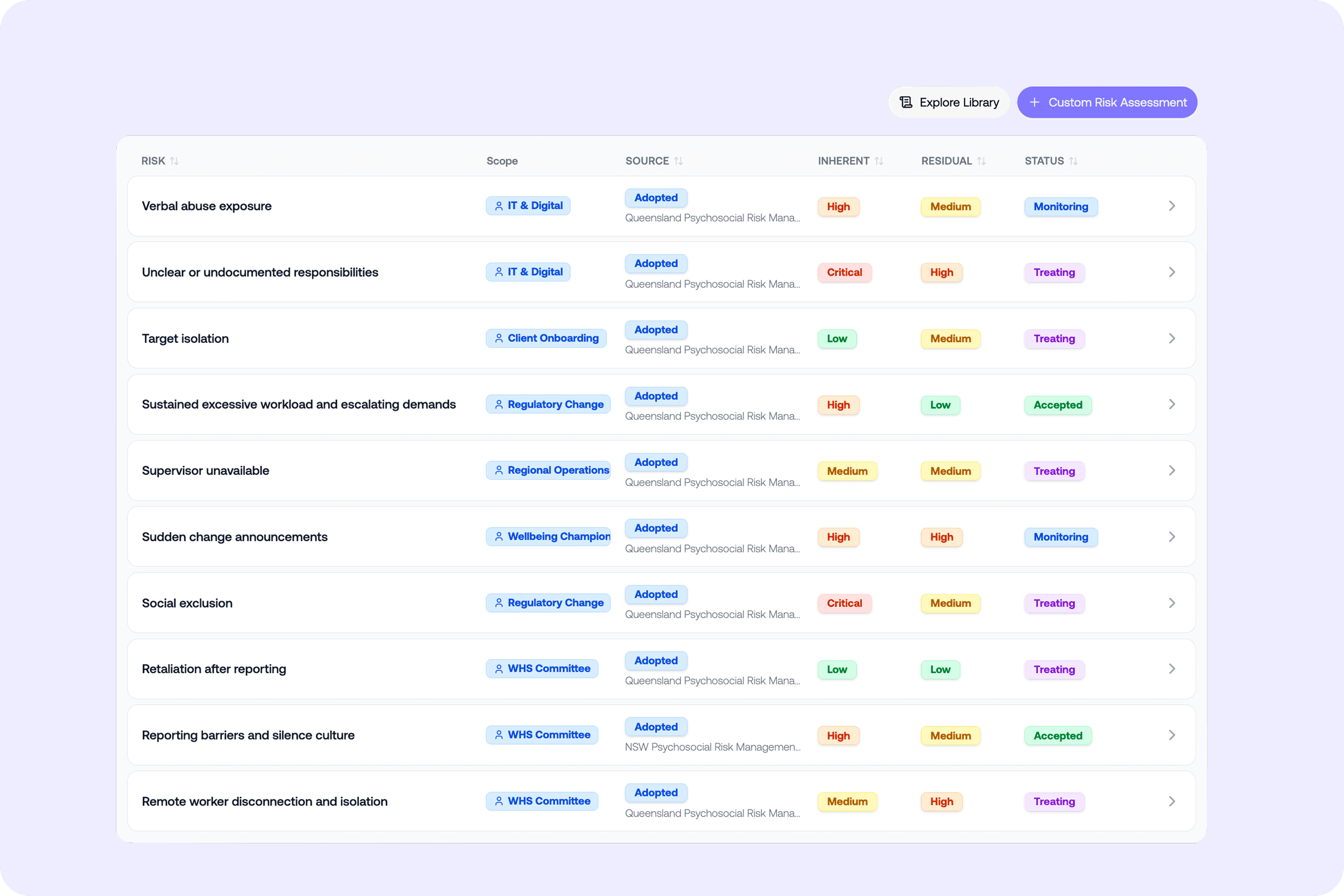
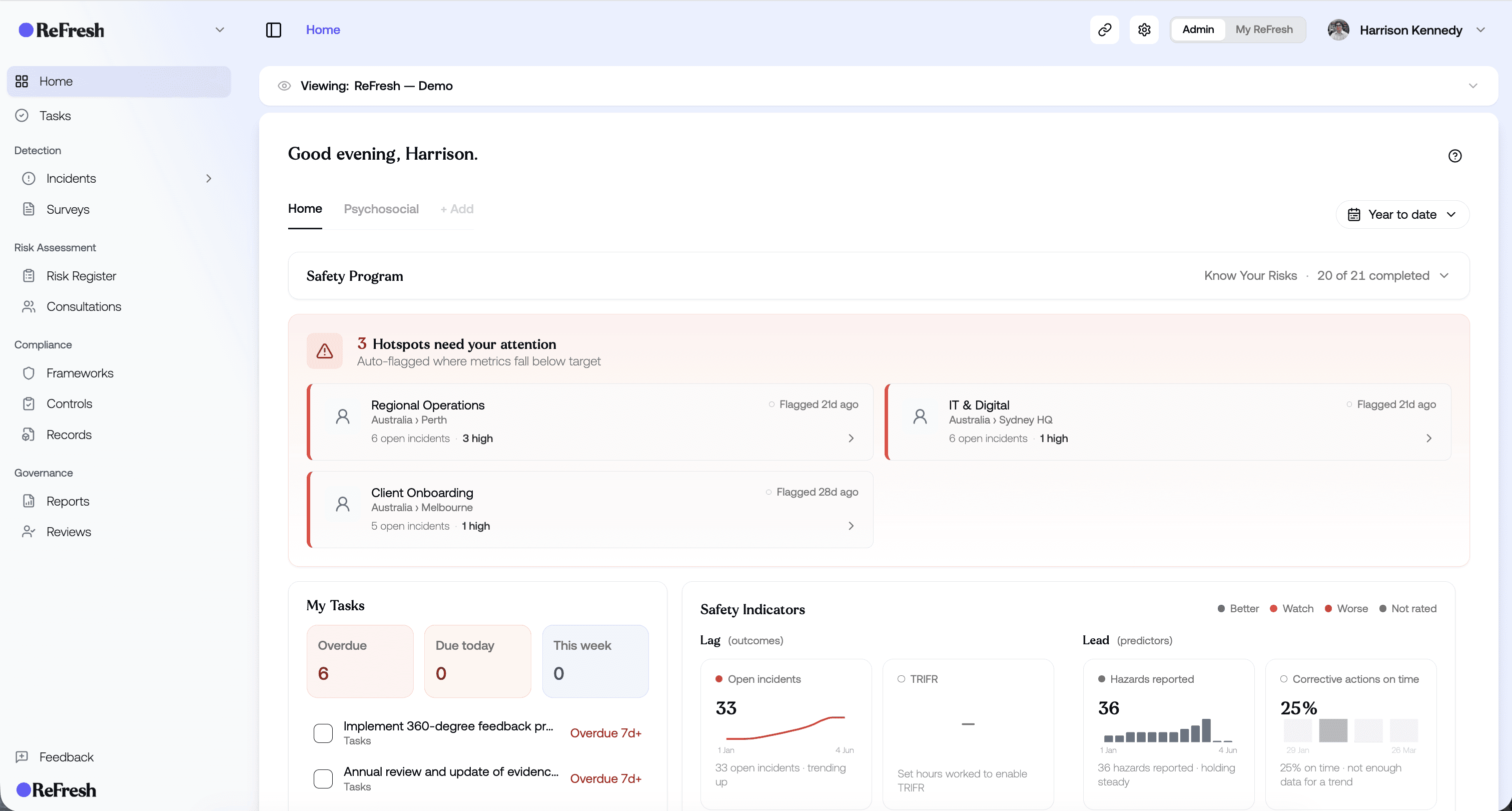
Spreadsheets cannot show whether a risk is getting better or worse. The risk register holds every psychosocial hazard in one place, with its inherent and residual ratings and links to the controls, records and incidents around it.

woman working comfortably on a laptop in a warm office setting

Psychosocial risk register

Your single, centralised record of every psychosocial risk

Spreadsheets cannot show whether a risk is getting better or worse. The risk register holds every psychosocial hazard in one place, with its inherent and residual ratings and links to the controls, records and incidents around it.

woman working comfortably on a laptop in a warm office setting

Psychosocial risk register

Your single, centralised record of every psychosocial risk

Spreadsheets cannot show whether a risk is getting better or worse. The risk register holds every psychosocial hazard in one place, with its inherent and residual ratings and links to the controls, records and incidents around it.

woman working comfortably on a laptop in a warm office setting
A newly appointed WHS coordinator in her early 30s sitting at a desk in a small, bright office within a professional services firm, setting up her workspace on her first week. Her laptop is open and she is scrolling through a structured list on screen — rows with category labels and status indicators, visible in shape but not legible. Her expression is one of grounded relief — the look of someone who expected to start from scratch and discovered a comprehensive foundation already waiting.

CENTRAL REGISTER

Get every psychosocial hazard off the spreadsheet and into one place

Hold every identified hazard in a single register fed by surveys, incidents and direct assessment, so risk stops living in scattered spreadsheets and shared drives and becomes one current, scoped record the whole organisation works from.

CUSTOM RISK ASSESSMENT

Build a custom risk assessment, or adopt one from the library

Create a custom psychosocial risk assessment from scratch, or adopt a pre-built scenario from a library aligned to your jurisdiction, so you can stand up a register quickly and still tailor it to how your organisation actually works.

A senior safety manager in his mid-40s and a frontline team leader in her late 30s sitting in a small meeting room at a regional hospital. The safety manager has a laptop open showing a form-builder-style interface with editable fields and dropdown menus — visible in structure but not legible. The team leader is talking, gesturing with one hand as she describes something from her operational experience, while the safety manager listens and has one hand poised over the keyboard, ready to translate what she is saying into the system.
A risk and compliance manager in his late 40s sitting at a desk in a quiet, well-lit office, holding a pen horizontally between both hands and looking at a wide monitor with the expression of someone comparing two things side by side. The monitor shows a split-view interface — two columns of coloured risk indicators, one noticeably warmer-toned and the other shifted toward greens and ambers — but the content is not legible. His posture is still and considered: elbows on the desk, pen held loosely, weight slightly forward.

INHERENT VS RESIDUAL

Show what your controls actually change

Each risk carries an inherent rating before controls and a residual rating after them, side by side, so the value your controls add is explicit and a critical risk reduced to moderate reads very differently from one left untouched.

LINKED ACROSS THE PLATFORM

Connect each risk to the controls, records, incidents and consultations around it

Every risk links to the controls treating it, the records that evidence it, the incidents that raised it and the consultations held about it, so the register is the hub that ties detection, action and evidence together rather than a standalone list.

A wide shot of a bright, open executive office at mid-morning. A head of safety in her early 50s is walking a board member in his late 50s through a large wall-mounted screen showing a register-style view with rows of risk items, each with a coloured lifecycle status indicator — some green, some amber, a few blue — and date columns. She is standing beside the screen, one hand gesturing toward the middle section of the display, explaining something specific. He is standing a step back, arms loosely folded, nodding.
A risk and compliance manager in his late 40s sitting at a desk in a quiet, well-lit office, holding a pen horizontally between both hands and looking at a wide monitor with the expression of someone comparing two things side by side. The monitor shows a split-view interface — two columns of coloured risk indicators, one noticeably warmer-toned and the other shifted toward greens and ambers — but the content is not legible. His posture is still and considered: elbows on the desk, pen held loosely, weight slightly forward.

RISK SCENARIOS

Show what your controls actually change

Each risk carries an inherent rating before controls and a residual rating after them, side by side, so the value your controls add is explicit and a critical risk reduced to moderate reads very differently from one left untouched.

GOT QUESTIONS?

Frequently asked questions

Frequently asked questions

What is in the risk register?

The risk register is the centralised record of every identified hazard, with a built-in library of common psychosocial risks and risk scenarios. Each entry shows:

  1. What to consider

  2. What to implement

  3. Recommended controls

  4. Linked policy templates ready to use

Can I build my own risk assessments?

es. Alongside the library, you can create custom risk assessments. A custom assessment captures:

  1. Inherent risk

  2. Residual risk

  3. The target position on the hierarchy of controls

  4. The controls applied

  5. An exposure assessment

  6. Any linked records and incidents

How is the register connected to the rest of the platform?

Everything in the register is linked. A risk connects to its controls, the incidents related to it, the records held as evidence, and the tasks created to manage it, so the register is a working record rather than a static list.

Where do the recommended risks and controls come from?

The library is built around the psychosocial hazards recognised in legislation and the Code of Practice, with controls drawn from regulatory requirements. You adapt them to your organisation rather than starting from a blank page.

How many templates are available?

There are over 70+ risk scenario templates across the platform, covering different jurisdictions and scenarios. You do not use all of them; they are there so the right document exists when a situation arises.

GOT QUESTIONS?

Frequently asked questions

What is in the risk register?

The risk register is the centralised record of every identified hazard, with a built-in library of common psychosocial risks and risk scenarios. Each entry shows:

  1. What to consider

  2. What to implement

  3. Recommended controls

  4. Linked policy templates ready to use

Can I build my own risk assessments?

es. Alongside the library, you can create custom risk assessments. A custom assessment captures:

  1. Inherent risk

  2. Residual risk

  3. The target position on the hierarchy of controls

  4. The controls applied

  5. An exposure assessment

  6. Any linked records and incidents

How is the register connected to the rest of the platform?

Everything in the register is linked. A risk connects to its controls, the incidents related to it, the records held as evidence, and the tasks created to manage it, so the register is a working record rather than a static list.

Where do the recommended risks and controls come from?

The library is built around the psychosocial hazards recognised in legislation and the Code of Practice, with controls drawn from regulatory requirements. You adapt them to your organisation rather than starting from a blank page.

How many templates are available?

There are over 70+ risk scenario templates across the platform, covering different jurisdictions and scenarios. You do not use all of them; they are there so the right document exists when a situation arises.

Don't just measure risk. Prevent it

Bring emotional, psychosocial, and leadership risk into one unified framework.

Don't just measure risk. Prevent it

Bring emotional, psychosocial, and leadership risk into one unified framework.

Don't just measure risk. Prevent it

Bring emotional, psychosocial, and leadership risk into one unified framework.