Psychosocial Risk Surveys

Identify psychosocial risk across 17 hazard categories

Psychosocial risk is invisible until you measure it. ReFresh surveys score all 17 recognised hazard categories by severity, then turn the results into a risk profile, protective factors and a cost impact you can act on.

woman working comfortably on a laptop in a warm office setting

Psychosocial Risk Surveys

Identify psychosocial risk across 17 hazard categories

Psychosocial risk is invisible until you measure it. ReFresh surveys score all 17 recognised hazard categories by severity, then turn the results into a risk profile, protective factors and a cost impact you can act on.

woman working comfortably on a laptop in a warm office setting

Psychosocial Risk Surveys

Identify psychosocial risk across 17 hazard categories

Psychosocial risk is invisible until you measure it. ReFresh surveys score all 17 recognised hazard categories by severity, then turn the results into a risk profile, protective factors and a cost impact you can act on.

woman working comfortably on a laptop in a warm office setting
A team of three workers collaborate on a series of work papers. One of the workers sports a high-vis vest.

RISK PROFILE

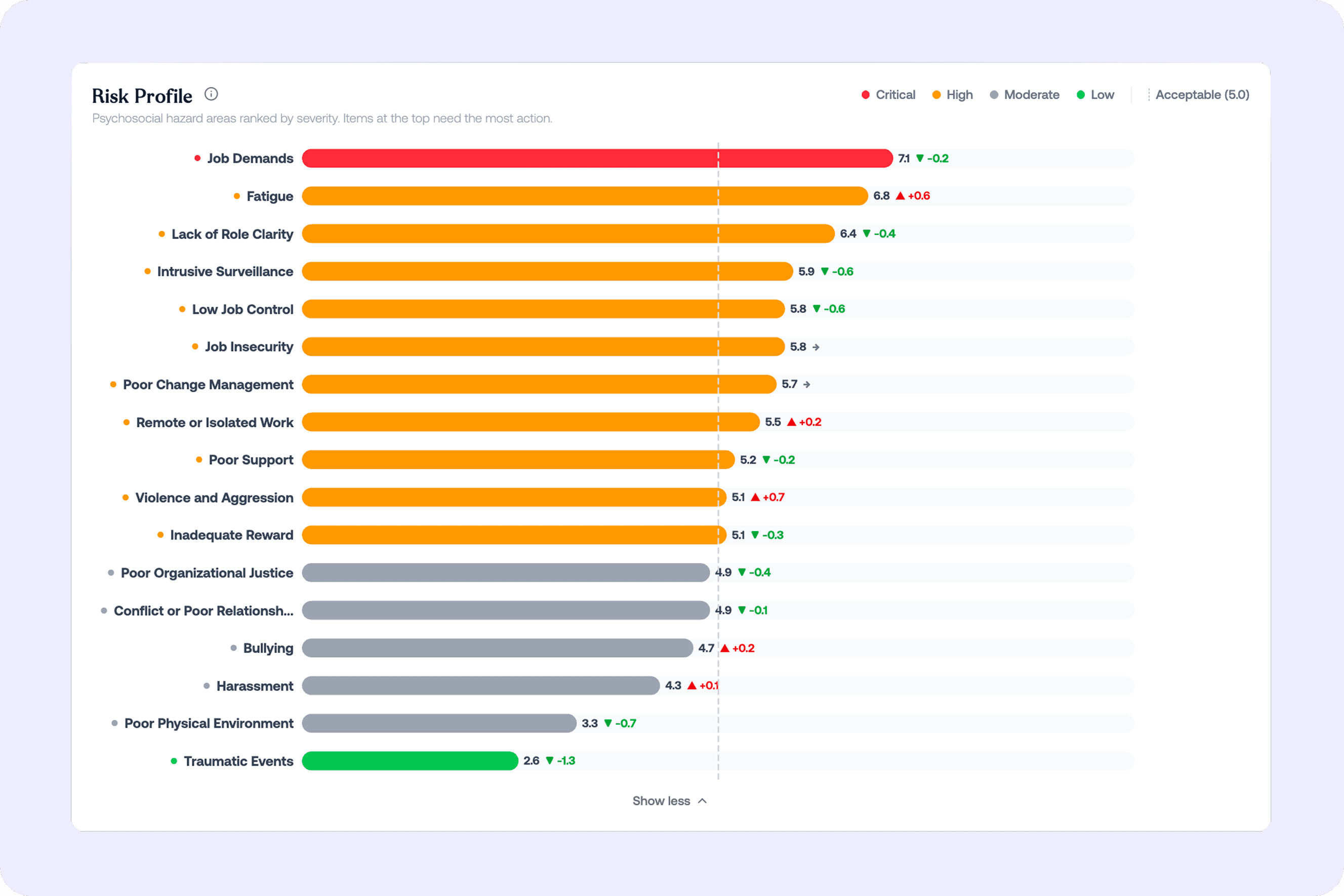
Get a scored risk profile across the 17 hazard categories

Each survey produces a risk profile that scores all 17 psychosocial hazard categories by severity, with the trend against the previous period, so you can see at a glance which hazards are driving risk and which way they are moving.

PROTECTIVE FACTORS

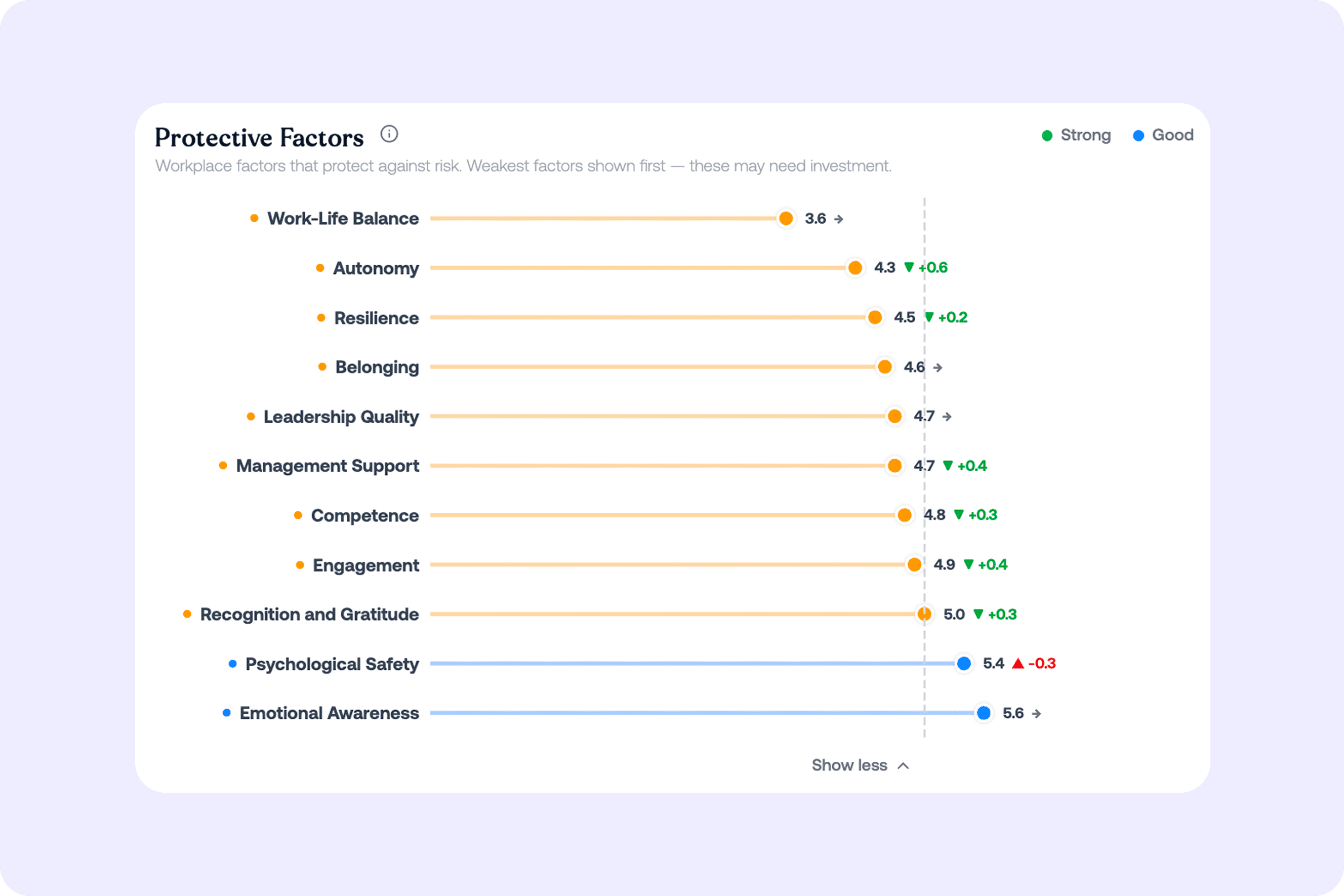
Read the strengths that offset the risk, not just the harm

Alongside each hazard, the survey scores the protective factors such as support, autonomy and work-life balance, so a high-demand team with strong support reads differently from one without, and you can see what is already working before you change anything.
A people-and-culture lead in her early 30s working at a large monitor in a bright, modern co-working-style office.
A people-and-culture manager in his mid-30s leaning back in his chair at a tidy desk in a bright, open-plan professional services office, hands behind his head, looking at a monitor with an expression of quiet satisfaction — the look of someone checking on a process that is running itself.

COST IMPACT

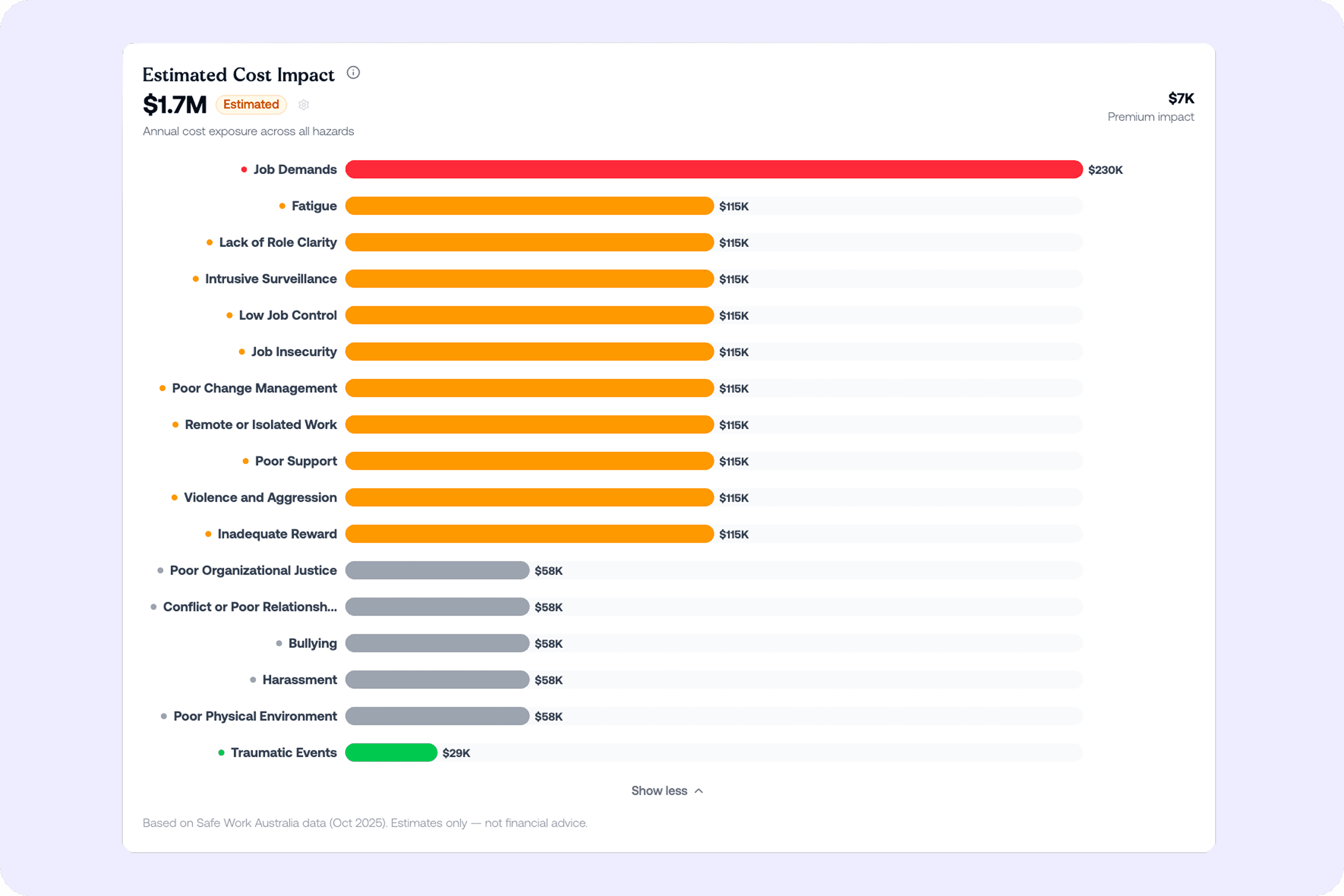
See the cost impact behind the risk

Every survey translates the result into an estimated cost impact, which is consistently the figure that moves a leadership team from a polite interest to a decision to act.

RESPONSE TRACKING

Reach the coverage that makes the data defensible

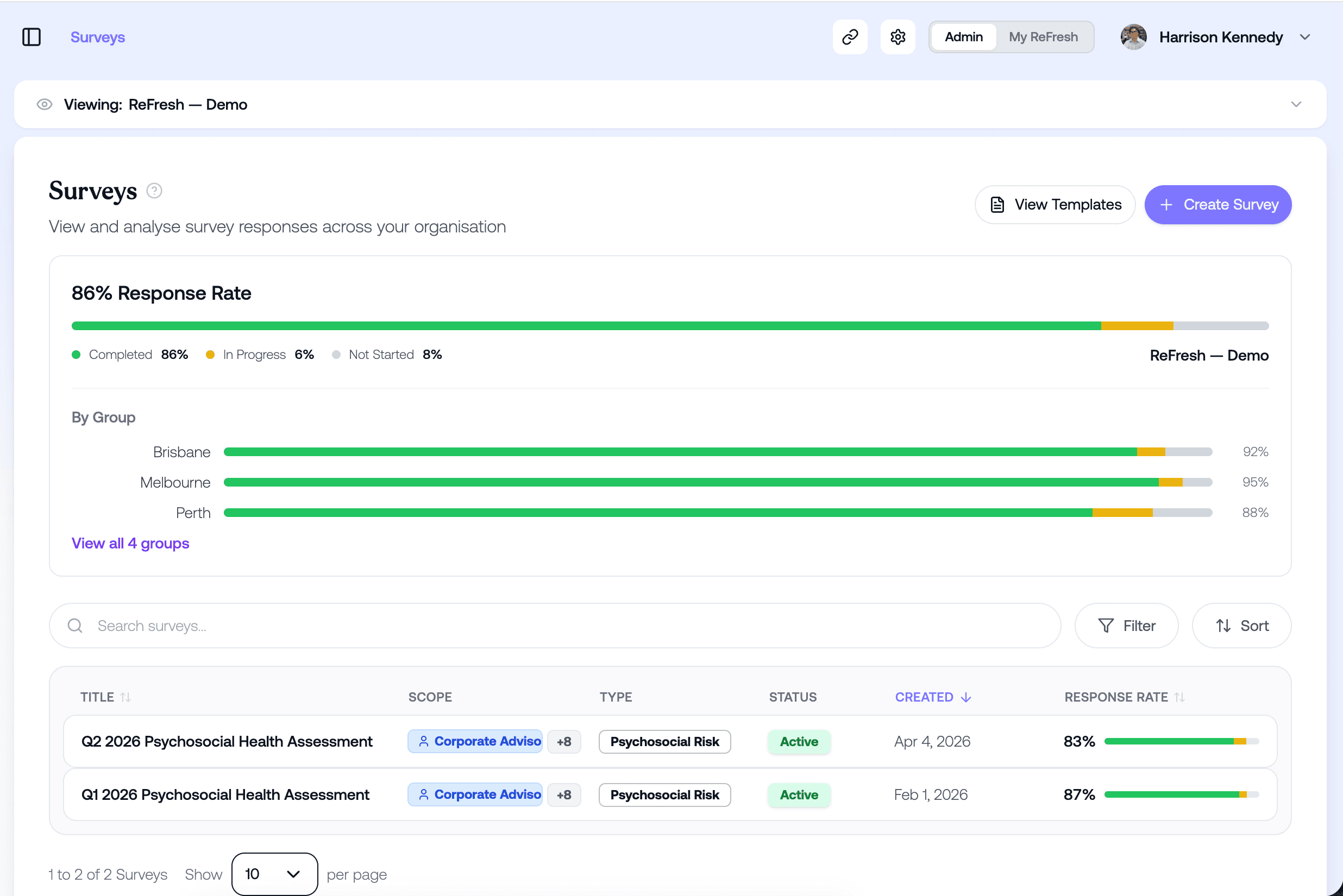
Watch response rates climb live and broken down by group, so you can lift completion in busy or frontline teams before the window closes and stand behind the result.

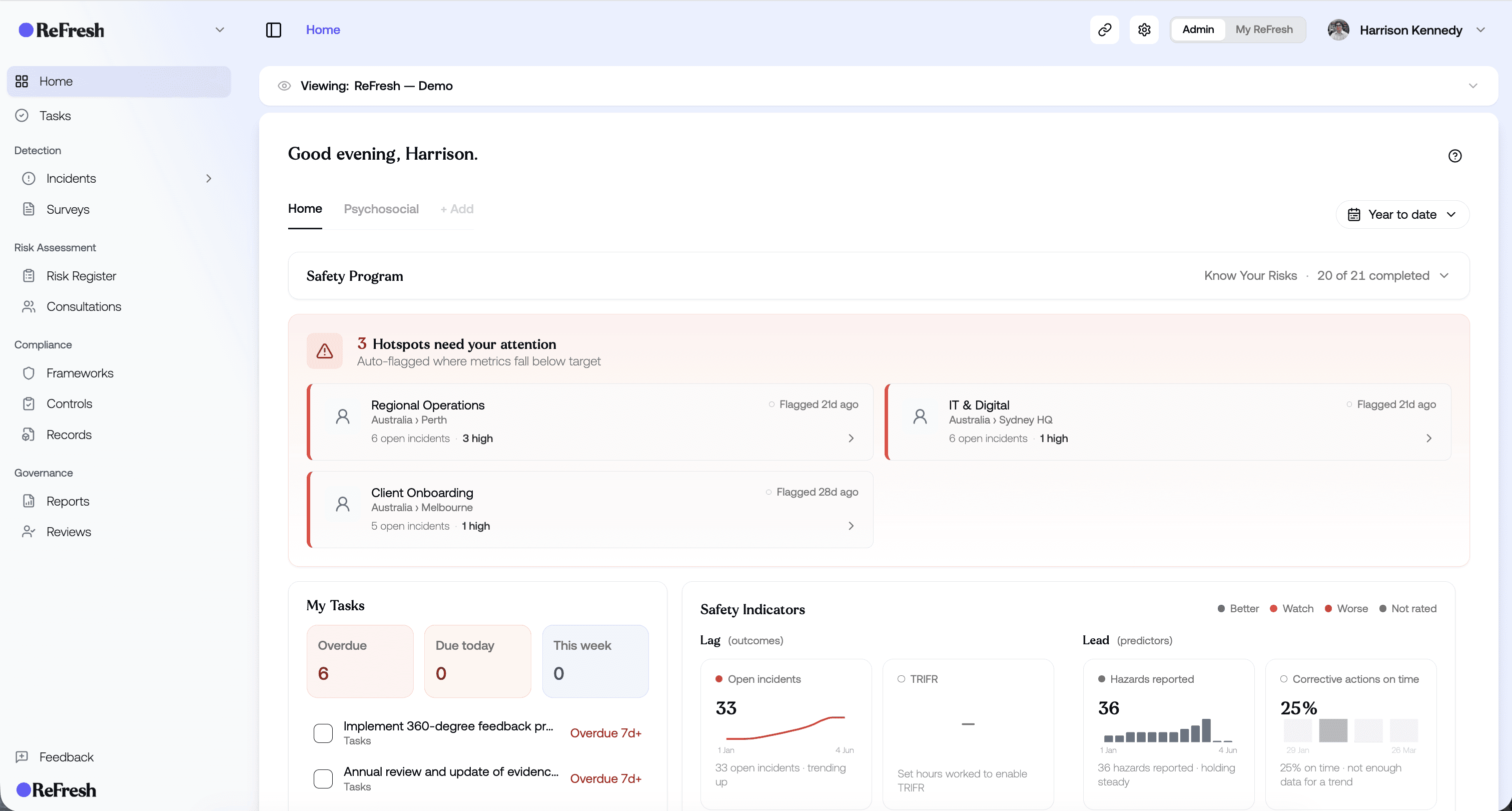
A senior WHS manager in his late 40s and a younger HR business partner walking side by side through a wide corridor connecting two wings of a mid-sized corporate office, in relaxed mid-conversation.

GOT QUESTIONS?

Frequently asked questions

Frequently asked questions

What does the survey measure?

The ReFresh survey is a psychosocial risk assessment built into the platform and sent to your workforce. It returns a psychosocial risk score and a risk profile across the 17 psychosocial hazard categories, so you can see which hazards are present and how severe they are. Conducting a risk assessment across the organisation is a requirement under work health and safety law.

Can ReFresh replace our People at Work survey?

Yes. The ReFresh survey is a standalone module that can stand in for People at Work as that survey is decommissioned. It covers the psychosocial hazard categories the regulation expects, inside a platform that also holds your risks, controls, and reporting rather than a survey sitting on its own.

Can we bring our historical survey data across?

Yes. Historical survey results can be imported during onboarding, so you keep your baseline and trend lines rather than starting from zero.

What are protective factors?

Alongside the hazards, the survey measures protective factors: the things an organisation does well that offset exposure. For example, where job demands are high, strong work life balance can counterbalance that hazard. Tracking both sides shows not just what is going wrong, but what to strengthen.

Can I see results by team or location?

Yes. Results break down by group, so you can see how each region, location, department, or team is tracking across each hazard, rather than only seeing a company-wide average.

Does the survey put a cost on the risk?

The survey links each hazard to an estimated cost impact, drawn from enforcement and claims data, covering:

  1. Insurance premiums

  2. Workers compensation

  3. Absenteeism

  4. Potential regulatory fines

This helps frame psychosocial risk in terms leadership teams act on.

Can workers respond anonymously, and can I track participation?

Workers can respond anonymously, and the platform tracks the participation rate so you can see how representative the results are and follow up where response is low.

Do I need the survey if we already run an engagement survey?

An engagement survey measures how people feel. The regulation requires you to identify which psychosocial hazards exist. They do different jobs. Where you already run a survey, relevant data can be surfaced into ReFresh rather than duplicating the exercise.

GOT QUESTIONS?

Frequently asked questions

What does the survey measure?

The ReFresh survey is a psychosocial risk assessment built into the platform and sent to your workforce. It returns a psychosocial risk score and a risk profile across the 17 psychosocial hazard categories, so you can see which hazards are present and how severe they are. Conducting a risk assessment across the organisation is a requirement under work health and safety law.

Can ReFresh replace our People at Work survey?

Yes. The ReFresh survey is a standalone module that can stand in for People at Work as that survey is decommissioned. It covers the psychosocial hazard categories the regulation expects, inside a platform that also holds your risks, controls, and reporting rather than a survey sitting on its own.

Can we bring our historical survey data across?

Yes. Historical survey results can be imported during onboarding, so you keep your baseline and trend lines rather than starting from zero.

What are protective factors?

Alongside the hazards, the survey measures protective factors: the things an organisation does well that offset exposure. For example, where job demands are high, strong work life balance can counterbalance that hazard. Tracking both sides shows not just what is going wrong, but what to strengthen.

Can I see results by team or location?

Yes. Results break down by group, so you can see how each region, location, department, or team is tracking across each hazard, rather than only seeing a company-wide average.

Does the survey put a cost on the risk?

The survey links each hazard to an estimated cost impact, drawn from enforcement and claims data, covering:

  1. Insurance premiums

  2. Workers compensation

  3. Absenteeism

  4. Potential regulatory fines

This helps frame psychosocial risk in terms leadership teams act on.

Can workers respond anonymously, and can I track participation?

Workers can respond anonymously, and the platform tracks the participation rate so you can see how representative the results are and follow up where response is low.

Do I need the survey if we already run an engagement survey?

An engagement survey measures how people feel. The regulation requires you to identify which psychosocial hazards exist. They do different jobs. Where you already run a survey, relevant data can be surfaced into ReFresh rather than duplicating the exercise.

Don't just measure risk. Prevent it

Bring emotional, psychosocial, and leadership risk into one unified framework.

Don't just measure risk. Prevent it

Bring emotional, psychosocial, and leadership risk into one unified framework.

Don't just measure risk. Prevent it

Bring emotional, psychosocial, and leadership risk into one unified framework.