the refresh platform
The psychosocial compliance platform for understanding and managing risk
The psychosocial compliance platform for understanding and managing risk
The psychosocial compliance platform for understanding and managing risk
Most organisations can't answer where psychosocial risk actually sits. ReFresh replaces spreadsheets and annual surveys with continuous psychosocial risk management across your entire workforce.

How ReFresh Works
One psychosocial compliance platform, four connected pillars
How ReFresh Works
One psychosocial compliance platform, four connected pillars
uNIVERSAL BENEFITS
One psychosocial compliance platform, four connected pillars
Risk Intelligence
Safety Orchestration
Governance and Evidence
AI and Automation

Risk Intelligence
Identify and understand psychosocial hazards through surveys, incident reporting, and structured risk assessment.
Risk Intelligence
Safety Orchestration
Governance and Evidence
AI and Automation
Risk Intelligence
Identify and understand psychosocial hazards through surveys, incident reporting, and structured risk assessment.
Psychosocial Risk Assessment
ReFresh operationalises your organisation's risks against the 17 psychosocial hazard categories defined by ISO 45003, SafeWork Australia, and Comcare. A structured methodology for identifying, assessing, and treating risks, providing a defensible framework for ongoing compliance, governance, and reporting.

Continuous risk data
Detect psychosocial risk signals such as job demands, support, role clarity, conflict, and leadership insights as they evolve.
Live scoring
Maintain a psychosocial risk score for every team, department, or location.
Measurable indicators
Generate trackable measurements mapped to indicators aligned with board and regulator expectations.
Track your health
Create a defensible trail of psychosocial risk and psychosocial health over time for compliance and investigations.

The psychosocial operating system
Connect every signal of psychosocial risk
Every hazard identified here flows through to controls in safety orchestration and resolves into governance evidence, producing the end-to-end traceability the regulation requires.
What this enables
Link incident reports, survey results, and early concerns in one system
Identify patterns across teams and locations
Surface concerns through structured channels while protecting confidentiality
Produce audit-ready evidence for boards and regulators
Built for psychosocial risk intelligence
Structured identification, not once-a-year snapshots
ReFresh is psychosocial compliance software built around continuous detection, not an annual engagement survey repurposed for a legal obligation it was never designed to meet.
Surveys, incident reporting, analytics, and risk assessment in one system. Everything recorded, time-stamped, and linked to hazard categories.
No more disconnected surveys or spreadsheets. No more unclear reporting pathways or missing records.

82% of leaders using ReFresh identify psychosocial risk three months earlier than through engagement surveys.
82% of leaders using ReFresh identify psychosocial risk three months earlier than through engagement surveys.
GOT QUESTIONS?
Frequently asked questions
Frequently asked questions
What is a psychosocial compliance platform, and what does ReFresh cover?
A psychosocial compliance platform is the system of record for identifying, assessing, controlling, and evidencing psychosocial risk, the way physical safety has had structured systems for decades. ReFresh is the psychosocial operating system built for that obligation. It covers the full compliance lifecycle across four connected pillars: risk intelligence (surveys, incident reporting, and risk assessment across the 17 hazard categories), safety orchestration (controls, tasks, and consultation), and governance and evidence (frameworks, board reporting, and a continuous audit trail), plus the worker experience that feeds them. Everything is recorded, time-stamped, and linked, so compliance becomes the byproduct of managing risk rather than a separate reporting exercise.
How is ReFresh different from an engagement survey tool?
Engagement surveys such as Culture Amp and Qualtrics measure how people feel about their work, their manager, and the organisation, and they are valuable for culture and retention. They were not built to identify psychosocial hazards against the 17 recognised categories or to produce the evidence a regulator expects, and a regulator will not accept an engagement survey as evidence of hazard identification. ReFresh surveys are structured around those categories and feed directly into risk assessment, controls, and reporting. Different tool, different job: ReFresh sits alongside your engagement survey, not instead of it.
We already use a WHS platform. Doesn't that cover psychosocial risk?
General WHS platforms such as SafetyCulture and myosh are strong for physical safety, incident logging, and inspections. Psychosocial hazards work differently: they have their own assessment methodology, their own control frameworks, and their own evidence requirements, which a physical-safety module is rarely designed to meet. ReFresh runs as the psychosocial layer alongside your existing WHS system rather than replacing it. Your WHS platform records what happened; ReFresh handles what you do about the psychosocial risk, and whether you can prove you did it.
How is ReFresh different from using a consultant?
Consultants provide valuable specialist advice, but they deliver a point-in-time report and then leave the organisation to implement, track, and evidence everything afterwards. Regulators do not just want to see that you identified risks once; they want evidence that you are managing them on an ongoing basis, and a consultant engagement from 18 months ago does not demonstrate current compliance. ReFresh is the ongoing system that operationalises the work and maintains the evidence continuously. Many organisations use both: a consultant for specialist advice, and ReFresh as the system that runs the cycle and proves it.
Do we still need an EAP?
Yes. An employee assistance programme provides reactive, individual support after someone is already struggling, which matters and should continue. It does not identify or manage the workplace conditions that create psychosocial risk, and having an EAP does not demonstrate to a regulator that you have identified and controlled hazards. ReFresh addresses the organisational obligation: finding hazards, assessing them, implementing controls, and producing governance-ready evidence. Your EAP supports individuals after harm; ReFresh helps prevent the conditions that cause it.
Do we need an existing WHS team or safety function to use ReFresh?
No, and this is the most common starting point. ReFresh provides the structure from scratch: hazard identification across the 17 categories, risk assessment, controls, and governance evidence, with no prerequisite WHS infrastructure, safety team, or prior experience required. Because it is purpose-built for this workflow rather than a generic platform you have to configure, most organisations get running without having to design a system first.
If a regulator audits us, does having ReFresh actually protect us?
Regulators run a process-based assessment, not an outcomes-based one: they look at whether you had reasonable systems in place and followed them. In practice that means being able to show you:
identified hazards across the 17 categories
assessed the risks
implemented controls
consulted workers
reviewed your approach over time
ReFresh maintains a continuous, time-stamped record across that full lifecycle, so you can invite an inspector into the platform or export an evidence pack that shows what you did, when, and why. No system removes all risk, but structured, evidenced processes are exactly what a regulator expects to see.
Does it cover multiple states, contractors, and multi-site operations?
Yes. ReFresh is built for Australian WHS law and accommodates the variations between states and territories, with framework activation for each jurisdiction you operate in. The duty covers workers in the broad sense, including employees, contractors, labour hire, and casual and frontline staff, and a shareable reporting link reaches people who do not have a platform account. For groups running several entities or sites, risk and reporting roll up across teams, locations, and states in one view, with multi-entity management for organisations that need separate data boundaries.
How is our data protected?
Psychosocial data is sensitive, and the platform is built for that. All data is hosted in Australia (AWS, Sydney), encrypted in transit and at rest, with role-based access so information is only visible to the people who should see it. ReFresh is SOC 2, GDPR, and Australian Privacy Act compliant, and undergoes annual independent security audits. Sensitive matters such as conduct or grievance reports can be restricted further so that only named people can view them.
How quickly can we get started, and is the platform modular?
Most organisations are up and running in about four weeks, covering setup, team configuration, and the first survey, and there is a hands-on onboarding option where the ReFresh team configures it with you, including HRIS connections such as BambooHR, Employment Hero, Deel, and HiBob. It is modular: you start with the modules you need now, from risk intelligence at the entry level through to incident and investigation management, compliance frameworks, and board reporting, and add the rest as you grow, all sharing one data model, one permission system, and one audit trail.
How does pricing work?
Pricing is tiered and scales with the capabilities and scale you need rather than a flat licence. The most useful way to frame it is against the cost of the current approach (manual hours, consultant fees, and the risk of gaps) and the cost of non-compliance: penalties reach $500,000 or more for organisations and average around $380,000 for a psychosocial breach, while a single psychological injury claim averages about $288,000 and takes far longer to resolve than a physical one. For a figure mapped to your organisation, see the pricing page or book a short walkthrough.
GOT QUESTIONS?
Frequently asked questions
What is a psychosocial compliance platform, and what does ReFresh cover?
A psychosocial compliance platform is the system of record for identifying, assessing, controlling, and evidencing psychosocial risk, the way physical safety has had structured systems for decades. ReFresh is the psychosocial operating system built for that obligation. It covers the full compliance lifecycle across four connected pillars: risk intelligence (surveys, incident reporting, and risk assessment across the 17 hazard categories), safety orchestration (controls, tasks, and consultation), and governance and evidence (frameworks, board reporting, and a continuous audit trail), plus the worker experience that feeds them. Everything is recorded, time-stamped, and linked, so compliance becomes the byproduct of managing risk rather than a separate reporting exercise.
How is ReFresh different from an engagement survey tool?
Engagement surveys such as Culture Amp and Qualtrics measure how people feel about their work, their manager, and the organisation, and they are valuable for culture and retention. They were not built to identify psychosocial hazards against the 17 recognised categories or to produce the evidence a regulator expects, and a regulator will not accept an engagement survey as evidence of hazard identification. ReFresh surveys are structured around those categories and feed directly into risk assessment, controls, and reporting. Different tool, different job: ReFresh sits alongside your engagement survey, not instead of it.
We already use a WHS platform. Doesn't that cover psychosocial risk?
General WHS platforms such as SafetyCulture and myosh are strong for physical safety, incident logging, and inspections. Psychosocial hazards work differently: they have their own assessment methodology, their own control frameworks, and their own evidence requirements, which a physical-safety module is rarely designed to meet. ReFresh runs as the psychosocial layer alongside your existing WHS system rather than replacing it. Your WHS platform records what happened; ReFresh handles what you do about the psychosocial risk, and whether you can prove you did it.
How is ReFresh different from using a consultant?
Consultants provide valuable specialist advice, but they deliver a point-in-time report and then leave the organisation to implement, track, and evidence everything afterwards. Regulators do not just want to see that you identified risks once; they want evidence that you are managing them on an ongoing basis, and a consultant engagement from 18 months ago does not demonstrate current compliance. ReFresh is the ongoing system that operationalises the work and maintains the evidence continuously. Many organisations use both: a consultant for specialist advice, and ReFresh as the system that runs the cycle and proves it.
Do we still need an EAP?
Yes. An employee assistance programme provides reactive, individual support after someone is already struggling, which matters and should continue. It does not identify or manage the workplace conditions that create psychosocial risk, and having an EAP does not demonstrate to a regulator that you have identified and controlled hazards. ReFresh addresses the organisational obligation: finding hazards, assessing them, implementing controls, and producing governance-ready evidence. Your EAP supports individuals after harm; ReFresh helps prevent the conditions that cause it.
Do we need an existing WHS team or safety function to use ReFresh?
No, and this is the most common starting point. ReFresh provides the structure from scratch: hazard identification across the 17 categories, risk assessment, controls, and governance evidence, with no prerequisite WHS infrastructure, safety team, or prior experience required. Because it is purpose-built for this workflow rather than a generic platform you have to configure, most organisations get running without having to design a system first.
If a regulator audits us, does having ReFresh actually protect us?
Regulators run a process-based assessment, not an outcomes-based one: they look at whether you had reasonable systems in place and followed them. In practice that means being able to show you:
identified hazards across the 17 categories
assessed the risks
implemented controls
consulted workers
reviewed your approach over time
ReFresh maintains a continuous, time-stamped record across that full lifecycle, so you can invite an inspector into the platform or export an evidence pack that shows what you did, when, and why. No system removes all risk, but structured, evidenced processes are exactly what a regulator expects to see.
Does it cover multiple states, contractors, and multi-site operations?
Yes. ReFresh is built for Australian WHS law and accommodates the variations between states and territories, with framework activation for each jurisdiction you operate in. The duty covers workers in the broad sense, including employees, contractors, labour hire, and casual and frontline staff, and a shareable reporting link reaches people who do not have a platform account. For groups running several entities or sites, risk and reporting roll up across teams, locations, and states in one view, with multi-entity management for organisations that need separate data boundaries.
How is our data protected?
Psychosocial data is sensitive, and the platform is built for that. All data is hosted in Australia (AWS, Sydney), encrypted in transit and at rest, with role-based access so information is only visible to the people who should see it. ReFresh is SOC 2, GDPR, and Australian Privacy Act compliant, and undergoes annual independent security audits. Sensitive matters such as conduct or grievance reports can be restricted further so that only named people can view them.
How quickly can we get started, and is the platform modular?
Most organisations are up and running in about four weeks, covering setup, team configuration, and the first survey, and there is a hands-on onboarding option where the ReFresh team configures it with you, including HRIS connections such as BambooHR, Employment Hero, Deel, and HiBob. It is modular: you start with the modules you need now, from risk intelligence at the entry level through to incident and investigation management, compliance frameworks, and board reporting, and add the rest as you grow, all sharing one data model, one permission system, and one audit trail.
How does pricing work?
Pricing is tiered and scales with the capabilities and scale you need rather than a flat licence. The most useful way to frame it is against the cost of the current approach (manual hours, consultant fees, and the risk of gaps) and the cost of non-compliance: penalties reach $500,000 or more for organisations and average around $380,000 for a psychosocial breach, while a single psychological injury claim averages about $288,000 and takes far longer to resolve than a physical one. For a figure mapped to your organisation, see the pricing page or book a short walkthrough.
Helping businesses build safer workplaces
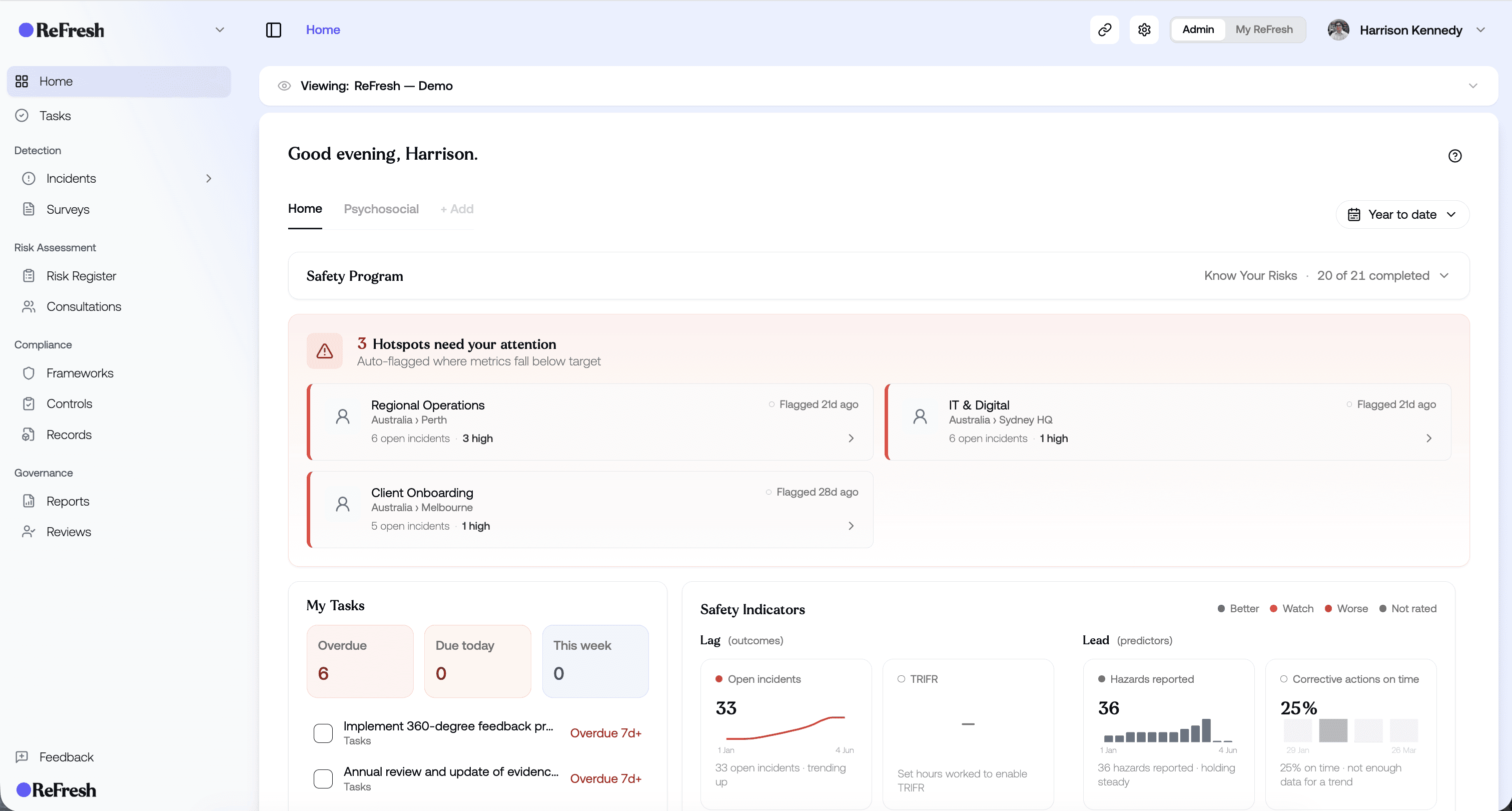
Manage psychosocial risk end to end, from detection and assessment through to controls, oversight, and governance.

Helping businesses build safer workplaces
Manage psychosocial risk end to end, from detection and assessment through to controls, oversight, and governance.
Helping businesses build safer workplaces
Manage psychosocial risk end to end, from detection and assessment through to controls, oversight, and governance.