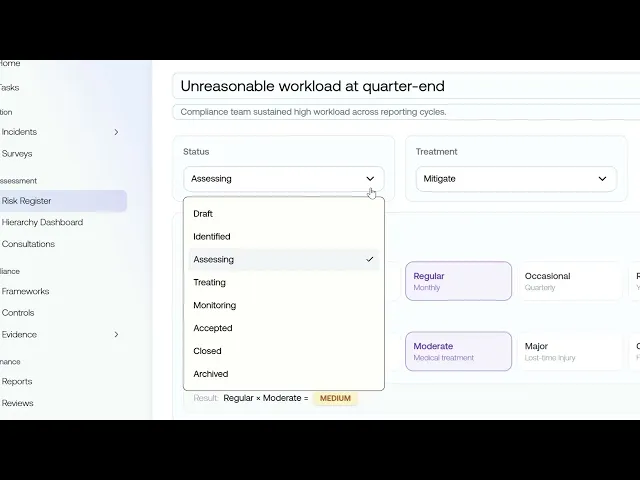
This lesson covers how to set a risk's status and treatment strategy: where it sits in your management workflow, and how you've decided to deal with it.
What you'll cover:
Status. Tracking where a risk is in your workflow, from Draft (still putting it together) and Identified (named but not yet actioned) through Assessing, Treating (controls and tasks in flight), and Monitoring (controls in place and being watched).
Treatment strategy. Your overall approach, across four options: Accept (acknowledge it, do no more), Mitigate (put in controls to reduce it), Transfer (shift it elsewhere, like insurance), and Avoid (stop the activity that creates the risk).
Key takeaways:
Status reflects progress through your management workflow; treatment reflects the strategy you've chosen for the risk.
The two are separate. A risk can be at any status regardless of which treatment approach you've picked.
For most psychosocial risks the treatment strategy will be Mitigate, since you're usually putting controls in place rather than accepting, transferring, or avoiding the risk.
IN THIS COURSE
2
.
E13. From survey data to risk assessment
2
min
2
.
E14. Creating custom risk assessments
2
min
1
.
E15. Inherent risk scoring
1
min
2
.
E16. Exposure assessment
2
min
1
.
E17. Risk status workflow and treatment strategy
1
min
1
.
E18. Residual risk scoring and the was-vs-now comparison
1
min
1
.
E19. Hazard category drill-down
1
min