This lesson covers managing the people involved in an investigation and collecting their statements. By the end you'll know how to add people in the right role, track statement status, and use this tab as the record itself.
What you'll cover:
Why the people list matters. How the list does two jobs: an audit record showing who was spoken to and in what role, and your own working list, with the statement progress bar showing how close you are to the full picture before writing findings.
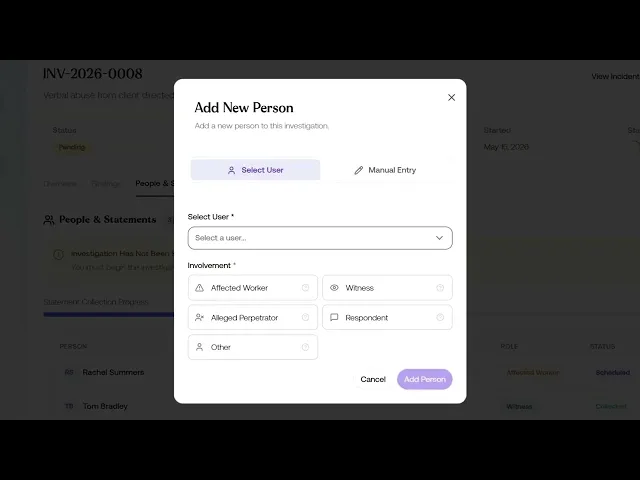
The roles. The roles you'll assign, including Affected Worker (the person the incident happened to), Witness (saw or heard something relevant), and Alleged Perpetrator (the person an allegation is made against), and why precision matters: the role doesn't pre-judge the outcome.
Adding a person. Searching and selecting an internal employee (which links the investigation to their record) or adding an external person manually, with one role per person per investigation.
Statement status and collection. The three statuses (Pending, In Progress, Collected), the progress bar that sums them, and the three ways a statement lands: typed in by the investigator, submitted by the person via a link, or uploaded as a document.
Key takeaways:
The people list is the audit record. It's what an auditor, regulator, or lawyer opens to see who was spoken to and whether their statement is on file.
Be precise with roles, especially Alleged Perpetrator. The "alleged" matters, since the recorded outcome is what determines whether an allegation is substantiated, and misusing the role early is what a lawyer will pick up later.
However a statement is collected, it's timestamped and attributed, which is what keeps the investigation record auditable.
IN THIS COURSE
3
.
O13. Incident reporting and triage
3
min
1
.
O14. Shareable reporting links, QR codes, and multi-channel deployment
1
min
4
.
O15. Incident handler groups, SLAs, and escalation rules
4
min
4
.
O16. Opening and managing investigations
4
min
4
.
O17. Collecting statements, managing people involved, and the investigation record
4
min
2
.
O18. Incident resolution
2
min
3
.
O19. Notifiable incidents and regulatory deadlines
3
min
3
.
O20. Worker self-service incident reporting and the portal experience
3
min