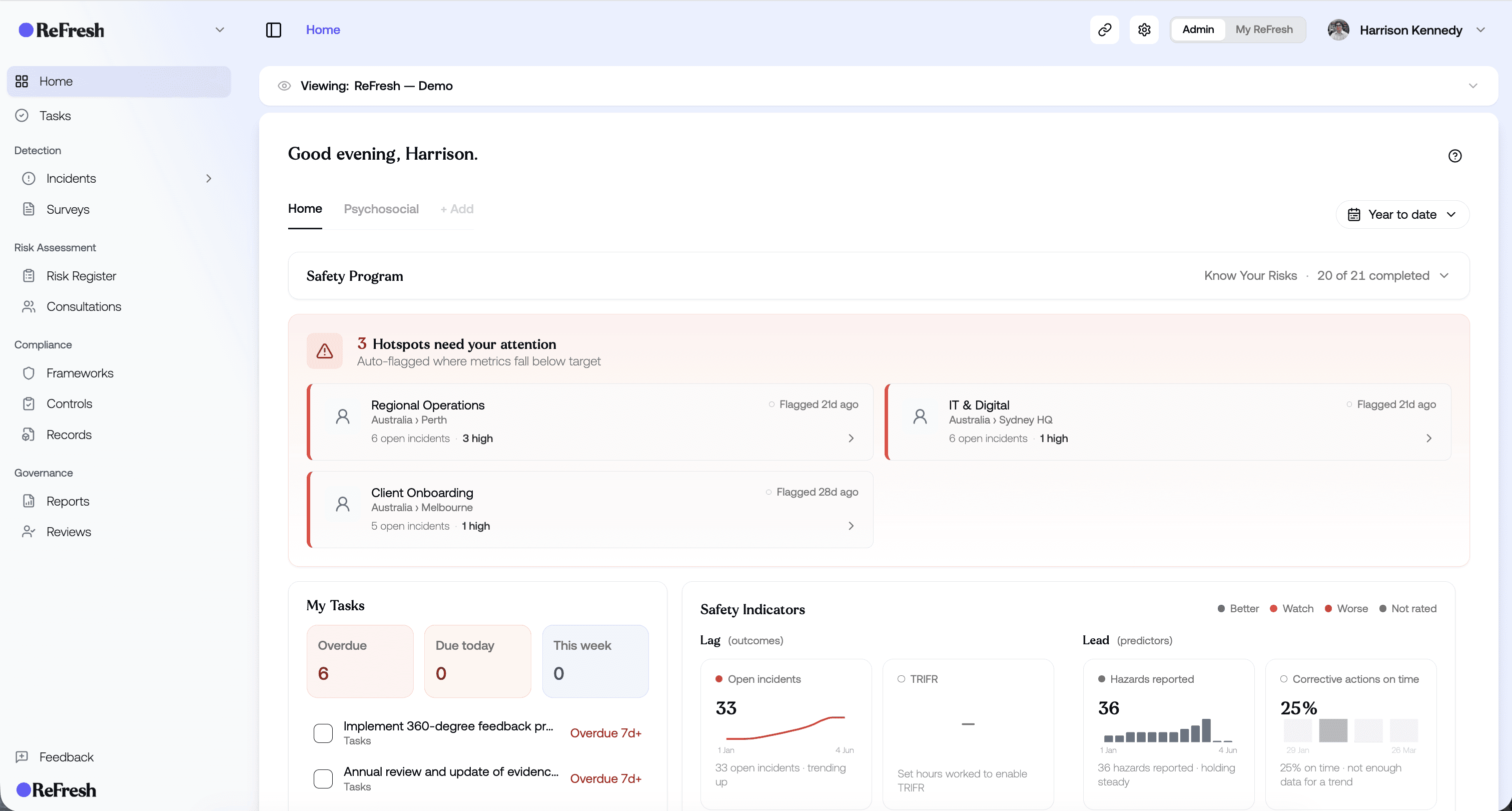
This lesson walks through the worker incident report flow in My ReFresh, so you know what your team sees when they're the ones reporting.
What you'll cover:
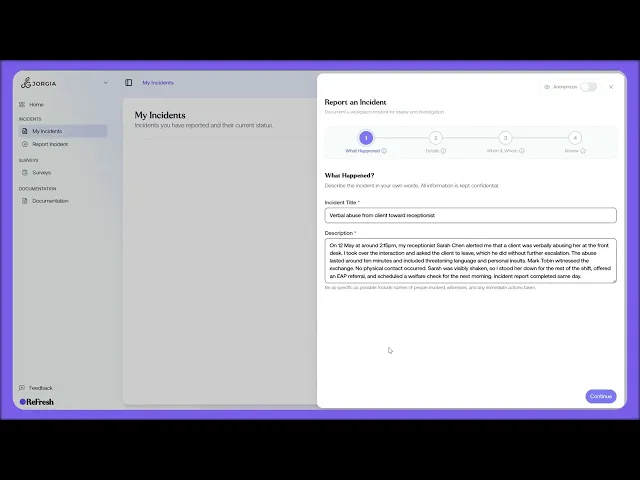
Switching to My ReFresh. The same user moving into the worker app, with the sidebar dropping to Home, My Incidents, Report Incident, Surveys, and Documentation.
The report flow. The four-step drawer (What Happened, Details, When and Where, Review) with an Anonymous toggle in the corner.
Steps one to three. Capturing the title and description, then incident type and severity (with a purple banner showing ReFresh pre-filling fields from the description, all overridable) plus "has this happened before" and an immediate-risk flag, then date, time, and location.
Review and the anonymous toggle. The summary cards with Edit links, the privacy statement, and how flicking on Anonymous swaps the privacy statement, strips the worker's identity, and routes the report through the anonymous pathway to the triage queue.
Key takeaways:
My ReFresh is the same login, a different app. Workers get a pared-back sidebar focused on reporting and their own incidents.
The AI pre-fill is a starting point, not a lock. It populates fields from the worker's description, but the worker can override anything before submitting.
The Anonymous toggle does more than hide a name. It swaps the privacy statement and sends the report through a separate anonymous pathway, while everything still lands in the same triage queue.
IN THIS COURSE
3
.
O13. Incident reporting and triage
3
min
1
.
O14. Shareable reporting links, QR codes, and multi-channel deployment
1
min
4
.
O15. Incident handler groups, SLAs, and escalation rules
4
min
4
.
O16. Opening and managing investigations
4
min
4
.
O17. Collecting statements, managing people involved, and the investigation record
4
min
2
.
O18. Incident resolution
2
min
3
.
O19. Notifiable incidents and regulatory deadlines
3
min
3
.
O20. Worker self-service incident reporting and the portal experience
3
min