This lesson covers protective factors: the workplace elements that pull against psychosocial risk, and how to drill into one to see what's behind the score.
What you'll cover:
What protective factors are. The workplace elements pulling against risk, like work-life balance, leadership quality, and belonging, with the list sorted weakest first.
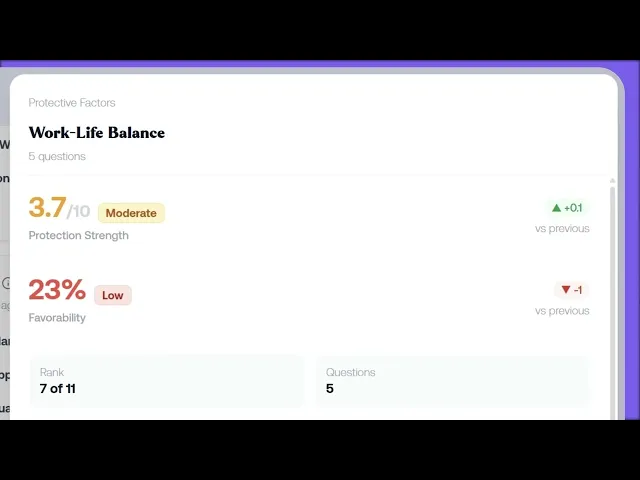
Drilling into a factor. Opening the side panel to see the factor name and how many questions feed it.
Protection Strength and Favorability. The two scores attached to each factor: Protection Strength is the average score out of ten (higher is stronger), and Favorability is the percentage of workers responding positively (higher is better).
Response sentiment and contributing questions. The positive, neutral, and negative breakdown, plus the individual questions feeding the score and their response distributions.
Key takeaways:
Protective factors are what's going well, the workplace strengths working against your psychosocial risks.
The list sorts weakest first, so the factors most worth shoring up sit at the top.
Each factor carries two reads: Protection Strength (average score out of ten) and Favorability (percentage responding positively).
IN THIS COURSE
3
.
E5. How psychosocial surveys work
3
min
3
.
E6. Choosing the right survey template and designing your first assessment
3
min
1
.
E7. Distribution strategy
1
min
1
.
E8. Reading your risk profile
1
min
1
.
E9. Drilling into hazard categories
1
min
1
.
E10. Protective factors
1
min
1
.
E11. The cost impact model
1
min
1
.
E12. Survey trends
1
min