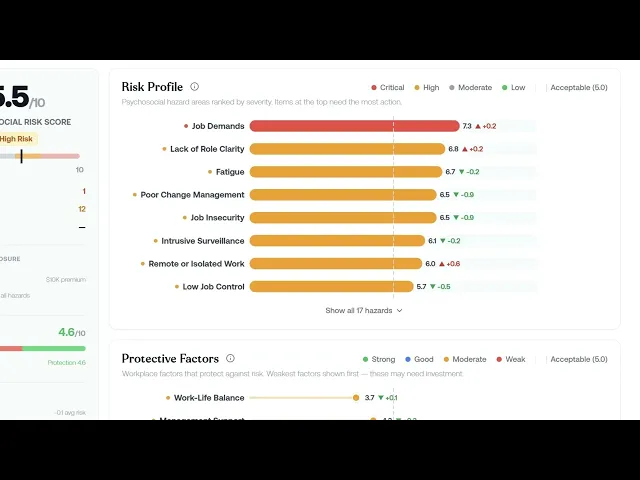
This lesson covers how to read your organisation's overall psychosocial risk profile once your first survey closes, so you know what to act on first.
What you'll cover:
The headline risk score. Your psychosocial risk score out of ten, an aggregation across every hazard weighted by how your workforce responded, with a band tag underneath showing your severity range (Critical, High, Moderate, or Acceptable).
The risk profile list. Each hazard row shows the hazard name, its score on the same zero-to-ten scale, and a direction arrow showing whether the score has moved since your previous survey. Colours match the headline severity bands.
What to act on first. Why your top three hazards matter more than your overall score, and why the lowest-scoring hazards aren't automatically well-managed.
Showing all 17 hazards. Expanding the default top-eight view to every hazard the survey measured.
Key takeaways:
The headline number is a temperature reading, not a diagnosis. The useful work happens in the risk profile underneath.
Anything above five needs attention; five or below sits in the acceptable band.
Lead with your top three hazards, and cross-check your lowest scores against incidents and consultations before discounting them.
IN THIS COURSE
3
.
E5. How psychosocial surveys work
3
min
3
.
E6. Choosing the right survey template and designing your first assessment
3
min
1
.
E7. Distribution strategy
1
min
1
.
E8. Reading your risk profile
1
min
1
.
E9. Drilling into hazard categories
1
min
1
.
E10. Protective factors
1
min
1
.
E11. The cost impact model
1
min
1
.
E12. Survey trends
1
min